Custom Manicure Set Cost: How to Compare Wholesale & Private Label Quotes
A buyer’s guide to complete-set specifications, branding, case and packaging costs, with a worked quote comparison and an editable first-order budget.
By BlendCraft
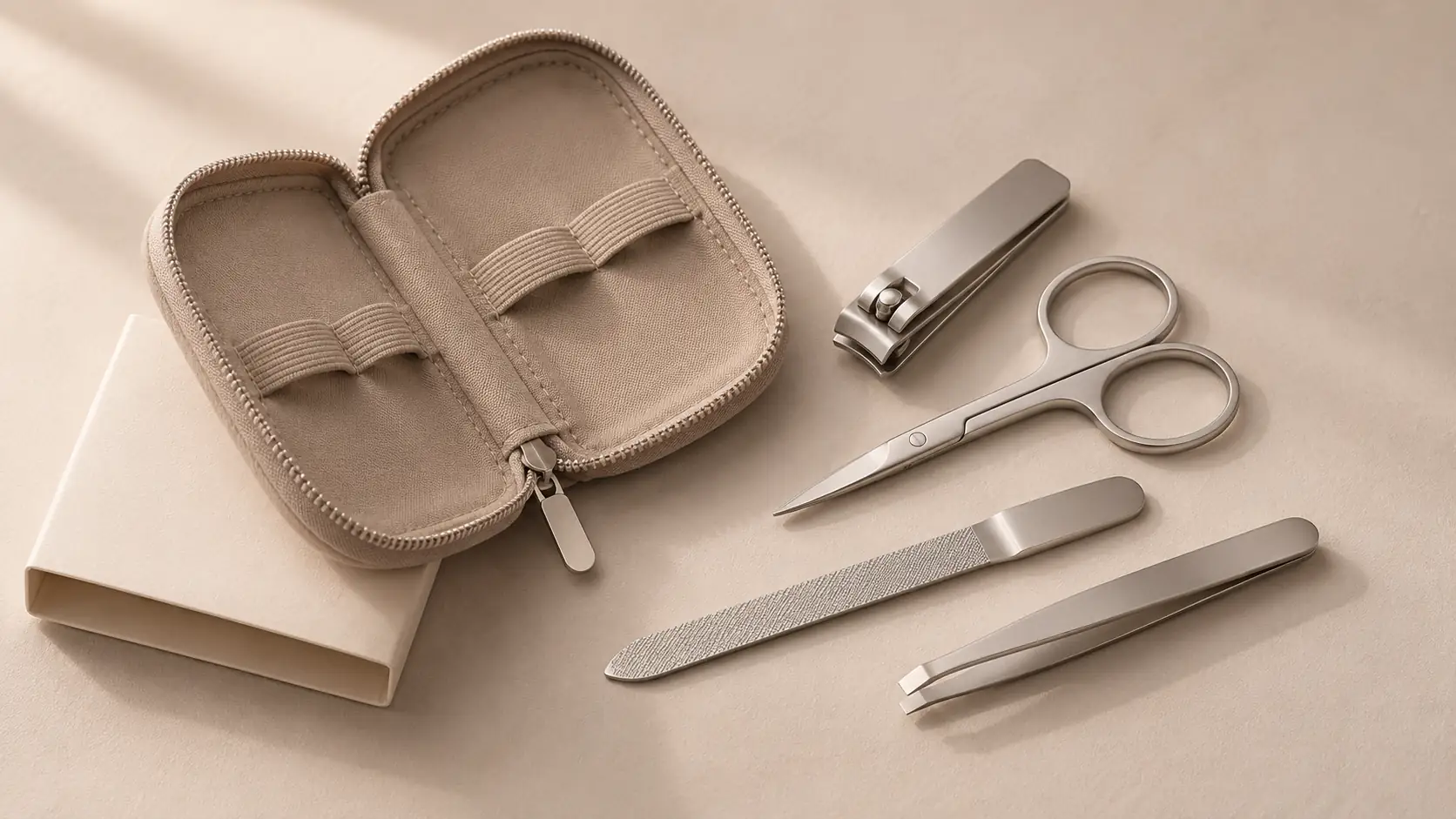
Custom manicure set cost depends on the exact tools, their materials and working quality, the fitted case, branding, packaging and quantity per version. Compare the price of one complete, packed set, then add charges outside that unit price. A lower advertised price can require a larger first-order budget once missing decoration, packaging and setup charges are included.
This guide covers reusable, non-electric manicure and grooming tool sets for brands, retailers and distributors. Nail-polish systems, electric drills, press-on nails and disposable salon packs need different specifications. The worked budget scenarios below are fictional calculation examples. A separate section shows dated third-party public listing prices; those are not BlendCraft quotations, confirmed factory costs, or an average market price.
Comparing offers? Review the dated public price observations, then follow the worked quotation example or download the editable comparison workbook. Preparing an inquiry? Copy the supplier quotation brief.
How much does a custom manicure set cost?
There is no reliable single price for an unspecified custom manicure set. An offer for unbranded tools in a standard pouch and an offer for a branded retail set in a fitted hard case cover different products. Establish the contents and required quality before asking suppliers to compete on price.
For a defined configuration:
First-order budget within the agreed scope = complete sets ordered × complete recurring price per set + separate project charges + required surplus-component purchases − confirmed credits.
The recurring price includes every required item charged per finished set: tools, fitted case, decoration, retail packaging and assembly, where applicable. Separate charges can include sampling, artwork setup, tooling and agreed inspection. Add each charge once.
Keep this subtotal separate from a delivered import budget. International transport, insurance, import charges and destination delivery must be added when outside the quotation. Unknown required amounts stay pending; a blank line does not mean zero.
Browse the manicure tools and private label set options to choose a product reference before requesting a firm price.
Public wholesale manicure set prices: three dated listing examples
Public-listing check: 4 November 2026. Prices were read directly from the sellers' public product tables, using the stated quantity and branding options. The examples below are advertised prices from unrelated third-party suppliers or wholesalers. They are not negotiated offers, actual transactions, verified factory production costs, or BlendCraft prices. Each uses a different tool count, case and sales channel, so the figures cannot be averaged into an OEM market rate or ranked as equivalent offers. Public prices can change.
| Public seller and configuration | Displayed price and quantity condition (USD) | What a buyer must check |
|---|---|---|
| Eros Wholesale: seven tools, zipper pouch and retail clamshell; US stock wholesale | $2.60 per set at 17+ cases of 24 units (at least 408 sets) | Ready-stock channel, not a private-label manufacturer quote. Confirm freight, availability and whether the existing packaging is suitable. |
| PromotionChoice: five tools in a vinyl pouch, one-color imprint option | $2.04 item + $0.30 per-piece run charge = $2.34 per printed piece at 1,000 pieces | Verify any separate setup, freight, tax and selected artwork charges. The unprinted price table is a different option. |
| Sense2: four tools, PU pouch and black gift box; one-color, one-position pouch print included | $4.13 per unit at 1,000 units, plus a listed $51.96 setup charge (branded, one-colour/one-position price tier) | This is a promotional-product reseller offer. Freight and tax are additional; the included logo applies to the pouch, not every tool. |
Buyer calculation from the displayed terms: at 1,000 units, PromotionChoice's item plus run charge is 1,000 × ($2.04 + $0.30) = $2,340 before any unconfirmed charges. Sense2's displayed first-order subtotal for the branded option is 1,000 × $4.13 + $51.96 = $4,181.96, or approximately $4.18 per unit before freight and tax. Neither figure is equivalent to the other supplier's scope, and neither can be treated as an eight-tool OEM factory price.
A material-label discrepancy worth checking before you quote
One ESHA eight-in-one listing uses “stainless steel” in the product title and highlights, while its structured product attributes say “Carbon Steel” under Material. That inconsistency does not establish which material will be supplied. Before comparing corrosion resistance, edge performance or price, request a component-by-component material statement, coating details and agreed sample tests.
How to use these observations: treat public listings as a starting point for questions, not a finished sourcing decision. Send an identical tool-and-case bill of materials, quantity per color, logo-location plan, retail-pack specification and delivery boundary to each potential supplier. Ask for a dated written quote that identifies included and separate charges; only then compare first-order budgets on equal terms. Use the editable quotation worksheet for confirmed figures, not as a substitute for missing answers.
Define what one complete manicure set includes
An “eight-piece set” is not a sufficient purchasing specification. One seller might count eight tools; another might count seven tools and a case. A double-ended tool is one physical tool with two working ends. Count these separately in your brief.
Use a component list, often called a bill of materials or BOM, to record every item and its quantity in one sellable set.
| Specification | What to record | Why the quotation can change |
|---|---|---|
| Tool list | Tool type, quantity, dimensions or drawing reference | Two sets with the same piece count can contain different tools |
| Tool materials | Material or grade for each component; coating separately | One material description may not apply to all parts |
| Working quality | Agreed cutting, alignment, operation and finish checks | Appearance alone does not define function |
| Fitted case | Dimensions, shell or covering, lining, retention and closure | Construction and internal fit change the assembly |
| Branding | Each marked component, method, size, position and artwork | A case-only logo differs from a logo on every tool |
| Retail pack | OPP bag, sleeve, box, insert, labels and instructions as required | A storage case does not automatically include a retail box |
| Order breakdown | Complete sets per color, configuration and artwork | Product, component and packaging minimums can differ |
| Commercial scope | Currency, quote validity, delivery rule and named place | Offers may end at different handover points |
A real eight-tool configuration
The published BlendCraft 8-piece manicure set with case contains one nail clipper, one angled nail clipper, scissors, tweezers, a nail file, a V-shaped cuticle trimmer, a double-ended cuticle tool and an ear pick, plus one fitted case. The case is additional to the eight tools.
For 1,000 sets of that listed configuration, the contents are 8,000 physical tools and 1,000 cases. There are still 1,000 sellable sets. This configuration describes a product reference; it does not establish a price for every eight-piece kit.
The product page lists an MOQ of 1,000 sets per color, chargeable samples in 10 days after payment, bulk production in 45 days after payment and standard outer packing in an OPP bag. Confirm the selected customization and schedule in the quotation. Shipping time is separate.
The page does not identify a steel grade for each tool or the case-covering material. Request those details before making material claims or comparing an offer with a stainless steel manicure set.
What changes the cost of wholesale manicure sets?
1. Tool construction and working quality
Specify each tool by its job. For clippers, record the jaw format, lever operation and agreed cutting check. For scissors, record the blade and tip configuration, pivot operation and cutting check. For tweezers, record the tip shape and alignment. For a file, identify the abrasive or working surface and required finish.
Ask suppliers to explain any proposed substitution. A change from one file construction to another, or a change in clipper geometry, is a different configuration that needs sample review. It cannot be treated as an equivalent saving simply because the item name stays the same.
Material names also need context. worldstainless explains that stainless steels belong to different families; martensitic grades can obtain hardness through heat treatment and are used in cutting applications. For sourcing, the practical question is which material and processing route suit each component. A broad “stainless steel” label alone does not establish cutting performance or corrosion behavior.
Request material evidence linked to the quoted components and agree how function will be checked. Avoid ranking every tool solely by a familiar grade number. A more expensive material description cannot compensate for poor alignment, unfinished edges or an unsuitable design.
2. The case and its internal fit
Compare the filled case. Record its external material, lining, frame where present, clasp or zipper, hinge arrangement and tool-retention system. Confirm what changes when an item is removed or replaced.
A case can look acceptable when empty but close poorly when loaded. Retaining loops can hold one tool securely and leave another loose. These are reasons to approve the complete packed sample rather than approving tools and an empty case separately.
If a quotation says “leather case,” request the actual covering material before using that description on your packaging. Keep the material specification separate from the color and surface appearance.
3. Logo positions and decoration
Write down every logo location. “Custom logo included” might cover only one mark on the outside of the case. It may exclude marks on eight tools, additional print colors or a different artwork version.
Ask whether the charge is per marked component, per finished set or per production batch. Identify any separate screens, plates, fixtures, dies or artwork work that the proposed method requires. Confirm mark legibility and appearance on the real surface through sampling.
For a fictional 1,000-set order, marking eight tools once each means 8,000 tool-marking operations, plus any case decoration. That is not the same scope as 1,000 case logos. Suppliers may price the work differently; request an itemized explanation instead of assuming a universal marking rate.
4. Packaging, assembly and distribution
Separate the fitted storage case from the outer sales pack. Specify whether the set needs a bag, printed sleeve, gift box, barcode label, instruction insert or other channel-required items. Include the work of placing tools in their retainers and packing the finished unit.
Ask for complete packed dimensions, sets per export carton, carton dimensions and gross weight. Those fields let a freight provider estimate transport for the actual order. Net product weight alone is insufficient.
Use the manicure set packaging guide to compare pack formats and approve a fully loaded sample.
Where a buyer requires transit testing, choose a method for the intended shipping route and package. ISTA distinguishes screening tests from distribution-simulation procedures. Specify the procedure, package configuration, acceptance criteria and responsibility for the cost. There is no single transit-test requirement for every manicure set.
5. Quantity, colors and component minimums
An order total can meet a headline MOQ while one color or component remains below its own minimum. Ask for the complete-set minimum by version and any separate minimum for cases, decoration or printed packaging.
For example, a plan for 1,000 sets split into two colors of 500 would not meet a confirmed minimum of 1,000 sets per color. Keeping both colors would require a revised quantity and quotation. Using one color is a different plan that also needs confirmation.
Record how the supplier handles parts left over from a component minimum: who pays, who owns them, where they are stored and whether they can be used on a later order. Do not assume surplus parts will be stored free of charge or stay usable after an artwork change.
Compare supplier quotes in three steps
First, check the specification. Match the component list, materials, agreed functional requirements, case, decoration, packing and quantity breakdown. Record differences as alternatives requiring review.
Second, check inclusions. Mark each line as included, separately priced, confirmed not required or pending. Request the amount for every necessary pending item. Ask whether a quoted “unit” means one tool, one set, one retail multipack or one export carton.
Third, compare a common scope. Use the same currency, quantity and delivery boundary. Do not rank a tool-only price against a complete retail-pack price, or an import-delivered price against a collection-point price.
| Offer status | What it means | Next action |
|---|---|---|
| Comparable | Required specification and cost scope align | Compare the complete budget and supply terms |
| Alternative | A tool, material, case or other requirement changes | Review the change and sample separately |
| Pending information | A required amount or specification is unresolved | Request clarification; keep the subtotal provisional |
A supplier does not need to reveal every internal production cost to give a usable quotation. It does need to define the finished product, inclusions, separately payable charges and order conditions clearly enough for you to compare offers.
Worked example: the lower unit price needs a larger first-order budget
All prices in this example are fictional. They demonstrate comparison arithmetic, not current factory prices, supplier performance or a BlendCraft offer.
Assume 1,000 identical eight-tool sets with a fitted case, one color, the same required logo scope, one printed sleeve, standard outer bag and complete assembly. Both offers have confirmed matching specifications and use USD at the same named FCA handover point under Incoterms® 2020. No new product tooling is required. Sample delivery, onward freight, insurance, import charges and destination costs are outside this example. There are no credits or surplus-component purchases in the base comparison.
| Fictional charge, USD | Quote A | Quote B |
|---|---|---|
| Complete sets ordered | 1,000 | 1,000 |
| Base price per set | 2.20 | 2.48 |
| Required branding per set | 0.18 | Included |
| Printed sleeve per set | 0.12 | Included |
| Complete recurring price per set | 2.50 | 2.48 |
| Production amount | 2,500.00 | 2,480.00 |
| Separate setup charge | 180.00 | 80.00 |
| Sample charge | 80.00 | 80.00 |
| Agreed inspection, separately paid | 180.00 | 180.00 |
| First-order budget within this scope | 2,940.00 | 2,820.00 |
| Planned spend per ordered set | 2.94 | 2.82 |
Quote A: 1,000 × (2.20 + 0.18 + 0.12) + 180 + 80 + 180 = USD 2,940.
Quote B: 1,000 × 2.48 + 80 + 80 + 180 = USD 2,820.
The base unit price suggests A is cheaper. After matching the required scope, B requires USD 120 less first-order spending. This calculation does not establish which supplier has better quality, reliability or delivery performance.
What if the sleeve supplier requires 3,000 pieces?
Now change only Quote A's packaging arrangement. Suppose the buyer must purchase 3,000 sleeves at USD 0.12 each, while the order uses 1,000 sleeves. The minimum sleeve purchase is USD 360. The base calculation already includes USD 120 for the sleeves used in the sets.
Additional sleeve purchase = (3,000 − 1,000) × USD 0.12 = USD 240.
Quote A's revised first-order spending becomes USD 3,180. Do not add the full USD 360 to the original budget: that would count the 1,000 used sleeves twice. Record the remaining 2,000 sleeves and the storage or later-use agreement separately.
If a supplier absorbs the packaging minimum, there may be no separate surplus purchase. Use the written arrangement rather than assuming that every component minimum creates an extra bill.
A deposit changes payment timing, not total cost
Return to the base example without surplus sleeves. Assume, for illustration, a 30% deposit on the production amount only. Setup and sample charges are paid in full at the start; inspection is paid later. These are example terms, not BlendCraft's stated payment policy.
| Fictional payment stage, USD | Quote A | Quote B |
|---|---|---|
| Production deposit | 750.00 | 744.00 |
| Setup and samples paid at start | 260.00 | 160.00 |
| Total starting payment | 1,010.00 | 904.00 |
| Production balance plus inspection | 1,930.00 | 1,916.00 |
| Total across both stages | 2,940.00 | 2,820.00 |
Confirm what the deposit percentage applies to and when each charge is due. Never add a deposit on top of the full production amount as an extra expense. If samples have already been paid, retain them in cumulative project spending but subtract the payment when calculating the amount still due. Apply credits only where their conditions are confirmed.
The accompanying Manicure Set Quote Comparison workbook (XLSX) includes this example and editable inputs for required charges, surplus purchases and deposit timing.
Check samples and evidence before accepting the cheaper offer
Use the same sample-review record for each candidate. Photograph the complete contents, identify the sample revision and record proposed changes before placing the production order.
| Review area | What to agree before production | Possible cost consequence to clarify |
|---|---|---|
| Cutting and working ends | Test material, method and agreed result; tip and jaw alignment | Reworking or replacing an unsuitable component |
| Moving parts | Lever, pivot, hinge and closure operation | Additional adjustment or a changed component |
| Exposed surfaces | Workmanship, unintended burrs, coating and finish expectations | Different finishing work or rejection of unsuitable samples |
| Filled case | Correct contents, secure retention, closure and protection | New retainers, changed layout or revised packing |
| Marks and labels | Artwork, position, legibility and required product information | Repeated decoration or packaging changes |
| Inspection scope | Lot definition, sampling plan, defect categories and reporting | Inspection, reinspection and any agreed corrective work |
Where acceptance sampling is used, ISO 2859-1:2026 provides AQL-indexed sampling schemes for inspection by attributes. Agree the applicable plan and product-specific defect definitions. A sampling standard does not define the right blade alignment, cutting result or cosmetic tolerance for your set, and it does not guarantee every item is defect-free.
For EU consumer-market projects, include the required product-safety review, traceability and documentation work in the project scope. The General Product Safety Regulation, Article 9, addresses manufacturers' risk analysis and technical documentation. Allocate responsibilities and any required evaluation with the relevant operator and qualified adviser before finalizing costs. A general audit document does not establish that a particular set meets every market requirement.
Describe ordinary grooming tools according to supported specifications. Claims such as “surgical grade,” “sterilizable” or “medical grade” require evidence relevant to the exact product and intended use; they should not be added simply to make a quotation sound premium.
If the manicure kit is part of a grooming assortment with a hair brush or eyelash curler, use the custom hair brush cost guide and eyelash curler quote comparison guide for their separate specifications and quantities. Request a revised packing quotation for the complete assortment rather than adding individual packed dimensions as if they were the final shipment.
Calculate the delivered budget separately
After comparing the same packed-goods scope, ask your freight provider and customs broker to complete the destination budget using the confirmed cartons, shipment route, destination and product details.
The U.S. International Trade Administration's landed-cost guidance includes the product, freight, insurance, duties, taxes and other applicable fees. Record what is already covered by the supplier so you do not add it again.
Use the delivery rule with its named place or port and version. ICC Academy explains that FCA can cover different transport modes, while FOB is for sea or inland-waterway transport with delivery on board the vessel. Match the rule to the actual handover arrangement. A label such as “FOB price” without a named port leaves a basic comparison field incomplete.
Do not assume a generic duty rate for all manicure sets. Have the destination classification, origin and current charges confirmed. Separate import cash payments from your accounting treatment of any recoverable taxes.
How to reduce cost without losing the approved requirements
Request a revised quote that names each change and shows the new complete budget.
| Option | What to ask for | What still needs approval |
|---|---|---|
| Start from an available configuration | Price the existing tools and case before structural development | Actual availability, function and full packed sample |
| Use fewer color or artwork versions | Reprice the same total quantity with fewer versions | Brand presentation, minimums and new allocation |
| Concentrate branding | Compare case-only branding with the required tool marks | Retail brief and mark durability or legibility |
| Simplify outer packaging | Compare a sleeve with a box for the same set | Protection, labels, shelf presentation and transport |
| Review the assortment | Quote a smaller tool selection suited to the channel | Intended tasks and revised case fit |
A larger order may spread setup charges over more sets, but it also increases total cash committed and inventory. Ask for quantity tiers only at volumes you could realistically sell. For repeat orders, reconfirm whether the tools, case, colors and artwork are unchanged and which setup or sampling charges still apply.
A quotation brief you can send to suppliers
Copy these fields into your inquiry and request an itemized offer:
- Product reference and contents: model or reference photographs, exact tools and quantities per set, fitted case listed separately.
- Specification and sample requirements: material information by component, dimensions, working-quality checks and required evidence. Mark unresolved details “supplier proposal requested.”
- Order breakdown: complete sets per color, configuration and artwork version; request applicable component and packaging minimums.
- Branding and packing: every logo location, artwork, preferred method, retail packaging, labels, instructions and full assembly.
- Destination and delivery: market, delivery rule with named place or port, shipment information needed and required arrival date.
- Commercial confirmation: complete recurring set price, inclusions, separate setup or tooling, sample and delivery fees, required inspection, credits, payment stages and quotation validity.
Ask the supplier to identify any assumptions or substitutions in its reply. Confirm what starts the sample and production clocks and which approvals or materials must be ready. Use the beauty tool lead-time planning guide to work back from your arrival date.
For the listed eight-tool configuration, review the product and case, or discuss a wider specification through OEM and private label project support. Share the complete set contents and quantity per color so the quotation can cover your actual requirement.
Request a quotation for the eight-tool manicure set with your quantity per color, logo locations and packaging requirements.
Frequently asked questions
Are wholesale manicure sets cheaper when ordered in bulk?
Request tiered quotations for the same specification. A higher quantity can change recurring prices and spread fixed charges over more sets, but it also increases total spending. Compare the full order budget, version minimums and realistic stock needs.
Is the case included in a manicure set price?
Only if the quotation says so. Identify the fitted case separately in the component list and confirm whether it is included in the price per sellable set. Outer retail packaging is another field to check.
Does a private label manicure kit need new tooling?
Ask which parts change. Branding an available configuration may use existing product tooling, while changed tool geometry, case construction or retention can need development. Confirm the exact work, charge, ownership or use arrangement and repeat-order treatment.
Should every tool use the same stainless steel grade?
Do not make that an automatic requirement. Different components perform different jobs. Request the material of each tool, relevant supporting evidence and agreed functional checks, then assess the complete specification rather than relying on one grade label.
What is the MOQ for a custom manicure set?
It depends on the quoted configuration, colors, branding and packaging. BlendCraft's listed eight-tool set states 1,000 complete sets per color. Confirm that model's selected options and any separate component minimums in the quotation; the figure is not a universal MOQ.
Can I compare a stock wholesale price with a custom logo quotation?
Record the stock offer as a separate route until its contents, materials, branding, packing, quantities and delivery scope match your requirements. Add only confirmed extra charges. If an essential detail remains unknown, keep the comparison provisional.
Sources and scope
External references support the material, inspection, packaging and trade concepts discussed here. The separately labeled third-party prices above were checked against public seller pages on 4 November 2026; they are advertised listings, not verified transactions or the fictional budget examples, and do not certify the referenced BlendCraft product. Live prices and product terms may change. Confirm all project-specific specifications and terms in a written quotation.
Continue reading
Related Guides
Manicure Set Packaging Guide for Retail Buyers
Choose packaging for a manicure kit, then use the loaded-sample checklist to approve how it displays, holds tools and scans at checkout.
Beauty Tool Lead Time Planning for Seasonal Launches
A practical B2B framework for planning specifications, samples, approvals, production, inspection and shipping around a seasonal launch.
Custom Eyelash Curler Cost: How to Compare Private Label Quotes
Compare complete retail configurations, identify missing quotation items and calculate first-order spending for mechanical eyelash curlers. Includes an editable worksheet and worked payment examples.
Custom Hair Brush Cost: How to Compare Private Label Quotes
Compare hair brush specifications, tooling, quantity allocations and packing before choosing a supplier quote. Includes worked calculations and a reusable worksheet.