Custom Hair Brush Cost: How to Compare Private Label Quotes
Compare hair brush specifications, tooling, quantity allocations and packing before choosing a supplier quote. Includes worked calculations and a reusable worksheet.
By BlendCraft
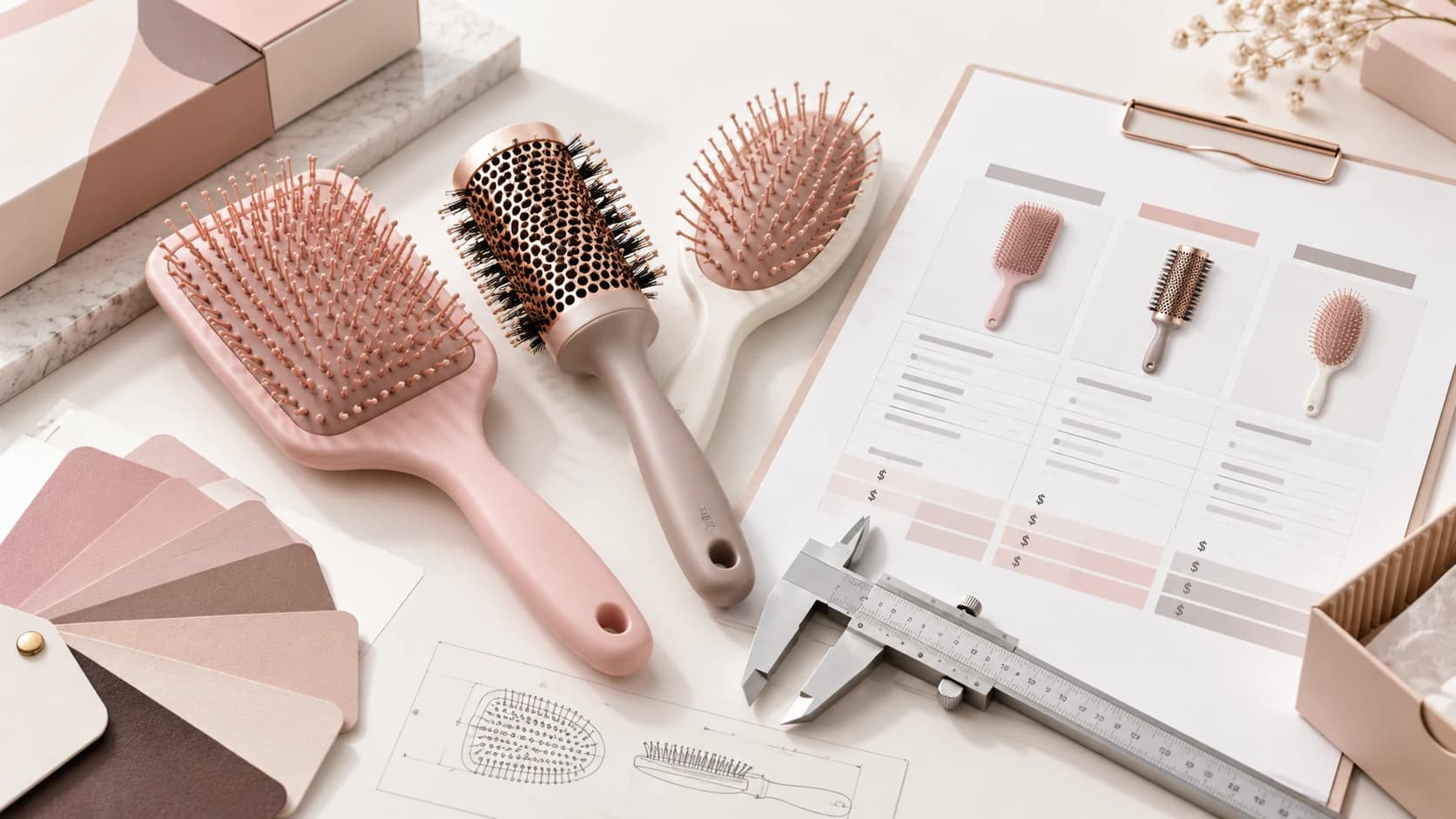
Custom hair brush cost depends on the finished construction, pin and bristle configuration, quantity per variant, tooling, branding, packaging and delivery scope. To budget a private label order, price the specified brushes at their actual quantities, then add required charges outside the unit price once. A lower listed price is useful only after the product and included work are clear.
This guide covers manual cushion, paddle, vented and round styling brushes. Dollar figures are fictional teaching examples, not market price estimates or BlendCraft offers. Use a written, configuration-specific quotation for a purchasing budget.
Start with the decision you need to make:
| Your situation | Use this part of the guide |
|---|---|
| The brushes look alike, but the prices differ | Compare the actual construction, then record the quotation differences. |
| You want several colors, bristle versions or round-brush sizes | Check the quantity allocation before calculating the order total. |
| You already have a defined brush and two quotes | Calculate the complete first-order comparison, including required extras. |
What should a hair brush quotation include?
A useful private label hair brush quote identifies the brush version, quantity by configuration, included production and packing work, separate charges and delivery boundary. Use the private label hair brush formats to identify a reference, then choose the scope the supplier should price:
- Existing model, selected branding: identify the current body and working elements, then the color, logo and pack changes.
- Existing model, changed configuration: list the altered pins, short bristles, cushion or finish. Ask for the revised sample and price under a separate version.
- New structure: describe the head, handle or component changes and request a development/tooling proposal alongside the production quotation.
| Quote field | Put this in the common brief |
|---|---|
| Product reference | Model or drawing revision, physical sample reference and intended use |
| Head and body | Dimensions, materials, construction, cushion or barrel where applicable |
| Working elements | Longer pins and shorter bristle tufts recorded separately, including layout and material |
| Quantity | Pieces of each model, size, color and bristle configuration |
| Branding and packing | Logo method and positions, individual pack, accessories, labels and export cartons |
| Additional work | Samples, tooling or modifications, setup, testing and inspection scope |
| Commercial terms | Currency, validity, named handover/delivery point, exclusions, payment and approval milestones |
Ask the supplier to label departures from this brief. A bundled price can be useful when its contents are clear; the supplier does not need to disclose its confidential manufacturing margin or every internal process cost. You need to know what you are buying and which required charges remain outside the figure.
If the brush type is still open, use the hairbrush sourcing guide first. If you have a reference, the six-field enquiry below is enough to start a feasibility discussion; complete the specification before final cost comparison.
Why can similar hair brushes have different prices?
Two brushes can share an outline while using different pin systems, bristle tufts, cushions, finishes or packing. Read the price against those components. Changing a component creates a product alternative that needs its own review, even if the photograph still looks similar.
| Cost area | What to define | A useful question about the price |
|---|---|---|
| Body and handle | Material, geometry, component count, finish and existing model reference | Is this the same body, or a different structure proposed to meet the budget? |
| Pins and short bristles | Material of each layer, layout, projection and sample reference | Has the supplier changed the contact elements, their distribution or the selected material? |
| Cushion and assembly | Cushion construction, fit and approved response where applicable | Does the quoted version retain the same cushion and assembly requirements? |
| Round-brush head | Barrel material, barrel-only diameter, diameter including bristles and length | Are the two suppliers pricing the same size definition and head construction? |
| Color, finish and logo | Component colors, surface finish, artwork, positions and application method | Is the result included in the price, and what setup or sample work is separate? |
| Packing and inspection | Retail contents, protection, labeling, assembly and agreed checks | Is the quote for a loose brush or the fully specified packed product? |
Separate nylon pins from the short-bristle configuration
“Boar bristle brush” does not fully identify a mixed head. Record the longer pins and shorter tufts separately. For example, BLC-04 oval cushion hair brush offers pin-only, natural-boar-mix and synthetic-mix versions using the existing body mold. These are distinct configurations, not interchangeable descriptions of one priced product.
If the short bristles change, record the material, layout and sample version in the alternative quote. Assess brushing feel and the intended use on samples; neither a material name nor a higher price establishes a universal performance ranking.
Define the round-brush diameter being priced
For a round brush, separate the barrel diameter from the outer diameter including bristles. A quoted “50 mm” is ambiguous until the measurement is identified. Also state the quantity for each size and whether the brushes are individually packed or assembled into a retail assortment.
The round blow dry brush page uses supplied size labels rather than verified barrel-only diameters. Use a drawing or measured sample when matching another brush. A photograph of several sizes does not define a multi-piece retail set.
Price the required finish and its evidence together
A molded color, painted surface and soft-touch finish describe different specifications. Name the components to be finished, the appearance reference and the logo area. Ask for alternatives with the changed finish identified, rather than assuming a standard percentage surcharge.
If the brief requires heat-use performance, coating durability or a particular material claim, define the applicable evidence and evaluation work. A sample photograph or the word “professional” does not establish those results. Include the agreed work in both quotations before comparing them.
When does custom hair brush development need tooling?
An unchanged existing body may allow a project to proceed without commissioning a new body mold. A revised handle, head profile, component fit or layout needs a manufacturing review to identify any modification, fixture, new tool or other development task. Color, decoration and packaging can still require setup and samples on an existing design. The OEM and private label process sets out the project-review and sample-approval steps.
Ask for a short tooling schedule:
| Development item | Record before approving the charge |
|---|---|
| Existing production tool | Tool or model reference, available construction and agreed use |
| Modification | Component and revision being changed, work covered and resulting sample |
| New tool or fixture | Part produced, quantity of tools, development stages and acceptance reference |
| Commercial treatment | Separate charge or documented unit-price recovery; avoid counting both |
| Later use | Agreed ownership, access, maintenance, storage, exclusivity and transfer arrangements |
Protolabs' injection-molding guidance explains how geometry, tooling work and surface requirements can affect molded-part costs. It provides manufacturing context; it does not establish a hair-brush mold price or the route for your selected design.
For a separately paid tool, divide its cost by the planned quantity only to show an internal allocation. Fictional example: a USD 1,200 tool allocated over 1,000 brushes contributes USD 1.20 per brush to that first-order view. Allocating it over 3,000 forecast brushes gives USD 0.40 per brush, but an agreed USD 1,200 tooling invoice due now still requires USD 1,200 now. Neither allocation is an additional charge on top of that same invoice.
If tooling is already recovered through the unit price, do not add it again. Obtain the specified tool and charge basis before comparing a separate-fee route with a unit-price route. The hypothetical USD 1,200 is not a typical mold price. Agree later use and exclusivity separately; an existing supplier design does not itself grant exclusivity.
How do colors, configurations and sizes affect the order?
Write the order as a model × size × color × configuration list. Then apply the minimum to the grouping the supplier actually confirms. The total number of brushes does not establish that every individual combination meets its minimum.
Two real model rules illustrate the difference:
- BLC-03 curved vented hair brush lists 1,000 pieces per color and allows natural-boar and synthetic configurations to be combined within that color.
- BLC-04 lists 1,000 pieces per color per configuration. Different configurations cannot be pooled to meet that minimum.
Consider two colors and two short-bristle configurations, with 500 pieces of each combination:
| Planned combination | Requested brushes |
|---|---|
| Color A, natural-boar configuration | 500 |
| Color A, synthetic configuration | 500 |
| Color B, natural-boar configuration | 500 |
| Color B, synthetic configuration | 500 |
| Total requested | 2,000 |
Under BLC-03's listed grouping, each color totals 1,000 pieces. Under BLC-04's rule, all four 500-piece lines are below their respective minimums; keeping all combinations at the listed minimum would require 4,000 pieces. Decide whether to reduce combinations or accept the additional inventory before comparing the proposed unit prices.
This is a quantity illustration, not a price comparison between those models. They have different structures. A feasible alternative could be fewer combinations, a different allocation or another suitable model; each needs its own valid quote and product review.
For a round-brush range, request the minimum and price at each proposed size allocation. Do not apply one average price or a discount quoted for a single size to the entire mixed range. If the pack contains several brushes, count each component and the retail packs separately.
Worked example: compare the complete first order
Fictional calculation only. Assume 2,000 identical manual cushion brushes, one color and configuration, the same approved specification, one retail box per brush and the same inspection scope. Both suppliers quote in USD to the same stated packed-goods collection point. Onward freight, insurance, import charges and destination costs are excluded. No separate tooling is required in this teaching example.
| First-order line, USD | Fictional quote A | Fictional quote B |
|---|---|---|
| Quantity of brushes | 2,000 | 2,000 |
| Main price per brush | 1.80 | 1.95 |
| Required retail box and packing outside main price, per brush | 0.25 | 0.00 — included |
| Unit-priced amount for this order | 4,100.00 | 3,900.00 |
| Additional sampling/setup within the stated scope | 100.00 | 250.00 |
| Required excess-component purchases | 0.00 | 0.00 |
| Applicable confirmed credits | 0.00 | 0.00 |
| First-order comparison subtotal | 4,200.00 | 4,150.00 |
| Planned spend per ordered brush, USD | 2.100 | 2.075 |
Quote A: 2,000 × (1.80 + 0.25) + 100 = USD 4,200.
Quote B: 2,000 × (1.95 + 0.00) + 250 = USD 4,150.
A has the lower main listed price. B requires USD 50 less within this complete first-order comparison. The result depends on the stated inclusions and identical specifications. It does not predict reorder pricing or establish better sample performance.
For one configuration:
First-order comparison subtotal = quantity × (main unit price + required unit extras) + additional order charges + required excess-component purchases − applicable confirmed credits
Count each charge once. Keep deposits on the payment schedule: a deposit paid toward the invoice is part of that invoice, not an additional project cost. Keep an unconfirmed sample credit pending.
For multiple configurations, calculate each at its actual quoted quantity and price, then add genuinely shared charges once. Another fictional arithmetic example: 1,000 brushes of configuration X at USD 1.80 and 1,000 of Y at USD 2.20 total USD 4,000 in product charges. If one additional USD 120 setup charge covers both lines, the scoped total is USD 4,120. Adding USD 120 to each line would overstate it by USD 120. Different configuration prices here are assumptions, not a material-cost ranking.
A quotation at one allocation cannot be extrapolated into a volume-discount curve. Reprice the proposed order mix. If a required amount is unresolved, retain the known-charge subtotal as provisional and request that amount before making a budget comparison.
What if the cheaper brush uses a different configuration?
Suppose B replaces the agreed natural-boar mix with synthetic short bristles. The arithmetic can still be recorded, but the result is now a specification alternative. Request the changed material and layout, evaluate the new sample and decide whether the revised product suits the range. A lower subtotal alone cannot close that decision.
Use the Hair Brush Quote Comparison worksheet for one configuration and two quotations normalized to a per-brush basis. Enter an explicit zero only for a confirmed zero charge. The additional-fee status keeps the calculated comparison pending while a required fee remains unresolved. Its separate specification record still needs human review; the file does not approve samples or select a supplier. For a mixed order, keep configuration-level records and reconcile shared charges once outside this single-configuration sheet.
How does packaging affect hair brush shipping cost?
Budget from the packed brush and final carton, not the brush's net weight alone. A retail box or insert can change carton capacity and external dimensions. Protection also matters: examine whether the pack bends pins, flattens tufts or presses the cushion, and compare the unpacked brush with the approved reference.
For a concrete packing reference, the rectangular paddle hair brush lists standard OPP packing of 250 brushes in a 61 × 54.5 × 50 cm carton, with 23 kg gross weight. At that unchanged packing, 1,000 brushes occupy four cartons:
| Derived packing quantity | Calculation | Result |
|---|---|---|
| Cartons | 1,000 ÷ 250 | 4 |
| Carton volume | 0.61 × 0.545 × 0.50 | 0.166225 m³ |
| Total carton volume | 4 × 0.166225 | 0.6649 m³ |
| Total gross weight | 4 × 23 | 92 kg |
These calculations use the published packing reference, not measurements of a new order. Custom retail packing needs new carton data. For a side-by-side packaging quote, request brushes per retail unit, retail units per carton, external carton dimensions and carton gross weight for each option. Keep the protection and labeling requirements the same unless you are deliberately evaluating a changed pack.
DHL Express' measuring guidance describes volumetric charging for large, light parcels. Confirm the applicable service, dimensions, weight, rounding, rates and surcharges with the transport provider. The volume above is useful quotation input; it is not a freight price or a universal billing rule.
Where a supplier requires more printed packs than the current order consumes, record the full required purchase and the unused balance. If current unit charges already include the packs used now, add only the required balance outside those charges. Agree how remaining packs are identified, owned and stored, and whether later artwork changes would make them unusable.
Which hair brush cost reductions should you request first?
First write the features your range must retain, such as the selected pin/tuft layout, cushion response, artwork and pack protection. Then ask for separately priced changes at a defined quantity. No saving is assumed until the revised quotation arrives.
| Alternative to request | What changes in the quotation | What to review before accepting |
|---|---|---|
| Suitable existing body instead of a new silhouette | Defined development/tooling work and the selected unit price | Head size, grip, differentiation and agreed design-use terms |
| Fewer colors or bristle configurations | Allocation, applicable minimums, purchased quantity and setup scope | Whether the reduced range still serves the intended customers |
| Revised finish or fewer logo positions | Component treatment, artwork and decoration work | Appearance, marking clarity and agreed durability requirements |
| Revised retail pack | Pack materials, assembly, carton capacity and transport quote | Pin/bristle protection, shelf presentation and unpacked condition |
| Another bristle or pin specification | Defined material, layout and sample version | Application behavior, material identity and relevant claims |
Use the hair brush QC checklist to turn the selected configuration into inspection requirements. A cost reduction should leave a written record of what changed and which sample or packing approvals need updating.
When are two quotes ready for a cost comparison?
Two quotes are comparable for cost review when the brush specification, quantity allocation, pack, inspection scope, currency and cost boundary match and required amounts are resolved. Sample approval, production schedule and commercial terms remain part of the purchasing decision.
The filled record below shows how to deal with differences. These are independent fictional quotation-review examples, not findings from actual suppliers or product tests.
| Requirement in the brief | What the offer says | Finding and next action |
|---|---|---|
| Nylon longer pins plus natural-boar short bristles | “Nylon pins + synthetic short bristles” | Specification alternative. Request the specified version separately and identify the changed sample. |
| Round-brush barrel-only diameter of 50 mm | “50 mm including bristles” | Different size definition. Obtain both dimensions and reprice the matching size. |
| One brush in a printed retail box | “One brush / OPP bag”; box amount pending | Incomplete packing budget. Obtain the box, assembly and revised carton details before comparing totals. |
Useful supplier message: “Quote B identifies a synthetic short-bristle layer; our brief specifies natural boar. Please confirm whether this is an alternative and quote the requested version separately.” Attach the brief revision so the requested correction has a fixed reference.
Send a useful hair brush quotation brief
Copy and complete these six fields:
Reference and use: [model link/image/sample, intended use].
Quantity plan: [model/size/color/bristle configuration and quantity for each line].
Branding: [component colors/finish, logo positions and artwork if ready].
Packing: [one brush or assortment; bag/box/display direction].
Market and delivery: [destination market and named handover/delivery point].
Timing and open items: [target date, development changes and undecided requirements].
Ask the supplier: “Please identify departures from this brief, the minimum for each grouping, what the unit price includes and any required additional charges.”
For the selected version, add dimensions and measurement definitions, pin/tuft layout, material references, artwork, packing contents, quality criteria and approval milestones. Mark an undecided requirement as open so the supplier can quote a defined option.
Send your hair brush references and quantity plan to start a scoped discussion. You can begin with a reference and incomplete fields; identify what remains open. Sampling and production start points belong to the selected model and quotation.
Buyer questions and sources
Does a higher order quantity always reduce the launch budget?
A larger order can have a lower quoted unit price while requiring more total cash and inventory. Compare the actual quantity purchased, complete charge lines and the allocation you can use. Request current prices for each proposed quantity.
Can a sample lead time be used as the whole launch timeline?
Plan development, sample revisions, approvals, production, inspection and transit separately. Identify what starts each stage and which parts can proceed together. New tooling and unapproved packing may add work beyond the existing-model sample schedule.
How was this guide prepared?
BlendCraft organized the specification comparisons and working records for buyers sourcing manual hair brushes. Linked product pages support the model-specific examples, checked on October 30, 2026. Protolabs supports general molding context and DHL supports the parcel-volume explanation. No supplier quotation dataset or product performance experiment was used to establish market prices, cost percentages or performance rankings.
Product terms can change. Use the selected model page and written project quotation when placing an order.
Continue reading
Related Guides
Sourcing Premium Hairbrushes: A Practical B2B Guide
A practical guide to comparing hairbrush types, materials, samples, quality checks, and customization options for a wholesale or private label project.
Hair Brush Quality Control Checklist for Buyers
A practical inspection guide for brands and sourcing teams reviewing pins, bristles, cushions, brush bodies, branding and packaging against an approved sample.
Powder Puff Types & Materials: A Buyer’s Guide
A practical guide to powder puff shapes, surface materials and construction, with a sample-comparison record and a private label brief for buyers.
Private Label Makeup Sponge Cost: How to Compare Supplier Quotes
A buyer’s guide to makeup sponge cost drivers, piece-versus-pack pricing and supplier quote comparison, with a worked example and a reusable brief.