Custom Eyelash Curler Cost: How to Compare Private Label Quotes
Compare complete retail configurations, identify missing quotation items and calculate first-order spending for mechanical eyelash curlers. Includes an editable worksheet and worked payment examples.
By BlendCraft
Custom eyelash curler cost starts with a defined retail unit: one assembled mechanical curler, its fitted pad, the stated spare pads, branding and retail packaging. Calculate the quoted units first, then add required project charges and any extra components you must purchase. Before comparing totals, check whether the offers cover the same specification. Keep the project budget separate from payments still due.
This guide covers non-heated mechanical curlers. No comparable factory-price dataset was collected; the worked figures below are fictional, not a market price range or a BlendCraft quotation.
| Your next decision | Start here |
|---|---|
| I need a starting budget | Define the budget and follow the worked example. |
| I already have supplier quotes | Classify the offers before comparing amounts. |
| I want a useful quotation | Prepare a six-field brief, or use the editable comparison worksheet. |
How much should you budget for a private label eyelash curler?
A usable first-order budget combines the price of the specified packed units with required charges outside that price. The minimum starting information is a product reference, quantity by version, pad configuration, branding, packaging and delivery scope.
For one configuration:
Budget for the defined scope = ordered quantity × (main unit price + required unit extras) + additional order charges + required extra-component purchases − confirmed applicable credits
This is a planned-spend calculation. It does not establish an accounting inventory value or the product's final landed cost. Freight, import charges and destination expenses belong in a wider budget when they are outside the supplier's quoted scope.
First identify which purchasing route you are pricing:
| Project route | What needs a quotation |
|---|---|
| Branding an available model | Selected curler, available finish, logo, pad configuration, retail pack and any separate setup or samples |
| Changing components or presentation | Each changed component, finish or pack, plus related sampling and evaluation |
| Developing a changed structure | Feasibility, affected components and tools, development samples, approval stages and the resulting production version |
Use the eyelash curler formats for private label projects to choose a reference. An available model does not automatically mean ready stock, zero setup charges or an exclusive design.
You can request an initial price before every detail is settled. Mark unresolved fields as “supplier proposal requested” and keep the resulting amount provisional. A preliminary quote based on a photograph should not later be treated as a confirmed price for a different approved sample.
Which curler, pad and retail-pack details must match?
Start with the complete retail unit, then identify the components and services behind it. “One eyelash curler” can mean an unpacked tool, a branded tool in a printed box, or a pack containing spare pads and instructions.
| Quotation field | Record in the shared brief | Difference to resolve |
|---|---|---|
| Reference and version | Supplier model, shared reference, quote revision and sample or drawing ID where applicable | A supplier may be pricing a different version from the one reviewed |
| Frame and working profile | Confirmed material description, working-area reference and existing or changed structure | Overall dimensions and a similar photograph do not define the same working profile |
| Handles and mechanism | Selected construction, components and assembly requirements | A compact push-style tool and a classic loop-handle frame are different products |
| Pad system | Fitted pad reference, material description, compatibility and spare count | “Pad included” may describe only the installed component |
| Finish and logo | Component, finish reference, artwork revision, location and method | A metallic appearance does not identify the underlying material or process |
| Retail packing | Tools per pack, box or card, insert, labels, instructions and assembly | A complete retail-pack price cannot be compared with a tool-only price without adjustments |
| Quantity and quality scope | Quantity by version, agreed checks and separately required evaluation | Total order quantity may not meet each version's minimum |
| Commercial basis | Currency, validity, delivery term and named place | Different handover boundaries can produce different totals |
Use a real product reference without assuming a price
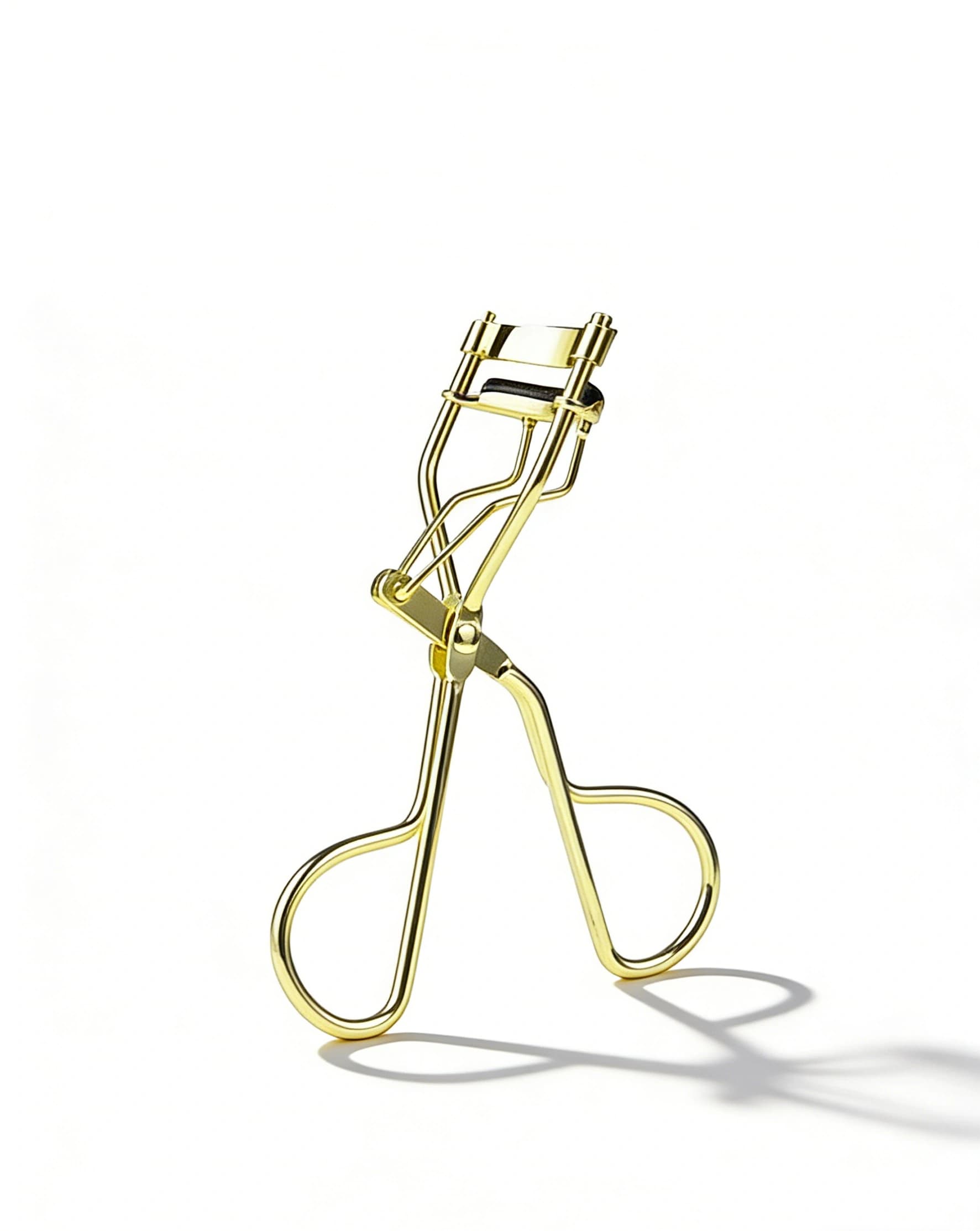
The published E1 classic metal eyelash curler identifies a stainless-steel frame, yellow-gold electroplating and a replaceable rubber pad. Those are useful starting fields for a quotation. They do not identify a steel grade, the exact pad compound or a universal price for similar-looking curlers.
The compact push-style curler introduces a different housing and operating structure. The partial curler format has a narrower working area. Review each as its own product direction; a smaller tool is not automatically cheaper, and different formats should not be grouped as equivalent merely because all are called eyelash curlers.
Count fitted pads and spare pads separately
For an illustrative retail configuration, write: one complete curler with one fitted pad, plus two compatible spare pads. For 2,000 retail units, that means 2,000 fitted pads and 4,000 spare pads. The spare count is not an additional number of complete curlers.
Keep the pad reference connected to the actual frame and holder. Tweezerman's official FAQ advises against other-brand replacement pads for its curlers because they may affect performance. This is brand-specific guidance that supports checking compatibility; it does not establish replacement instructions for a BlendCraft product.
For sample checks and approval records, use the eyelash curler sample and quality checklist. This cost guide records the configuration being priced; the QC guide explains how to review it.
Can these supplier quotes be compared?
Give each offer a status before comparing money. Matching a material name or color does not establish that two assemblies meet the same requirements.
| Status | What it means | Next action |
|---|---|---|
| Same specification, complete scope | The selected reference, components, retail contents, quantity, quality scope and commercial boundary align, with required amounts confirmed | Normalize the charges and compare spending within that scope |
| Alternative configuration | The offer changes the working profile, pad reference, mechanism, packing or another defined requirement | Record the change and review its suitability separately |
| Information missing | A required specification, amount or inclusion is unresolved | Keep the known subtotal provisional and request the missing information |
A cheaper alternative can still be worth considering. It is a different proposal, not evidence of a same-product saving. Ask what changed, what must be reviewed again and what the revised complete price covers.
For example, if Quote A says “rubber pad included” and Quote B specifies a fitted pad plus two compatible spares, ask A to confirm its retail contents. Do not insert an assumed pad price yourself. If A proposes a different pad, record that as a component change rather than only adding an accessory fee.
You can compare a smaller, clearly defined scope. Two offers that both exclude onward freight may be comparable for packed goods ready at the same named collection point. The result is a goods-and-project subtotal, not a completed import budget. Differences in currency or handover scope need resolution before a combined price comparison.
Worked example: normalize unit prices and first-order charges
All figures in this section are fictional teaching inputs, not supplier records, a BlendCraft quotation or market-price guidance.
Assume 2,000 identical non-heated mechanical curlers, one finish and one artwork. Both routes cover the same frame, finish, fitted pad, two compatible spare pads, retail box, assembly and agreed quality scope. No new structural development is required. Both use USD and cover goods ready for collection at the same named place. Sample transport, onward freight, insurance, import charges and destination expenses are excluded. No credits or extra component purchases apply.
Before paying either supplier's sample fee
Route A separates the tool, logo, spare pads, box and packing work. Route B includes the same retail configuration in its main unit price.
| Fictional charge, USD | Route A | Route B |
|---|---|---|
| Complete curlers ordered | 2,000 | 2,000 |
| Main unit price per curler | 0.58 | 0.92 |
| Logo per curler | 0.04 | Included |
| Two spare pads together, per curler | 0.06 | Included |
| Same retail box, per curler | 0.16 | Included |
| Same packing work, per curler | 0.03 | Included |
| Complete recurring unit amount | 0.87 | 0.92 |
| Unit-priced amount for this order | 1,740.00 | 1,840.00 |
| Additional logo setup | 120.00 | Included; no extra charge |
| Sample charge for this route | 70.00 | 50.00 |
| Budget for this route and scope | 1,930.00 | 1,890.00 |
| Planned spend per ordered curler | 0.965 | 0.945 |
Route A: 2,000 × (0.58 + 0.04 + 0.06 + 0.16 + 0.03) + 120 + 70 = USD 1,930.
Route B: 2,000 × 0.92 + 50 = USD 1,890.
Within these assumptions, B needs USD 40 less spending from the starting point. This does not show that B has better quality or supply capability. A's USD 0.06 spare-pad line already covers both spares per curler; multiplying it by two again would be an error.
If you have already paid for samples from both suppliers
Now change the decision point. You have paid A USD 70 and B USD 50. Both payments are non-refundable and non-creditable. No bulk goods or setup charges have been paid. Keep the other assumptions unchanged.
| Fictional decision now, USD | Choose A | Choose B |
|---|---|---|
| Samples already paid across both suppliers | 120.00 | 120.00 |
| Further spending for the selected order | 1,860.00 | 1,840.00 |
| Cumulative project spend in this scope | 1,980.00 | 1,960.00 |
The difference in further spending is now USD 20. The combined USD 120 sample expense has already happened under either choice. Choosing B does not erase the payment made to A, or vice versa.
If a sample payment is creditable or refundable, use the actual written conditions. Record a deposit against the charge it pays, rather than adding the deposit as another expense. Keep prior project expenses, full quoted charges and amounts still payable identifiable.
What changes when a charge is unknown?
If A has not priced the two spare pads, leave that line pending. Display a known subtotal with the missing item, not a completed budget. A blank is not evidence of free supply. Only restore the completed comparison after the component and its price are confirmed.
If a third offer changes the working profile or pad reference, keep it as an alternative outside this same-specification comparison. Adding an arbitrary price allowance cannot make a changed assembly equivalent.
When do tooling, finishes and MOQ change the budget?
A logo on an existing model and a new working structure can require different development routes. Ask which components change and what the supplier must do, rather than requesting one unexplained “mold fee.”
| Requested change | Confirm before budgeting |
|---|---|
| Logo on an available surface | Feasible location and method, per-unit decoration, setup and representative sample |
| Different finish or component color | Available process, affected parts, minimum by version and required appearance or evaluation work |
| Changed pad material or profile | Component reference, fit, sampling, any applicable tooling and affected checks |
| Different working width, curvature, handle or mechanism | Feasibility, affected components, forming tools, molds or fixtures where applicable, trials and approval scope |
| Changed retail pack | Pack contents, protection, inserts, artwork setup, assembly and any separately purchased balance |
Do not assume every change needs new tooling, or that all tooling is an injection mold. For relevant plastic components, Protolabs' molding guidance explains how geometry and mold design affect costs. It is process context, not a Chinese eyelash-curler tooling price list.
The OEM and private label development process is the next step for changes beyond the available configuration. Confirm the development scope, sample stages, revisions covered, payment conditions and agreed tool-use arrangements. Count a separate tool charge once; do not add it again if the same charge is already recovered through the unit price.
Apply MOQ to the actual version breakdown
Fictional quantity example: you request 2,400 curlers across three finishes, 800 each. If the written minimum is 1,000 per finish, keeping all three requires 3,000 curlers. Budget the actual proposed 3,000 units at their applicable prices, and identify the 600 units above the original plan. With two spare pads per curler, the revised order needs 6,000 spare pads.
Changing to two finishes creates another order plan that needs repricing. Do not assume that model, finish, logo and packaging minimums can all be pooled.
If a component minimum requires separately buying unused pads or boxes, record the excess quantity, price, ownership and storage arrangement. Add only purchases outside the amounts already charged for the packed goods. Extra complete curlers already included in the order quantity must not also be added as “excess components.”
Reconfirm repeat-order charges
A repeat order should identify whether the product, pad, artwork, finish, packing and quantity match the previous version. Ask which setup, sampling or development charges still apply. Neither “all first-order charges repeat” nor “all setup is free forever” is a safe budgeting assumption.
How can you simplify the project while keeping the approved requirements?
Ask for a revised quotation that names the change. Preserve the agreed functional requirements and make any alternative visible.
| Option to review | Request from the supplier | Keep explicit |
|---|---|---|
| Use an available structure | Price the selected existing model beside the development route | Intended use, working profile and sample approval |
| Reduce version count | Reprice fewer finish, color or artwork versions | Quantity by version, minimums and schedule |
| Define the accessory pack | Price the exact fitted and spare-pad configuration | Compatibility and the retail contents actually promised |
| Simplify decoration | Compare feasible locations or decoration scope | Artwork, appearance, method and setup charges |
| Simplify packaging | Compare a suitable available pack and a developed pack | Protection, accessory retention, labeling and channel requirements |
Some changes may not reduce the total at the actual order quantity. Do not promise a standard saving percentage. Avoid treating an unreviewed substitute pad, missing protection or reduced required inspection as a like-for-like saving.
Use the worksheet and resolve missing quotation items
The editable eyelash curler quote worksheet contains a shared brief, inputs for three offers, and a comparison with outstanding actions. It separates full route costs from amounts still payable and lets you record already-paid sample expenses across suppliers.
You can also use this compact record directly:
| Record for each offer | Your entry |
|---|---|
| Reference and revision | Model, shared reference and quotation date/version |
| Matching status | Same specification / alternative / unresolved |
| Retail unit | Complete tools, fitted pad, spare count, logo and packing |
| Actual proposed quantity | Quantity by model, finish and packaging version |
| Main unit price and extras | Included items and separately confirmed unit charges |
| Other charges | Setup, sampling, applicable development, evaluation and extra component purchases |
| Commercial scope | Currency, named handover point, inclusions and exclusions |
| Payment record | Charges already paid and confirmed credit conditions |
| Outstanding action | Exact missing item and supplier response needed |
Useful follow-up questions include:
- Which model and specification revision does this quote cover?
- Does the price include the fitted pad and the stated number of compatible spares per retail unit?
- Which logo, retail-pack and assembly charges sit outside the unit price?
- Which minimum applies to each finish and packaging version?
- Which required amounts remain unpriced, and what delivery point does the quote cover?
Keep the answer with the relevant quote revision. “Included” should identify both the item and its configuration; a zero in a spreadsheet does not establish that two offers contain the same product.
Prepare your private label eyelash curler brief
Send the information you know and flag open decisions. You do not need to invent technical values to start a project review.
| Six fields | What to send |
|---|---|
| Product direction | Model, image, drawing or physical reference; classic, compact or partial format |
| Quantity | Total and allocation by finish, color, logo or packing version |
| Pad configuration | Fitted component requirements and desired compatible spare count |
| Branding and packing | Artwork, position, finish reference and retail-pack direction |
| Market and timing | Market, sales channel, requested milestones and delivery point |
| Changes and review | Structural changes, required evaluation and unresolved specifications |
Share your curler reference, quantity by finish, pad configuration and packaging direction. We can review the scope and identify what is needed for a comparable quotation.
Request an Eyelash Curler Quote
Still choosing a structure? Browse the eyelash curler collection. For structural development, review the OEM project process.
Buyer questions
Can I use a platform's lowest listed price for my budget?
Only after confirming the actual model, quantity tier, customization, retail contents and delivery scope behind it. An advertised starting price is not a completed quotation for your project. Request the price for your configuration and record the extras.
Should inspection or testing fees be included?
Record the work required for the selected product and project, who arranges it, what the quote already covers and any separate charge. A budget cannot be called complete for a scope containing unresolved required evaluation fees. Do not invent a universal test package from a general certification claim.
Does paying for tooling make the design exclusive?
The charge alone does not describe the agreed arrangements. Clarify ownership, access, permitted use, maintenance, further trials and any exclusivity or transfer terms with the supplier. Keep those matters separate from the arithmetic used to allocate development spending across an order.
Sources and method
BlendCraft prepared this guide from its published product references and a specification-led quotation review method. Product references and linked sources were reviewed on November 1, 2026. Published specifications help define questions; they are not independent material testing or comparative supplier-price evidence.
The price and quantity examples are fictional. Replace them with written quotations and the actual payment record. The worksheet organizes inputs and calculations; it does not certify product equivalence, quality or supplier reliability.
External references: Tweezerman's official FAQ for its product-specific pad compatibility guidance; Protolabs' injection-molding cost guidance for the limited molded-component context described above.
For a coordinated accessory range, the custom makeup mirror cost guide explains the different specification and packing questions for mirrors.
Continue reading
Related Guides
Eyelash Curler Quality Control: A Practical Sourcing Guide
For brands and retail buyers comparing mechanical eyelash curlers: learn what to check in a sample, how to record defects, and which specifications to agree before production.
Custom Makeup Mirror Cost: How to Compare Supplier Quotes
Compare mirror specifications, quotation scope and required charges before calculating a first-order budget. Includes a worked example and an editable comparison sheet.
Custom Makeup Brush Cost: How to Compare Supplier Quotes
Compare supplier quotes on the same specification, calculate first-order costs, and record packaging, setup fees and payment terms with an editable worksheet.
Custom Hair Brush Cost: How to Compare Private Label Quotes
Compare hair brush specifications, tooling, quantity allocations and packing before choosing a supplier quote. Includes worked calculations and a reusable worksheet.