Eyelash Curler Packaging: How to Choose and Approve a Retail Pack
Choose a retail pack for a mechanical eyelash curler, verify the fit and spare-pad position, and record which sample you approved.
For mechanical eyelash curlers, start with a clear blister card when shoppers need to see the tool on a peg, a folding carton with a fitted insert when you need print space and a controlled opening, or an OPP bag for individual separation inside an agreed bulk pack. Before approving the format, close a sample around the exact curler you will order. Check that the pack holds the tool and any loose pads in place, then open it as a shopper would and check the tool after removal.
The part that locates the curler and the gap it needs during removal deserve separate checks. A tray can hold an integrated-comb curler securely and still catch a tooth as the customer lifts it out. This guide covers manual, non-heated curlers.
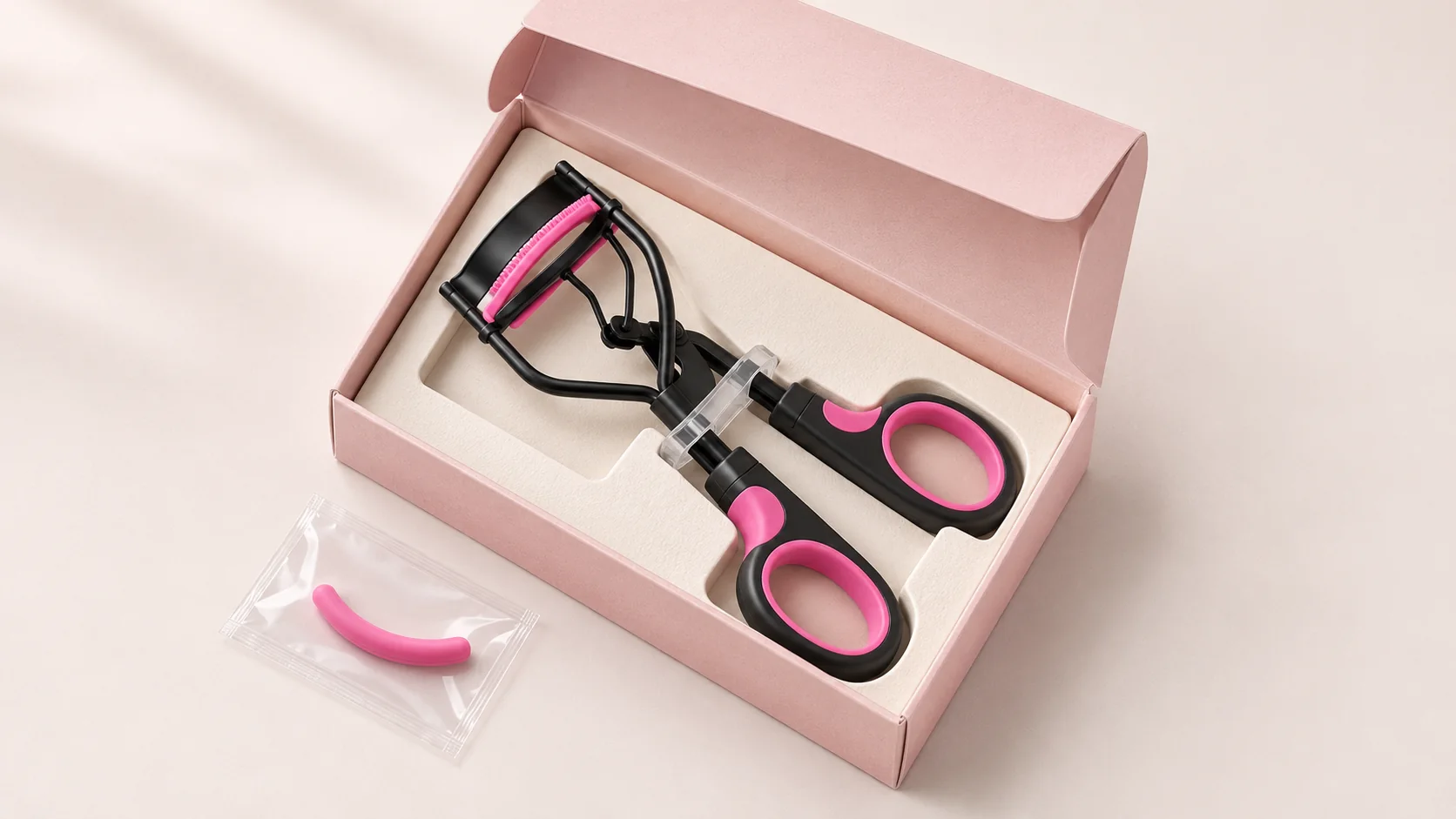
Which eyelash curler packaging suits your sales channel?
| Pack format | When to start here | What can put the sample on hold |
|---|---|---|
| Clear blister on a backing card | Peg display where buyers need to see the tool, its finish or the spare-pad compartment. | The filled card tilts on the intended peg, the blister separates from the card during the agreed check, or the customer has to pull on the curler head to remove the tool. |
| Folding carton with a fitted insert | Shelf retail, branded presentation, or online orders where the pack needs space for artwork or instructions. A window can show a selected area of the tool. | The tool shifts, the closed carton presses a moving part, a window shows the wrong area, or the insert blocks the intended grip. |
| Plain OPP bag or bag with a header card | Individual separation for bulk delivery. A header-card version can serve as a hanging retail pack if the retailer accepts it. | A protruding part punctures the bag, the seal opens, the header fails the agreed hanging check, or the bagged units can contact and mark each other in the shipping carton. |
| Shared tray in a gift set | The curler is sold alongside mascara, brushes or other tools. | A neighboring tool can strike the curler, or taking out one item dislodges the curler or its spare pads. |
If a retailer requires both a peg hole and an unobstructed view, get the hook and facing requirements before drawing the card. If a carton will ship to a shopper, decide whether fulfillment adds a mailer or ships the retail carton as received. That choice determines which assembled package to assess for shipping.
Where should the pack hold the curler?
Measure the exact tool in its agreed packed position. Note the widest and deepest points, protrusions, finish and any retainer. On a marked sample photo or drawing, show the support points, the features to keep clear, and the direction the tool should come out. Ask for a sample with the intended insert or blister shape so you can check all three together.
| Curler design | Where to start supporting it | What to check with the pack closed and during removal |
|---|---|---|
| Classic metal with finger loops, such as E1 | Trial support at the handles or a stable area of the frame away from the hinge. Specify the packed handle position. | Check whether the curling head or hinge takes pressure when the pack closes. Lift by the intended grip and check that the loops clear the insert and contact points leave no new finish marks. |
| Compact fold-out, such as E6 | Locate the housing with the rear lever fully stored. Leave a place to grip the housing. | Check that closing the pack keeps the lever in its stored position and that the lever deploys and returns normally after removal. |
| Integrated-comb, such as BLC-CWB1 | Start at the handle end or another stable area clear of the comb and exposed pivot. | Check the teeth, head and pivot for pressure in the closed pack. Lift by the intended grip through the full removal path to see whether a tray lip catches the teeth. |
Ask for three views of the same revision: the curler seated with its support points visible, a side view at the most exposed feature, and the curler partly removed by the intended grip. For a close fit, have the supplier record the agreed clearance or reference points on the drawing. Use physical samples to check closure and removal. If a finish, grip or component changes the packed shape or the surfaces in contact with the insert, review that version too.
What does the optional retail box include?
BlendCraft lists bag, blister-card and carton directions for the compact E6. BLC-CWB1 has an individual OPP bag as its standard pack, and the printed carton pictured on its product page is quoted separately. For a BLC-CWB1 carton order, confirm whether the bag stays inside the carton, what holds the curler, which pad is fitted, and whether spare pads and packing labor are included. Ask for the quote and sample to show the same configuration. BLC-CWB1 packaging reference.
How should spare pads be packed?
List the fitted pad and loose spare pads separately. Record the compatible part reference and number per retail unit. “Replaceable pad” describes the tool. The parts list, artwork and packing instruction should give the same spare count, including zero when no spare is supplied. For example, Tweezerman specifies three replacement pads for its own Classic Lash Curler. Tweezerman product specification.
A shaped pocket can work if it retains the spare during the agreed handling check. A closed sleeve or small accessory bag can work if the shopper can find it and remove it with the tool. On an opaque carton, have the packing team verify the count before closure. After the handling check, open the pack as a shopper would and verify that every spare is still present and easy to find.
Place one assembled curler with fitted pad [part ID] into [insert position]. Place [count] compatible spare pads [part ID] into [marked compartment]. Verify the fitted pad and count the loose spares before closing the pack.
If a spare escapes its compartment, change the pocket or closure and repeat the handling and opening checks. If the spare part changes, install it on the actual curler and check seating and closure using the eyelash curler QC guide.
How do you approve an eyelash curler packaging sample?
Agree on the sample versions, number of units, handling sequence and acceptable condition before the review. Save photos of the same tools before packing and after removal. Use the checks below to record a decision the supplier can reproduce.
| Check | What to do | Hold approval when |
|---|---|---|
| Close the filled pack | Pack the actual curler with its fitted pad, any spares, the proposed restraint and the intended closure. | The pack needs force to close, visibly deforms, or presses a head, tooth or moving lever. |
| Check retention and display | Run the agreed handling sequence. For peg retail, mount the filled unit on the intended hook. Check orientation, seal or closure, and accessory position. | The tool leaves its seat, the closure opens, the display position misses the retailer's requirement, or a spare leaves its designated compartment. |
| Open the pack | Follow the intended opening method and hold the tool at the intended grip. Compare the finish, pad seating and normal movement with the starting condition. | The tool catches, a spare drops out unnoticed, or the tool shows a new mark or change in movement beyond the agreed acceptance criteria. |
| Check the printed unit | Confirm tool orientation, contents, artwork version, required label copy and barcode on the assembled printed sample. | The printed configuration differs from the agreed contents, a window hides the required feature, or the barcode encodes the wrong item. |
Record which approval you are giving
- Structural sample. An unprinted prototype can establish the support points, normal closure and removal path. Record its materials and any substitutes. Confirm sealing and retention on production-intent materials if the prototype used different stock or a different seal.
- Printed pre-production sample. Use the agreed stock, insert, closure and artwork to verify the finished retail unit. Record the approved sample and packing instructions before bulk packing. Compare the first production-packed units against them, including the SKU label, insert, pad count and opening behavior.
- Shipment configuration. Record the retail unit together with the inner and outer packaging that will travel. Keep the shipping decision open when the agreed assessment or test evidence is pending.
Worked example of a structural hold
In this illustrative comb-curler trial, the carton closes, the fitted pad stays seated and a loose spare remains in its pocket. One comb tooth catches the tray lip during removal by the intended grip. Record the contact point and hold structural approval. Ask the packaging supplier to revise the lip and show the revised part on the same drawing. Recheck normal closing, retention and removal with the same curler and the revised insert. If the change shifts the tool, recheck its visibility through any window and whether the revised layout affects the shipping configuration. If you also source sets with multiple metal tools, the manicure set packaging guide shows how to check whether removing one tool shifts the others.
Copyable packed-sample sign-off record
| Record | What to fill in |
|---|---|
| Tool and contents | SKU, finish and revision. Fitted-pad reference. Loose spare reference, count and position. |
| Pack version | Sample ID, dieline, insert, materials, closure, artwork and applicable packing instruction revisions. |
| Checks and evidence | Intended grip and support points. Agreed check method and pass criteria. Observed result, photos and affected units or variants. |
| Approval scope | Structure, printed retail unit and shipment configuration. Mark each approved, on hold or pending evidence. |
| Follow-up | Owner, revision required, checks to repeat, approver and decision date. |
What should you verify before printing and shipping?
Check barcode data and print quality on the assembled pack. Keep the specified clear margins around the symbol and place it where folds, seams and die cuts leave it readable. Scan the assembled printed sample and match the decoded number to the intended SKU. If the retailer requires a verification grade or report, have the symbol checked with a barcode verifier to that requirement. Ask the brand owner to review the applicable GTIN rule when declared pack contents change. GS1 US barcode placement · GS1 printed barcode quality · GS1 GTIN Management Standard.
Evaluate the version that will actually travel. For store replenishment, specify the retail units per inner and master carton, their orientation, and the separators or cushioning. For direct parcel fulfillment, record the retail unit, quantity per parcel and the final mailer or overbox where used. Agree what damage counts as a failure for the tool, finish and saleable packaging. Where formal testing is required, the buyer and testing provider should select the procedure for the actual route, package and retailer requirements. ISTA 3A is one example for individual packaged products traveling through a parcel delivery system. Record the configuration covered by the assessment and review whether material, insert, pack count or outer carton changes require reassessment. ISTA test procedures · ISTA procedure selection guidance.
What should you send for a custom eyelash curler packaging quote?
Send the intended complete saleable unit or ask for alternatives based on your channel. You can paste the following brief into an inquiry.
Model or reference: […]
Quantity by tool color and artwork version: […]
Destination market, channel and display requirements: […]
Pack format, dimensions or fixture limits, and what must be visible: […]
Fitted pad, spare count and part reference, inserts and instructions: […]
Artwork language, barcode and retailer requirements: […]
Shipping configuration and any testing requirement: […]
Required sample stage, approval evidence and target date: […]
Ask the supplier to quote product, insert, retail packaging, pad storage, setup and packing labor separately where applicable. Confirm the minimum per printed version and whether multiple tool colors can share one carton design. If they can, document how each version will receive the correct barcode label. Use the eyelash curler cost guide to compare complete quotes. If the brief includes an insert or artwork unique to your brand, review BlendCraft’s private label sampling and production process before requesting a packed sample.
Explore BlendCraft's eyelash curler range or send your model, quantity and packaging requirements for a sample discussion.
Buyer questions
Can two eyelash curler models share the same carton?
Yes, if each has a validated fit, the agreed contents and the correct labeling. One outer carton can sometimes be paired with model-specific inserts. Approve each packed configuration and match each SKU to its carton, insert and label in the packing instructions.
Which checks should I repeat when the insert changes?
Repeat the fit, retention and removal checks the revised insert can affect. Check window alignment if tool orientation changes. Review the dieline or printed areas if the outer structure changes. Ask the buyer and testing provider whether the change affects the scope of an existing shipping assessment.
Can an OPP bag be a retail pack?
Yes, where the retailer accepts the format and the filled unit meets its display, retention, labeling and handling requirements. For a hanging bag, review the filled pack on the intended fixture. For shipment, confirm which outer pack will protect the bagged units.
Working across several product lines? Browse the packaging and branding guides.
Continue reading
Related Guides
Custom Eyelash Curler Cost: How to Compare Private Label Quotes
Compare complete retail configurations, identify missing quotation items and calculate first-order spending for mechanical eyelash curlers. Includes an editable worksheet and worked payment examples.
Eyelash Curler Quality Control: A Practical Sourcing Guide
For brands and retail buyers comparing mechanical eyelash curlers: learn what to check in a sample, how to record defects, and which specifications to agree before production.
Makeup Mirror Packaging: How to Choose and Approve a Pack
Compare retail packs for makeup mirrors, turn fit and removal observations into clear actions, and record which product-and-pack version a sample decision covers.
Makeup Brush Packaging Options: A Buyer’s Guide for Private Label Brands
A practical guide to choosing brush packaging, comparing complete-set layouts and recording artwork and sample decisions before bulk production.