Makeup Mirror Packaging: How to Choose and Approve a Pack
Compare retail packs for makeup mirrors, turn fit and removal observations into clear actions, and record which product-and-pack version a sample decision covers.
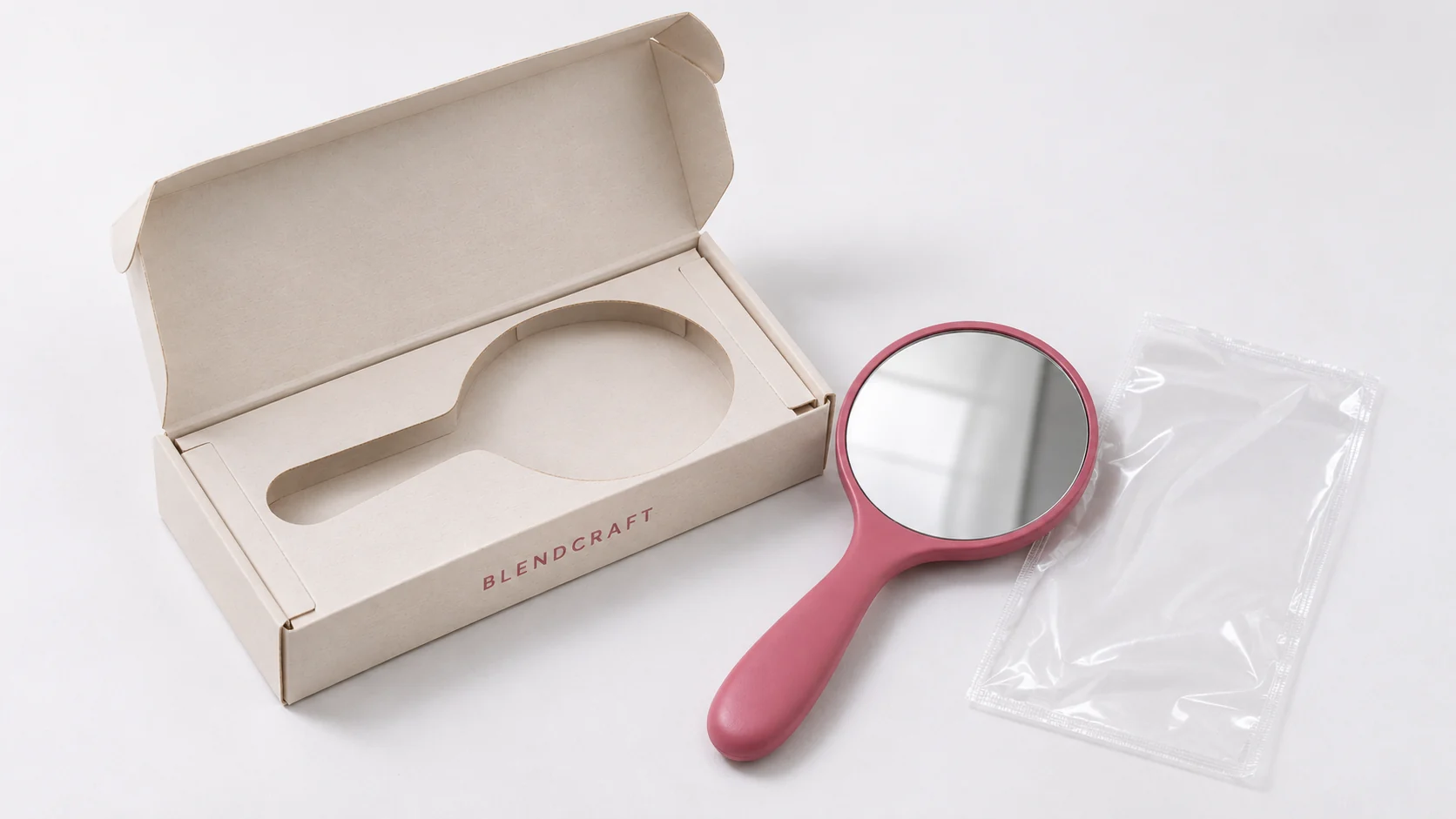
For a handheld makeup mirror order, shortlist a bag when the retail unit needs simple separation, a formed blister when visible positioning is required, or a carton with a proposed insert when an enclosed printed pack is needed. Define the delivery configuration separately, then review fit, removal and the evidence needed to approve each candidate.
These are starting points for sampling. A carton with a covered window can also provide visibility, while a bag can carry printed information. The complete design determines how the mirror is held, what touches it and how it comes out.
This guide helps brands, retailers and importers plan packaging within a non-powered makeup mirror project. It focuses on handheld products, with relevant checks for folding and sliding formats. Use it to prepare a brief, compare proposals and record a clear sample decision.
In this guide
Choose a retail pack around the buyer requirement
Start by defining what the customer buys. One mirror, a two-mirror assortment and a mirror-and-brush set require different layouts. Record the contents of one retail unit, then identify how that unit will be displayed and delivered.
For a visible display, specify what shoppers should see: the reflective face, the back decoration, the handle or the closed housing. If they must see the product without touching it, include that requirement before selecting a window or blister arrangement.
Use the makeup mirror collection to identify the product reference, then shortlist a retail format:
| Buyer requirement | Initial packaging direction | Reason to revise or remove the candidate |
|---|---|---|
| Separate individual units; no independent positioning or rigid display required | Individual bag or sleeve, with further protection defined for delivery | Required orientation or standing display is not provided by the proposed design |
| Show the mirror in a defined position | Formed blister with its backing or closure; alternatively, a covered-window carton with proposed internal support | Contact, visibility, closure or removal conflicts with the brief |
| Enclose the product and provide printed panels | Folding carton, with an insert or locating structure where needed | Closing or removing the product interferes with a designated area |
| Present a gift mirror in a specified opening sequence | Presentation box with a proposed locating arrangement | Appearance is acceptable, but fit, contact or removal remains unresolved |
These directions are candidates for review. Materials, dimensions, assembly and availability are confirmed for the selected mirror.
Is a rigid box safer than a folding carton for a makeup mirror?
A rigid presentation box is not automatically safer. Compare how the complete pack supports the mirror, maintains required clearances and controls contact, then review the evidence for its delivery configuration. A premium-looking outer box can still leave internal movement or removal problems unresolved. Box names alone do not establish a protection level.
Keep the transport unit separate from this comparison. Several boxed mirrors may share a divided outer carton; an individual retail unit may later enter a parcel box. Record who adds that packaging and where. Approving a retail carton for delivery to a distributor does not automatically resolve the distributor's later consumer shipments.
Define the product envelope and contact arrangement
Give the packaging designer the complete mirror in its packing position. Record its maximum length, width and thickness, weight, orientation and any protruding part. Mark the measurement directions on a photograph or drawing.
Keep three sets of dimensions distinct: the product's outer envelope, the assembled pack's usable internal space and the finished pack's external dimensions. An insert, folded tab or closure occupies space inside the box.
A useful product reference is the M1 handheld makeup mirror. The existing mirror cost guide compares its published dimensions with the decorative M6. Their shared overall length and width do not establish a shared packaging fit. For the raised-flower design, the actual maximum thickness and decoration profile still need to be established for the selected sample.
Mark support, contact and removal
Ask the designer to identify where the proposed pack supports or locates the mirror, which materials may touch each surface, and which areas must remain clear. Include the handle, frame, reflective face and any raised decoration.
The arrangement needs to work with the actual construction. A frame or handle is not automatically suitable for any clamping force. Equally, an intentionally specified soft contact layer should be evaluated on its own material and conditions rather than rejected simply because it touches a surface.
Show how the mirror is removed. A finger opening, pull or accessible gripping area needs to be reviewed as part of the structure. Check whether the intended removal path catches a decoration or brings an insert edge across a visible finish.
Make hidden contact reviewable
A photograph of a closed box shows its exterior. It does not establish what happens underneath the lid or behind the mirror.
Request an insert drawing, relevant section views and an assembly explanation for areas that cannot be seen. Where those leave an important question unresolved, ask the designer how a separate development sample could make the arrangement observable. Record the remaining uncertainty as pending evidence.
For folding mirrors, specify the intended packed position of panels and supports. For a sliding or compact mirror, identify the closed housing position. Packaging restraint should follow that agreed position; avoid assuming an opening mechanism can serve as a convenient fixing point.
Review contact materials under defined conditions
If protective film is proposed, identify the film and the surface it will cover. Record the product condition before application, the storage conditions relevant to the project and the intended removal method. Compare the surface afterwards.
Nitto's surface-protection selection guidance includes storage behaviour, changes to the protected surface and peeling among its selection considerations. Apply that principle to material review; suitability for a particular mirror requires its own confirmation.
Which component protects the surface, holds the mirror or cushions delivery?
Give each proposed component a job before comparing its material or price:
- Protective film: a temporary layer on a specified surface. Review compatibility, application and removal; the film's presence does not establish transport protection.
- Bag or sleeve: separates individual units or surrounds a mirror. Check which surfaces it contacts and whether the mirror can move inside it; separation alone does not establish restraint.
- Insert or locating structure: positions the product and defines clearances. Review the actual support points, edges and removal path; a shaped cavity alone does not establish cushioning performance.
- Transport cushioning and outer packaging: form part of the identified shipping configuration. Have the designer or testing provider assess them against the product and distribution conditions rather than applying a universal material thickness.
One component may contribute to several jobs. Record what the evidence establishes for each job; approval of surface contact should not silently approve impact protection.
Turn packing observations into a clear action
Review the actual mirror and pack together. Before assembly, keep a baseline record of the relevant surfaces, decoration and mechanism. Use the same sample identity and agreed observation conditions when reviewing it after removal.
Then follow the intended sequence: place the mirror, assemble any retaining parts, close the pack completely, perform the agreed development checks and remove the product by the specified method. Record the observation before deciding what it means.
| Observation or missing evidence | What to establish | Action to record |
|---|---|---|
| Closing requires pressing a raised decoration or forcing the product into place | Product envelope, contact location and the agreed closure requirement | Revise a confirmed nonconformity; request internal evidence where contact remains unclear |
| An insert edge catches the decoration during removal | Intended gripping point, removal path and relevant requirement | Request a revised opening, location or removal arrangement, then review the affected steps |
| A visible mark appears after peeling a film | Baseline condition, film identity, storage and removal conditions | Compare against the agreed criterion and investigate; do not assign a cause from appearance alone |
| The mirror changes position during an agreed handling check | Required location, check method and before/after positions | Decide whether the change breaches the criterion before changing the restraint |
| A transport report identifies another carton or pack quantity | Current product, component list, packing arrangement and report scope | Keep the current configuration pending while the responsible party reviews the evidence or retest need |
A development observation should produce a named action. “Improve the packaging” leaves too much open. Identify the affected component or location, the required submission and the checks to repeat.
For example, if an insert catches a flower during removal, changing only the printed colour does not address that observation. Request the structural revision and its removal record. If the cause is uncertain, ask for evidence before prescribing a remedy.
Use the makeup mirror sourcing and QC guide for the broader product checks. Here, concentrate on changes associated with packing and unpacking. A handling exercise or fitting photograph is development evidence; describe it by the method actually used.
Record what the packed sample actually approves
Give each decision a scope. Structural fit, printed appearance and delivery performance answer different questions, even when one representative sample supports several reviews. They need not always require three separate sample orders.
A plain structural sample can help resolve fit and removal. The printed assembly adds artwork, labels and finished material appearance. The delivery configuration adds the specified shipping unit and any required verification.
Use three decision states:
- Approved: the necessary evidence for the named stage is complete and meets its agreed requirements.
- Revise and resubmit: an observation confirms a requirement is not met; identify the correction and review scope.
- Pending evidence: a necessary input is missing or the available observation does not support a decision; name what is required.
Pending evidence is a distinct result. It does not establish a defect, and it does not release the configuration for the unresolved purpose.
Keep the decision record usable:
| Record field | What to enter |
|---|---|
| Object and stage | Product sample ID; packaging component list, drawing and artwork revisions; review stage |
| Requirement | The relevant area and required condition, including its source in the brief, drawing or approved reference |
| Method and conditions | Preparation, packing orientation, operation and observation method; any project-specific conditions |
| Observation and evidence | Actual result and evidence reference; identify anything not confirmed |
| Decision and scope | Approved, revise and resubmit, or pending evidence; state which combination and purpose the decision covers |
| Follow-up | Responsible person, required submission, next revision, review tasks and closure date |
For printed packaging, inspect the assembled unit. Check copy, variant identification, orientation and the selected barcode location. GS1 US guidance addresses placement, surrounding clear space and printing considerations. A fold, closure or label should be considered when reviewing the final location.
When something changes, record the affected version. A different insert, contact material, decoration profile or packing orientation can change the checks needed. Have the relevant designer or testing provider assess the impact; neither automatic approval nor an automatic repeat of every check is a useful substitute for that review.
Link the approved pack to its delivery configuration
Describe the route from the packed mirror to the buyer: consolidated delivery to a warehouse, later retail distribution or individual parcel fulfilment. Identify the unit being evaluated, including any dividers, outer carton and quantity inside it.
ISTA's design and testing guidance connects test selection with the actual distribution environment and representative samples. Agree the applicable method and version, product and package acceptance criteria, and required evidence with the buyer or laboratory. The procedure directory distinguishes different distribution settings; one procedure is not a default for every mirror order.
Keep development inspections separate from a formal test sequence where required. Opening a test sample midway can change its condition; follow the selected procedure and arrange separate investigative samples when appropriate.
Match any report to the current product and complete pack configuration. A change in the box, insert, orientation or carton quantity needs an impact review before earlier evidence is carried forward. A test result describes its identified scope and samples.
For complete quotation, packing quantities and shipment calculations, continue to the mirror cost guide. Compare proposals only after identifying what each includes.
Worked example: revise one candidate and keep another pending
Illustrative exercise: the product construction below comes from the published M6 reference. The buyer requirements, packaging candidates and observations are hypothetical teaching inputs, not an order, factory trial or test result.
The M6 flower handheld mirror has a reflective front and a fabric-covered back with a raised fabric flower. In this exercise, the buyer wants one mirror in a closed gift retail pack, followed by individual online delivery.
Assume the buyer and supplier have agreed two structural-review requirements: the closed lid must not press the flower, and the specified removal method must not catch it. These are requirements for this example, not universal performance limits.
| Review item | Candidate A | Candidate B |
|---|---|---|
| Proposed structure | Folding carton with locating structure A1 | Presentation box with locating structure B1 |
| Hypothetical observation | Closing the lid presses the flower, contrary to the example requirement | Open-box photographs show the arrangement, but internal-contact evidence and the full removal record are missing |
| Current structural decision | Revise and resubmit A1 | Pending evidence for B1 |
| Required next submission | Proposed A2 revision explaining space or location changes, with closure and removal evidence | Relevant structural and contact information, observable internal evidence and a removal record |
| Next review scope | Assembly, closure, contact and removal for A2; assess other affected checks | Resolve the missing B1 evidence and determine whether a revision is needed |
| Delivery status | Individual-shipment configuration remains unresolved | Individual-shipment configuration remains unresolved |
The exercise ends with two different actions: return A1 for revision and keep B1 pending. It provides no basis to name a winning box or claim parcel suitability.
A2 is only a proposed revision label. Once submitted, its evidence must be assessed against the agreed requirements. Any later approval should identify that product-and-pack combination and the stage covered. Printing and delivery work can then proceed or remain open according to the project's requirements.
Prepare a brief for a mirror-and-pack quotation
Start with six inputs. Mark an undecided item for discussion rather than filling it with an assumption.
- Product reference: model, drawing, sample or product link.
- Retail contents and quantity: mirrors and other included items per pack; estimated retail-unit quantities and variants.
- Market and display: destination, shelf or hanging presentation, and what must remain visible or enclosed.
- Delivery route: who adds the shipping protection and whether the unit will be redistributed or sent individually.
- Packaging direction: bag, blister, carton or presentation pack, with critical contact or removal needs.
- Branding and timing: artwork status, languages, barcode information and the required project date.
Before approving a stage, add its necessary details: complete product envelope, sample identities, contact and locating arrangement, component list, drawings, artwork, applicable checks and responsible reviewers.
Ask each supplier to describe the same complete retail unit. Identify the mirror, individual protection, insert or restraint, printed box, labels and assembly. Confirm separately whether outer-carton work or required verification is included. Packaging minimums and unused packaging also need written treatment; the cost guide covers their budget implications.
Use the mirror packaging brief and sample decision record to compare candidates and keep open actions together. The essential decisions are also explained above.
BlendCraft reviews packaging alongside the selected makeup mirror and sales channel. Through our OEM and private label project process, product-and-pack proposals are reviewed for feasibility, sampling and quotation. Send your mirror packaging brief with the six inputs above to start that review.
Method and source scope
The selection rules, action tables and decision record are editorial purchasing tools. The worked exercise is hypothetical. Linked product pages establish the referenced constructions, not the performance of a proposed pack. Nitto, GS1 and ISTA support the specific material-review, barcode and testing considerations linked above. Agree the actual requirements and evidence for your mirror project.
For other beauty-tool projects, continue with makeup brush packaging, makeup sponge and powder puff packaging, or hair brush packaging.
Working across several product lines? Browse the packaging and branding guides.
Continue reading
Related Guides
Makeup Mirror Sourcing & Quality Control Guide
A buyer-focused guide to makeup mirror formats, reflection quality, frame and hinge checks, protective packaging, sample approval and production QC.
Custom Makeup Mirror Cost: How to Compare Supplier Quotes
Compare mirror specifications, quotation scope and required charges before calculating a first-order budget. Includes a worked example and an editable comparison sheet.
Hair Brush Packaging Options: A Buyer’s Guide for Private Label Brands
Choose retail packaging for manual hair brushes, compare fixing and bristle clearance by construction, and approve a documented brush-and-pack sample.
Makeup Brush Packaging Options: A Buyer’s Guide for Private Label Brands
A practical guide to choosing brush packaging, comparing complete-set layouts and recording artwork and sample decisions before bulk production.