Makeup Sponge & Powder Puff Packaging: A Buyer’s Guide
Choose retail packaging for makeup sponges and powder puffs, compare complete quotations, and use practical worksheets to record packed-sample approval.
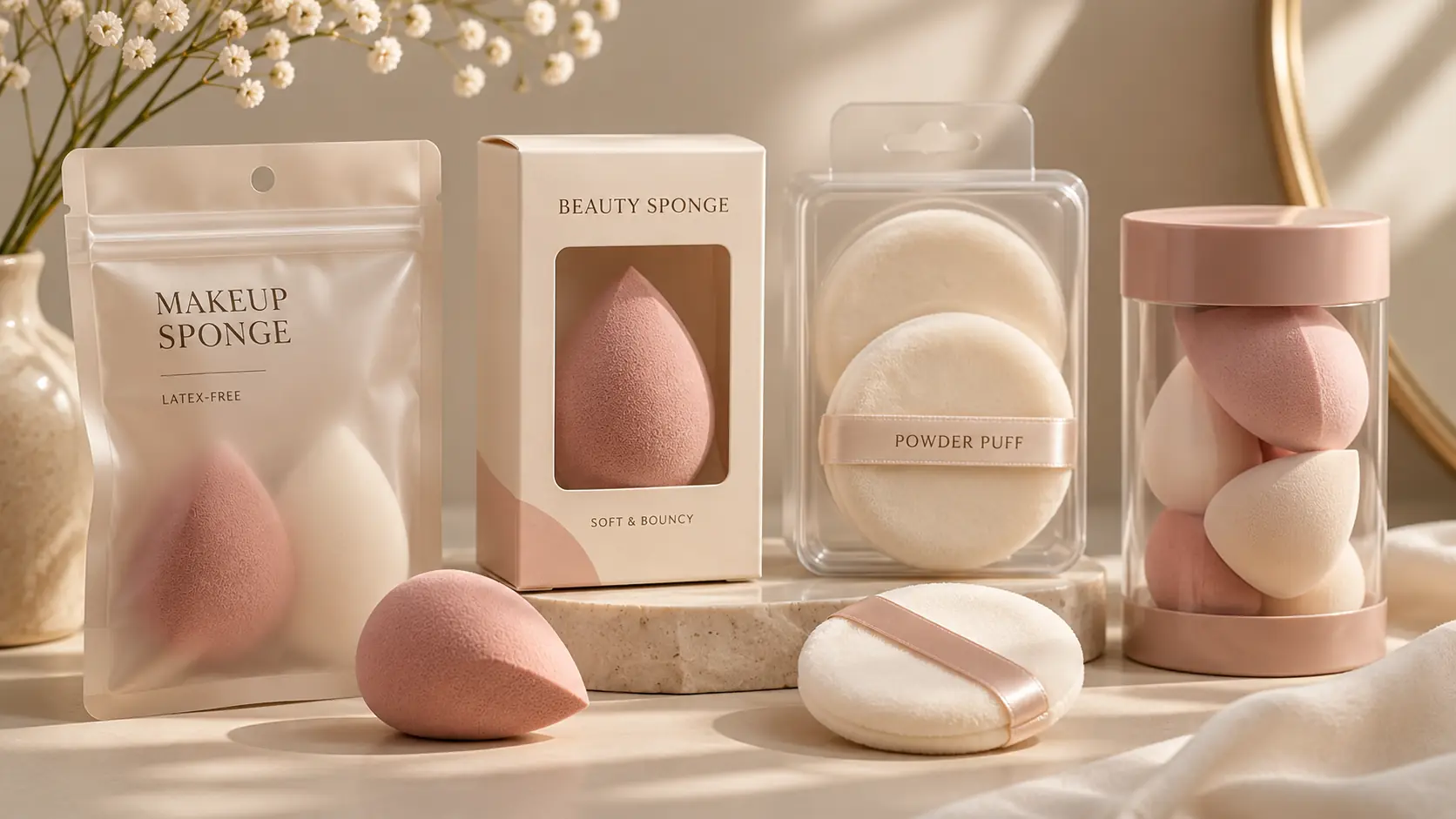
For makeup sponge packaging, compare a bag or pouch with a folding carton against the same contents and sales display. For powder puff packaging, settle the pack count, ribbon positions and stacking direction before choosing the structure. A window, hanging feature or insert can be added to a suitable structure; each needs its own specification and sample review.
We start with what your customer will receive: one sponge, a puff multipack or a mixed kit. From there, we define the complete layout, compare the work included in each quotation, and record what the artwork and packed sample actually approve. A box reference helps us understand the direction; the selected tools still determine the fit.
In this guide, we explain how we would approach that brief with you. We focus on packaging supplied with unused tools for brands, retailers, importers and distributors. Formula-filled powder containers and after-use storage cases need their own specifications.
In this guide
How do you choose makeup sponge and powder puff packaging?
Start with how the complete retail unit will be displayed and handled. We use this route to build a shortlist, then check the chosen configuration with the actual tools:
- One sponge: compare a bag or pouch with a folding carton. Define shelf, peg or ecommerce presentation before adding a header, hanging feature or window.
- A puff multipack: compare a pouch and carton after choosing stacked or side-by-side placement and ribbon direction.
- A mixed kit: map every component first, then compare a divided carton or another supported layout. Include any insert in the fit review and quotation.
- A shaped display or gift presentation: consider a formed blister or rigid box only when its display, opening and assembly requirements justify reviewing that additional structure.
| Structure | A useful starting point | Include in the proposal | Review with the complete contents |
|---|---|---|---|
| Bag or pouch | A single tool or defined multipack; a label or header card can provide the required information and display feature | Film or other material, usable dimensions, closure, printing, count and any header card | Clearance around seals and closures, product contact, visibility and removal |
| Folding carton | A printed retail unit for a shelf or specified peg display | Board, assembled dimensions, closure, print version and any window or insert | Layout, lid/flap contact, opening, display orientation and removal |
| Formed blister with backing or another closure | A shaped pack presenting tools in assigned positions | Polymer, formed structure, backing, attachment and opening arrangement | Retention, contact points, opening and access to each tool |
| Rigid presentation box | A collection whose merchandising brief calls for a structured box and defined opening sequence | Board and wrapping, insert, lid or closure, assembly and full assortment | Lid clearance, movement, complete-set appearance and removal |
A window, hanging feature and insert can belong to the same carton. We would list these separately so the quote identifies the complete configuration. For a window, specify whether the opening is uncovered or covered by a named film. For hanging packaging, supply the channel's display requirements and check the filled sample on the intended hardware.
For ecommerce, also define the shipping package surrounding the retail unit. Ask for the packed arrangement, carton count, external dimensions and gross weight before comparing transport options.
Put the material behind the description
“Clear box” or “OPP bag” is a useful reference, but we need more detail to compare proposals:
| Component | Record in the specification | Review on the packed sample |
|---|---|---|
| Flexible bag | Material/grade, layers where used, thickness, printing side and closing method | Usable space, seams, closure, contact and opening |
| Carton and paper support | Board grade, basis weight and caliper where specified, coatings, folds and cut edges | Support positions, closure, edge contact and assembled appearance |
| Window or formed insert | Polymer, thickness or formed-wall specification, dimensions and attachment | Visible area, retention, contact points and removal |
There is a practical reason to ask about the film construction. Jindal Films describes Bicor HND as a heat-sealable BOPP film, while Bicor MB100 is a non-heat-sealable OPP outer film for a laminate. Both are transparent. We would clarify which material and layer provides each function before accepting an equivalent-material proposal. These grades illustrate the question; the finished pack still needs project-specific review.
If you want paper packaging or an environmental claim, identify the components and supporting documentation covered by the request. Include the window, coating, insert and closure in that review.
What must sponge and powder puff packaging accommodate?
For a three-dimensional sponge, we focus on orientation and the surfaces touching the pack. For a fabric-covered puff, we also need the edge construction, ribbon position and arrangement of adjacent puffs.
| Product | Details we need in the brief | Questions to resolve with the sample |
|---|---|---|
| Makeup sponge | Selected shape, dry dimensions, tip and flat-face positions, orientation and product-logo location | Where does the pack touch it? Does closing the pack change its shape? Can it be removed without catching the tip or scraping a surface? |
| Powder puff | Outline, thickness, working face, edge construction, ribbon and branding | Where does the ribbon fold? Does it catch under a flap or in a seal? How do the faces and edges sit against neighboring puffs? |
We would record the packing direction for a puff multipack, including any separator. “Three puffs per bag” does not settle whether they are stacked, arranged side by side or packed in another layout. The chosen direction becomes part of the sample and packing instructions.
During review, record any marks, visible transfer, loose material or shape changes with the contact location and observation conditions. Those are findings to compare with the agreed requirement. A proposed separator or revised fold needs its own review before the issue can be closed.
If you are still selecting the tools, compare our makeup sponge and powder puff formats before fixing the pack.
Define the supplied condition
We recommend developing the outgoing pack around the agreed supplied condition and measured product state. Use the sponge's dry packing dimensions where the product is supplied dry. Keep its wet-use expansion and consumer care instructions as separate requirements.
A reusable case included in the kit adds another component to evaluate. Define whether it is intended for transport, dry storage or another use, along with the relevant care and performance requirements. A resealable retail pouch by itself does not establish suitability for a damp, used sponge, sterility or antibacterial performance.
How do you confirm packaging dimensions and product fit?
The pack size should follow the actual arrangement, including supports, closures and removal space. We recommend naming the reference for every dimension so the designer, supplier and buyer are discussing the same object.
| Measurement | What it describes | What we use it to decide |
|---|---|---|
| Product dimensions | The selected item and version, measured state, directions and complete envelope | What must fit, including the ribbon arrangement where relevant |
| Usable internal dimensions | Space available after folds, inserts and other internal features are fitted | Loading, support, closure and removal |
| Finished pack external dimensions | Outside dimensions of the closed, filled retail unit | Shelf space and grouping |
| Shipping-carton data | External dimensions, retail packs per carton and packed gross weight | The actual transport configuration |
What size box fits a 40 × 60 mm sponge?
Two product measurements do not establish the required box size. Our P3 Flat-Edge Makeup Sponge lists 40 × 60 mm; we would confirm the measurement directions, remaining dimension, dry condition and orientation with the selected sample. The complete layout, supports, closure and removal space then need checking in the proposed usable interior.
Our Triangle Powder Puff lists 45 × 55 × 10 mm and a ribbon finger strap. For a multipack, check the ribbon and complete stack in position. The nominal puff thickness alone is insufficient to approve the cavity depth.
A fit review we recommend
- Identify the product samples and packaging revision. List substitute materials or unfinished features.
- Load every component in its proposed position, including separators, labels, cases or leaflets that occupy space.
- Close the pack using the intended assembly method. Record pressure points, interference and any difficulty closing it.
- Reopen it and remove the tools as intended. Note snagging, movement and contact with edges or supports.
- Photograph the packed layout and unpacked products. Where compression matters, agree the packing duration, conditions and observation times before assessing the result against a suitable reference.
We would evaluate a smaller pack with this same complete configuration. Softness or an immediate rebound after hand squeezing does not establish the outcome after prolonged packing. Our makeup sponge QC guide covers the product-comparison and inspection questions in more detail.
What should a sponge or powder puff packaging quote include?
Ask each offer to identify the finished deliverable: empty packaging, erected boxes or fully packed retail units. Then compare the same tool configuration, material, artwork and assembly scope.
For powder puff packaging, write down individual puffs, puffs per retail pack, completed packs and purchased packaging components separately. Do the same for sponges and mixed sets. Quantities by product, color and print version should reconcile to the finished assortment.
Illustrative count: 2,000 packs with three puffs each require 6,000 puffs. If a hypothetical packaging purchase requires 2,500 boxes, 500 remain beyond the planned packs. These are assumed quantities, not BlendCraft MOQs. For a mixed-color pack, each color also needs its own allocation.
Copy this comparison table
For Offer A and Offer B, record included / separately charged / pending, followed by the unit, purchased quantity, amount and specification reference where applicable. Keep pending items visible and check for charges already bundled into another line.
| Area | Requirement to align | Offer A | Offer B |
|---|---|---|---|
| Tools and product logos | Exact references, quantities, colors and decoration locations | ___ | ___ |
| Main pack | Structure, material specification, dimensions and supplied assembly state | ___ | ___ |
| Printing and finishing | Artwork versions, print method, colors, coating and decoration | ___ | ___ |
| Window and display features | Film/opening, attachment, hanging feature and channel requirement | ___ | ___ |
| Inserts and separators | Material, layout, count and contact surfaces | ___ | ___ |
| Samples and revisions | Structure, print and complete packed samples; revision and dispatch scope | ___ | ___ |
| Tooling and setup | Work actually needed, deliverable, ownership and reuse terms | ___ | ___ |
| Assembly | Loading, folding, attachment, closure, labels and any supplied leaflet | ___ | ___ |
| Transport packaging | Inner grouping where used, cartons, quantities and marks | ___ | ___ |
| Extra packaging purchases | Minimum by version; surplus quantity, ownership, storage and handling | ___ | ___ |
| Commercial scope | Currency, quote validity, delivery boundary, exclusions and timing milestones | ___ | ___ |
An offer saying “logo and packaging included” still leaves the logo location, packaging specification and packing work to confirm. We suggest sending this clarification:
Please confirm the contents of one completed retail pack and state the unit used for your price. Identify the product and packaging logos, material specification, insert, labels, assembly and transport cartons included. Please list any additional purchases, setup charges and pending items separately.
Download the quotation comparison worksheet (TXT)
What determines packaging price and MOQ?
Compare the specified material, structure, purchased quantity, print versions, setup work and assembly before comparing the price per retail pack. For custom powder puff packaging, a quote per puff can describe a different deliverable from a quote per completed multipack.
Confirm product and packaging minimums independently, including the minimum for each color or print version where it applies. For a mixed kit, check every component's allocation alongside the shared pack requirement. We would ask for a revised quote when one of these inputs changes; a generic price range would not establish the cost of your configuration.
To request comparable offers, copy the packaging brief below and identify any decisions still open.
Include the full required surplus-packaging purchase in the spending record, with its management terms. Before reusing stored components, check the product, artwork, structure and condition against the new order. The makeup sponge cost guide and powder puff quotation guide provide the broader budget calculations.
What artwork is needed for custom sponge and puff packaging?
For custom makeup sponge packaging, we recommend settling the structure before preparing final artwork. A dieline is the flat layout of the pack's cut, fold and related structural features. Its sheet dimensions describe a different object from the assembled cavity.
Prepare these items for the design and print review:
- Structure: dieline filename and revision, dimensions, panel direction, window, hanging feature and insert drawing where used.
- Brand assets: usable logo files, product names, final wording, pack count, language versions and any printed instructions.
- Color and finish: material-specific references, intended print approach, coating and decoration areas.
- Printer requirements: file format, bleed and safe areas for the actual job.
- Identification: approved product data, required barcode or other code, position and intended printed size; check any linked destination.
- Approval scope: the copy, layout, materials, colors and finishes represented by the particular proof.
Esko's packaging prepress guidance explains why the dieline version and artwork around cuts and folds need checking. We would obtain the printer's job requirements rather than assume a universal bleed or text clearance.
Review the assembled orientation as well as the flat file. If the design shows a ribbon logo through a window, check that the actual packing direction presents that logo as intended.
Approve the color on the relevant material
Pantone explains that material can change color appearance. We recommend identifying the reference and approval basis separately for the sponge or puff, ribbon and printed pack, then reviewing the relevant physical samples together. Record which material and finish each approval covers.
Reserve and check the required code area
Where a barcode is specified, follow the selected symbol's requirements for size, proportions, contrast and quiet zones—the clear areas around it. GS1 US's printing guidance addresses these decisions; GS1 UK's placement guidance identifies interfering features such as folds and seams.
If printed-barcode verification is required, agree the scope and keep the report. GS1 describes a compliant verifier measuring symbol parameters and issuing a grade. A phone scan records a different check.
Confirm applicable wording, language, identification and material requirements with the channel contact and appropriate market specialist before artwork release. We would keep any unresolved environmental or hygiene claim open until its supporting information is available.
How do you approve packaging samples before production?
We recommend separate approvals for the structure, represented print and complete packed sample. Each approval should identify its version and the questions it resolves.
| Sample or assessment | What it can help approve | What remains outside its scope |
|---|---|---|
| Structural sample | Loading, layout, usable space, supports, closure and removal | Materials, print or finishing not represented |
| Artwork or printed sample | Represented copy, orientation, color and finish on the stated material | Unrepresented physical features and full-pack fit |
| Complete packed sample | Selected tools, packaging components and assembly together | Storage or distribution conditions not covered by the review |
| Transport-packaging assessment | The specified configuration under the chosen method | Other conditions or configurations |
For transport testing, select the method around the distribution task. ISTA's procedure overview distinguishes screening and simulation approaches. Keep the tested configuration, method, requirements and actual report together; an informal drop or visual check is not an ISTA test.
Keep a usable sample approval record
Record header: project/SKU; product sample IDs and versions; complete contents and count; structure revision; artwork revision; actual materials and substitutions; insert/separator revision; packing arrangement; sample ID; reviewer; review date.
We recommend agreeing the check method and acceptance requirement separately before reviewing the sample. Use this table as a project record:
| Check | Method and conditions | Agreed acceptance requirement | Actual result and evidence | Decision/action |
|---|---|---|---|---|
| Contents and versions | Count tools and match references, colors and versions | Contents list/version: ___ | Count, photo or sample ID: ___ | ___ |
| Dimensions and layout | Record state, directions, usable space and loading positions | Drawing/fit requirement: ___ | Measurements and layout photo: ___ | ___ |
| Closure and removal | State closing, opening and removal sequence | Handling/function criteria: ___ | Interference or access observations: ___ | ___ |
| Contact and appearance | Record locations, packing conditions and observation times | Appearance/contact reference: ___ | Findings and photo/sample IDs: ___ | ___ |
| Puff ribbons and stacking | Use the full count and defined fold/stack direction | Ribbon, edge and access criteria: ___ | Position and removal evidence: ___ | ___ |
| Artwork and identification | Compare actual-size artwork and represented print; cite required verification | Artwork, color and code requirements: ___ | Proof IDs, observations and reports: ___ | ___ |
| Assembly and shipping pack | Compare grouping, labels and carton configuration; cite separate assessments | Packing specification: ___ | Photos, counts and report IDs: ___ | ___ |
Mark each decision Accept, Revise or Open, with an action owner and next review date. Add the final approver and approval date. This is a development record; batch sampling and standardized testing need their own agreed plans.
Download the sample approval record (TXT)
If a ribbon catches under a flap, for example, record the location and sample ID, specify the proposed change, and review the revised complete pack. We recommend authorizing production only after the required open items are resolved and the released product, structure, artwork and assembly versions are named.
Three buying scenarios: one sponge, puff multipacks and mixed kits
The retail references below are real published products. Our proposed briefs are illustrative project directions, with fit, feasibility and quotation still to be confirmed.
1. One sponge: compare the display task before the finish
Beautyblender's New Bio Pure page describes carton packaging made from plastic-free FSC-certified papers. This is a specific material statement to investigate when developing a paper-packaging brief.
For a proposed single-P3 project, we would define the sales channel and complete measured envelope first. For peg display, compare a bag with a header card and a hanging folding carton. Ask both quotes to cover the same display task, printing, assembly and transport pack. The sample review would focus on sponge orientation, tip contact, hanging arrangement and removal. Material claims require documentation for the proposed components.
2. Three puffs: specify the ribbons and arrangement
e.l.f. Halo Glow Pinkie Puffs is a published three-piece format with mini velour puffs and satin bands. Its count and attached grips are useful reference points; a different puff size needs its own layout.
For a proposed three-puff pack, we would ask for the selected puff reference, color split, ribbon-logo direction and sales channel. Compare a pouch and carton using defined arrangements, with any separator included in the quote. Review the complete count, folded ribbons, edge contact, working faces and access to each puff before approving the pack depth.
3. A mixed kit: list each component before designing the box
Real Techniques' official collection page describes a set pairing its Miracle Complexion Sponge with a dual-sided powder puff. It provides a real assortment reference for two different applicator constructions.
If your proposed kit instead contains one sponge and two puffs, record that separate configuration explicitly. We would clarify the front view, component positions, depth and accessories, then compare a divided carton with another supported layout. Quote each tool allocation, shared packaging, insert and assembly. Review lid clearance, contact between components, visibility and individual removal with the full set.
If brushes are added, our makeup brush packaging guide covers their layout and contact questions.
Send us your packaging brief
You do not need a finished dieline to start a discussion. Send the details you have and mark open decisions. We can review the selected tools and packaging direction through our OEM and private label project process.
BUYER WORKSHEET 8 FIELDS
Your packaging project brief
Fill in what you already know. Leave unresolved details blank so they remain visible in the conversation.
Products & quantities
Retail & packaging
Artwork & approval
Nothing is submitted automatically. Copy or download your notes when you are ready to share them with a supplier.
As the proposal develops, add measured product dimensions and orientation, materials, internal layout, channel specifications, artwork versions and sample requirements. Keep the final approval record attached to the agreed configuration.
We can help clarify what needs to be quoted and sampled. Feasible materials, quantities, charges and timing are confirmed for the selected project.
Working across several product lines? Browse the packaging and branding guides.
Continue reading
Related Guides
Private Label Makeup Sponge Cost: How to Compare Supplier Quotes
A buyer’s guide to makeup sponge cost drivers, piece-versus-pack pricing and supplier quote comparison, with a worked example and a reusable brief.
Custom Powder Puff Cost: How to Compare Private Label Quotes
A buyer’s guide to powder puff specifications, ribbon branding, packaging minimums and comparable first-order budgets.
Makeup Sponge Quality Control Checklist for Buyers
A buyer inspection guide to approved samples, dry and wet measurements, color transfer, cleaning, packaging and traceable lot decisions. Includes an editable inspection record.
Makeup Brush Packaging Options: A Buyer’s Guide for Private Label Brands
A practical guide to choosing brush packaging, comparing complete-set layouts and recording artwork and sample decisions before bulk production.