Custom Makeup Mirror Cost: How to Compare Supplier Quotes
Compare mirror specifications, quotation scope and required charges before calculating a first-order budget. Includes a worked example and an editable comparison sheet.
By BlendCraft
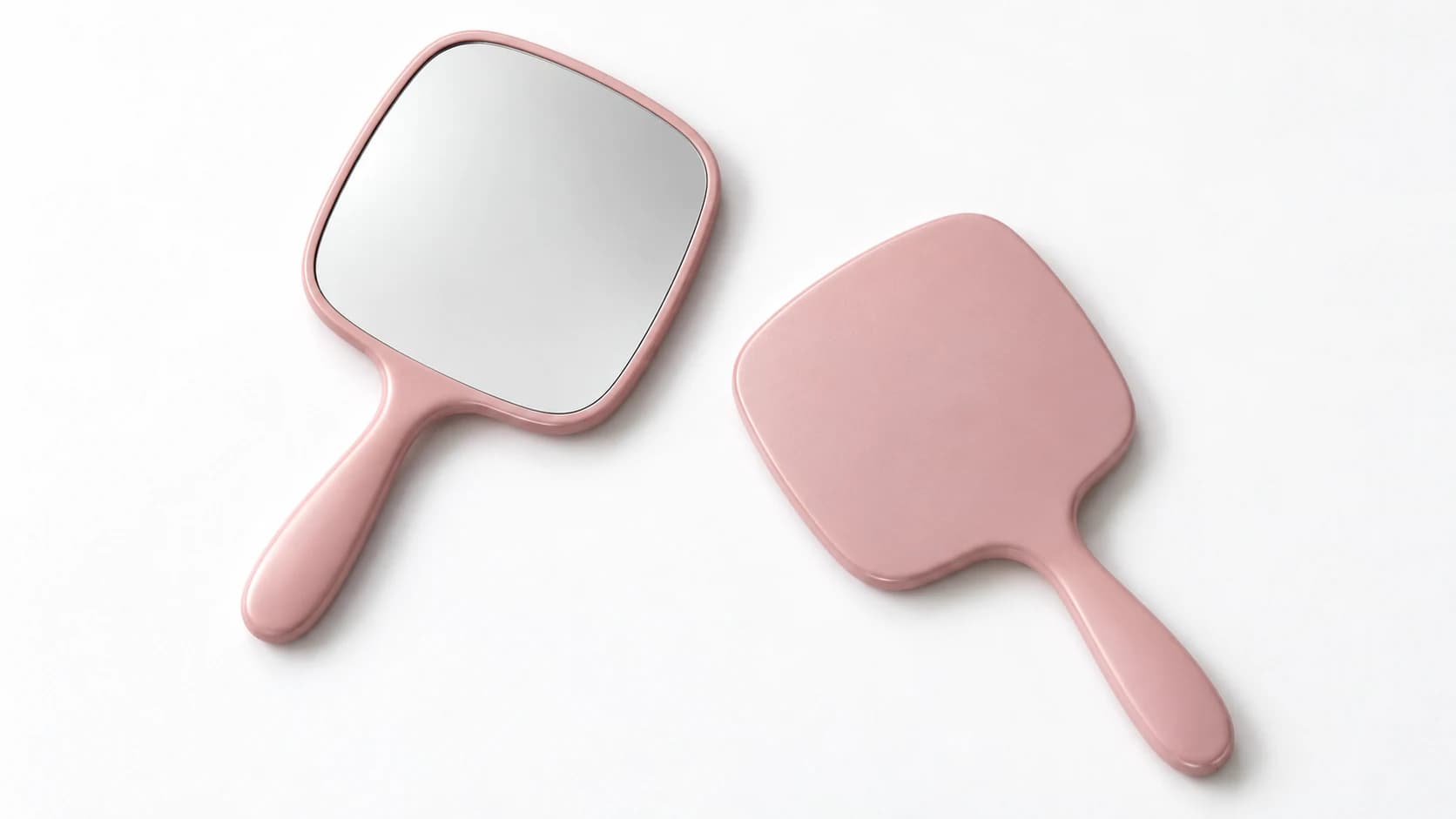
Custom makeup mirror cost depends on the viewing area, mirror material, frame or housing, moving parts, finish, logo, order allocation and protective packaging. To compare supplier quotes, define the same finished product and quantity first. Then add required charges outside the unit price, including development work and any packaging you must buy beyond the current order.
This guide helps beauty brands, retailers and importers prepare an enquiry or review quotations for non-illuminated mirrors. Handheld examples anchor the specification review; compact, folding/tabletop and slider formats have additional fields. LED and battery-powered mirrors need a separate brief.
Use this as a quotation method, rather than a factory price list: no comparable supplier-price dataset was collected. All calculation examples are fictional. You can use the editable quote comparison sheet or the records in the article to review your own offers.
| What you need to decide | Start here |
|---|---|
| Two similar-looking mirrors have different prices | Match the specifications, including viewing area and frame material. |
| A new shape or mechanism may need development | Separate tooling from decoration. |
| The lower unit price may hide extra purchases | Follow the first-order calculation. |
| You want to send an enquiry now | Copy the six-field mirror brief. |
Choose the quotation route and price quantity
Budget from a specified mirror at its actual order quantity, with the delivery boundary written beside the total. A logo on an available design and a newly developed housing are different purchasing projects, even when both are called “custom.”
| Starting route | What the supplier should identify | What belongs in the budget review |
|---|---|---|
| Existing model with selected branding | Model reference, available construction, finish and logo scope | Priced mirrors, samples, decoration setup and defined packing |
| Existing model with changed components or presentation | Every changed material, finish, mirror insert, attachment or pack | Revised unit price and any additional sampling, setup or development |
| New shape or mechanism | Drawings, components, tooling proposal and approval stages | Development charges, tools, trials, approved production version and packing |
Use the makeup mirror formats for private label projects to choose a starting reference. Ask the supplier to identify which parts of that reference are available and which changes need review. An existing design does not automatically mean ready stock, zero setup fees or exclusive use.
Do not multiply a headline “from” price by your order quantity
The minimum order and the quantity qualifying for the lowest advertised price can differ. For example, Sense2's compact-mirror collection distinguishes its volume “from” price from entry-quantity pricing and quotes setup and freight separately. This illustrates a listing convention, not a factory-price benchmark.
Request the unit price for your exact model, quantity, finish, artwork and packing. A stock-color, logo-only offer and a custom-color production run need separate scope confirmation. Keep first-order spend, recurring unit charges and payment timing separate.
Which mirror specifications must match before comparing prices?
Match the reflective part and its surrounding construction separately. A metallic-looking finish does not identify the frame material, and the outside dimensions do not establish how much viewing area the buyer receives.
| Specification | Record in the common brief | What to ask the supplier to price |
|---|---|---|
| Finished format and purchase unit | Complete handheld, compact, tabletop or slider product; contents per retail unit | One finished product or itemized set, with both reflective faces included where specified |
| Dimensions | Overall size, visible viewing area and thickness; open and closed sizes where applicable | The same measured version; identify any new insert or housing work needed for a size change |
| Mirror insert | Material, dimensions, thickness where specified, number of faces and viewing function | The specified insert and any separately identified alternative, including sampling work |
| Frame and housing | Actual material, components, handle and finish | Existing body versus changed body, with development charges separate |
| Moving parts and retention | Hinge, closure, stand or slider; attachment reference | Complete parts and assembly, plus agreed evaluation work for a changed mechanism |
| Surface, decoration and logo | Component colors/finishes, artwork, positions, size and application method | One versus multiple logo positions, per-unit decoration and any setup by artwork/color/location |
| Packing and quality scope | Retail contents, protection, labels, cartons and required checks | The complete packed unit, required surplus components, and separately charged tests or inspection |
A real example: the same dimensions, different construction
Two published BlendCraft handheld mirrors illustrate why dimensions alone are insufficient:
| Published product reference | Overall size / viewing area | Body and back construction | Listed MOQ |
|---|---|---|---|
| M1 custom handheld makeup mirror | 10 × 17 cm / 6 × 6 cm | One-piece ABS body; standard reference has a silver electroplated finish | 1,000 pcs |
| M6 3D flower handheld mirror | 10 × 17 cm / 6 × 6 cm | ABS body; fabric-covered back and adhesive-bonded raised fabric flower | 3,000 pcs |
Both pages identify single-sided float-glass mirrors. Their back construction, decoration and listed minimums differ; these facts do not establish a price or performance ranking.
For M1, the silver appearance is a finish on ABS; it does not make the body metal. For M6, the raised decoration introduces a separate appearance and attachment reference. Specify which construction you want before asking what a custom handheld mirror costs. The linked model terms were checked on October 31, 2026; confirm the selected version in the project quotation.
Worked example: a lower unit price, but a higher first-order cost
Fictional calculation, not a BlendCraft quotation or a market price estimate. Assume 1,000 identical non-illuminated handheld mirrors, one color and one artwork, with the same approved mirror insert, body, finish, retail box, protective insert, assembly and inspection scope. No new tooling is required. Both offers cover packed goods ready for collection at the same named address; onward freight, insurance, import charges and destination costs are excluded.
Quote A separates the mirror and retail packing. Quote B includes that same packing in its unit price. In A, the required USD 0.25 packing extra comprises a USD 0.14 printed box, USD 0.06 protective insert and USD 0.05 packing work. Its printed-box minimum is 1,500, so 500 extra empty boxes must also be purchased at USD 0.14 each. B has no additional packaging purchase for this example.
| First-order line, USD | Fictional quote A | Fictional quote B |
|---|---|---|
| Complete mirrors ordered | 1,000 | 1,000 |
| Main unit price per complete mirror | 1.10 | 1.38 |
| Required unit extras outside main price | 0.25 | 0.00 — same packing included |
| Unit-priced amount for the order | 1,350.00 | 1,380.00 |
| Additional sampling / setup covering the agreed scope | 120.00 | 100.00 |
| Required unused printed-box purchase outside unit charges | 70.00 | 0.00 |
| Applicable confirmed credits | 0.00 | 0.00 |
| First-order comparison subtotal | 1,540.00 | 1,480.00 |
| Planned spend per ordered mirror | 1.540 | 1.480 |
Quote A: 1,000 × (1.10 + 0.25) + 120 + (500 × 0.14) = USD 1,540.
Quote B: 1,000 × 1.38 + 100 = USD 1,480.
A's lower main unit price leads to USD 60 more first-order spend within this scope. A also leaves 500 purchased empty boxes as inventory. Their possible later use does not remove the present cash requirement or establish a reorder saving.
For one configuration:
First-order comparison subtotal = quantity × (main unit price + required unit extras) + additional order charges + required excess-component purchases − applicable confirmed credits
For multiple models or colors, calculate each line at its actual quoted quantity and price. Add genuinely shared charges once. Record a deposit against the invoice it pays; it is not another project cost. Keep an unconfirmed sample credit pending.
Only finalize the comparison when required amounts are resolved. A blank charge field is not a confirmed zero. If a required test fee is still open, label the known subtotal provisional rather than selecting the cheaper supplier from an incomplete budget.
What changes compact and folding mirror costs?
A custom compact mirror cost comparison needs a defined shell, mirror-face arrangement, hinge, closure and pack. “Double-sided” does not say whether both faces have the same viewing function. Record each face separately, including any requested magnification, and approve it on the selected size.
For a folding tabletop mirror, identify the panel layout, hinge and support behavior, open footprint and closed dimensions. The foldable tabletop mirror reference is a starting design direction; its final materials, dimensions, quantity and timing require project confirmation.
A changed mirror face, housing, hinge or attachment creates a separately reviewed alternative. Record what changed, request its complete price and evaluate the selected sample rather than assigning a standard percentage surcharge to a material name.
When does a custom mirror need new tooling?
Changing an existing mirror's decoration can involve artwork setup and samples without changing its body tool. Changing the outline, handle, panel arrangement, housing fit or opening mechanism needs a manufacturing review to identify any tool modification, new component tool or fixture.
A molded-in logo is also a structural detail to review; do not assume it uses the same route as printed artwork. The OEM and private label development process is the next step when the required changes go beyond the available version.
Ask the supplier to list the affected components, the work covered, the trial sample, approval conditions and the charge basis. Clarify the agreed ownership, access, maintenance, later use and any exclusivity or transfer arrangements separately.
Protolabs' injection-molding guidance explains how geometry, undercuts, cosmetic requirements and mold design can affect molded-part costs. That is process context, not a price list for mirror tools.
Fictional allocation example: a separately invoiced USD 900 tool allocated over 1,000 mirrors contributes USD 0.90 per mirror to an internal first-order view. Allocating it over 3,000 forecast mirrors gives USD 0.30 per mirror, but the agreed USD 900 invoice still requires USD 900. The larger denominator does not reduce the invoice or establish future sales.
Count tooling once. If it is already recovered in the quoted unit price, do not add the same charge again. Paying for a tool also does not, by itself, establish the agreed design-use rights.
How do MOQ, colors and packaging minimums affect the budget?
Write down the minimum's grouping: per model, color, finish, artwork or another confirmed production combination. A product page listing “1,000 pcs” does not by itself establish whether two colors can be pooled. The M1 and M6 minimums above are model references, not a universal mirror MOQ or a per-color commitment.
Fictional quantity example: you request 500 black mirrors and 500 pink mirrors. If the quotation specifies 1,000 pieces per color, the 1,000-piece total does not meet it. Keeping both colors at that minimum requires 2,000 mirrors; reducing the range to one color is a different order plan that needs repricing.
Packaging can have a separate minimum. If you need 1,000 retail units but must purchase 1,500 printed boxes, record the 500 unused boxes and who pays for them. Confirm ownership, storage, identification and the handling of later artwork changes.
Check how the box cost is presented. If the price for the 1,000 packed mirrors already covers the boxes used now, add only the required unused balance outside that price. If the supplier separately invoices all 1,500 boxes, do not also add 1,000 boxes again through a unit extra. The worked example above uses the first approach.
How should packaging protection and freight be compared?
Compare what happens inside the pack as well as its printed appearance. Confirm how the reflective surface and edges are separated, where the insert supports the product, whether the mirror can move, and whether a closed housing or raised decoration is under unwanted pressure. Review the packed sample and the product after unpacking.
Request these five fields for each proposed pack: contents per retail unit, retail units per carton, external carton dimensions, gross weight per carton and the packing revision. Recalculate after changing the box, insert or orientation.
Use confirmed packing data to calculate the shipment:
Cartons required = round up (retail units ÷ confirmed units per carton)
Total external carton volume, m³ = sum of each carton's length × width × height in cm ÷ 1,000,000
Fictional counting example: 1,250 retail units at a confirmed capacity of 120 units per carton require 11 cartons: ten full cartons and one containing 50 units. Check the partial carton's actual dimensions and gross weight. This is arithmetic only, not a packing specification for the pictured mirrors. Use a carton-by-carton schedule when sizes or weights differ.
DHL Express' measuring guidance explains why large, light parcels may be charged by volumetric rather than actual weight. Confirm the carrier's current calculation, rounding and surcharges instead of applying a universal divisor to every freight service.
If transport testing is required, identify the distribution route and complete packaged configuration before pricing it. ISTA's procedure directory describes different distribution tests; Procedure 3A addresses individual packaged products in parcel delivery within its stated scope. It is not a default requirement for every mirror shipment. Agree the applicable procedure/version, sample configuration, evaluation criteria, report and any retest charges with the testing provider. A retail box or a “fragile” label is not test evidence.
Which sampling and inspection costs should be agreed?
Identify what each sample is meant to approve. A structure sample, a decorated product sample and a packed sample may answer different questions. Ask which are included, how revisions are charged and when any sample fee can actually be credited.
| Approval task | What the quoted work should deliver | What remains open without it |
|---|---|---|
| Product and decoration | Referenced material, dimensions, viewing function, finish and logo sample | Whether the quoted construction and appearance meet the brief |
| Moving parts or attachments | Agreed review of hinges, stands, sliders, mirror seating or decoration attachment | Whether the selected mechanism or attachment is acceptable |
| Retail packing and shipment review | Packed sample, carton arrangement and any specified test report | Whether the cost covers the approved protection and distribution requirement |
Use the makeup mirror sourcing and quality-control guide to define the detailed checks. In the cost record, capture the agreed work, charge, timing and approval reference. Avoid introducing new acceptance criteria after suppliers have priced different inspection scopes.
For a mirror marketed with a measurable optical, impact or durability claim, identify the required evidence before production. Words such as “HD,” “shatterproof” or “scratch-proof” do not establish a test method or make the product comparable. A low price cannot resolve an unapproved requirement.
Copy this makeup mirror quote comparison record
Give each comparison a common brief revision and each supplier offer a quotation reference/date. Review the following dimensions separately: a quotation can contain a changed mirror insert and an unresolved packing charge.
| Review dimension | Record for each supplier | What permits the next step |
|---|---|---|
| Specification | Matches written brief / Alternative / Open / Not reviewed | Compare the specified versions, or approve a revised common brief and reprice both |
| Required charges | Accounted for / Open / Not reviewed | Resolve all required amounts; enter zero only when confirmed |
| Commercial comparison basis | Same basis / Different basis / Not reviewed | Use the same currency, purchase unit, quantity and named delivery boundary, with exclusions recorded |
| Sample and packing approval | Pending / Approved, with reference | Complete required approvals before production release; a cost comparison alone does not approve production |
A calculation is a comparable budget only after the first three dimensions are resolved. Sample approval is a separate purchasing milestone. Do not hide a product substitution simply because every amount has been entered.
These filled examples are fictional review records:
| Common requirement | Supplier response | Finding and next action |
|---|---|---|
| 6 × 6 cm visible viewing area | “6 × 6 cm overall mirror head” | Incomplete dimension definition. Request a drawing identifying the visible area and outer head separately. |
| Electroplated ABS body | “Silver metal-look frame”; material unstated | Incomplete specification. Request the body material and finish separately. |
| Float-glass insert and specified retail pack | Alternative plastic insert; packing fee also pending | Two open findings: an alternative specification and unresolved charges. Request the specified insert and the full packing price. |
| Printed box, protective insert and packing work | Box included; insert and packing charge pending | Incomplete quote. Resolve both amounts and obtain the revised carton data. |
Copy this short record for the two offers:
Common brief revision / purchase unit / quantity allocation: [ ].
Supplier and quotation number/date: A [ ]; B [ ].
Product or packing departures: A [ ]; B [ ].
Currency, quote validity, named delivery boundary and exclusions: A [ ]; B [ ].
Main unit price and required unit extras: A [ ]; B [ ].
Additional sampling, tooling, setup, testing and inspection charges: A [ ]; B [ ].
Required excess-component purchase and confirmed credits: A [ ]; B [ ].
Specification review: A [not reviewed / matches brief / alternative / open]; B [ ].
Required-fee review: A [not reviewed / accounted for / open]; B [ ].
Commercial-basis review: A [not reviewed / same basis / different basis]; B [ ].
Known subtotal / finalized comparison subtotal: A [ ]; B [ ].
Payment milestones and sample/packing approval references: A [ ]; B [ ].
Finding, open question, responsible person and next review date: [ ].
The editable worksheet applies these reviews to one configuration and two quotes at a common quantity and currency. It keeps missing amounts separate from confirmed zeros and withholds the comparable amount while specifications, charges or the declared comparison basis remain open. The selections are your recorded review, not automated verification of supplier documents. Re-review them after changing any quote, brief or order allocation. For mixed-model orders, reconcile model-level amounts and shared charges separately.
Ask for cost reductions as named alternatives
First mark the requirements the range must retain. Then request a separately priced change: fewer colors, fewer logo positions, another approved finish, an available housing instead of a new outline, or revised packing. Each alternative needs its changed specification, actual quantity, sample requirements and new total.
Useful supplier message: “Please quote the same mirror and viewing area with one logo position instead of two. Keep the agreed protective pack unchanged, identify any revised setup fee and confirm the total at our stated color allocation.”
The purpose is to see what creates the saving. A material substitution or reduced protection is a product decision that still needs approval.
Send a useful mirror quotation brief
You can start a feasibility discussion with these six fields. Mark undecided details as open rather than letting different suppliers silently choose different versions.
Reference and use: [model link, drawing, photo or sample; handheld/compact/tabletop/slider; intended sales channel].
Dimensions and construction: [overall and visible viewing dimensions; open/closed sizes where relevant; mirror insert, faces, body, mechanism and required viewing function].
Quantity allocation: [pieces per model, color, finish and artwork; complete mirrors per retail unit].
Branding and packing: [component colors/finishes; logo file, position and size; box, protection, label and carton direction].
Market, delivery and timing: [destination market; named handover/delivery point; required date; current approval status].
Development and evidence: [new structure/tooling, sample stages, inspection or claim-specific requirements; open decisions].
Ask: “Please identify any departures from this brief, the MOQ for each grouping, exactly what the unit price includes, all required additional charges and any excess packaging we must purchase. Please state quote validity, payment milestones and what starts sampling and production.”
Send your mirror reference and quantity plan to discuss a defined option. Complete the agreed specification, quality scope and packing reference before approving the production quotation.
Buyer questions and sources
Is a stock-model logo quote comparable with a fully custom mirror quote?
Only when their deliverables match. A new housing may require development, tools and trials that an unchanged existing model does not. Separate those charges and compare the approved finished versions. A low minimum on an available item does not establish the minimum for a new shape.
Is the price of a two-sided compact quoted per reflective face?
State the purchase unit explicitly. If your brief orders complete compacts, record the number of finished products and the configuration of both faces. Do not divide a complete compact price by two and compare it with a single handheld mirror price.
Should breakage be included in a cost comparison?
Record actual shortages and damage separately when reliable shipment data exists, together with the agreed inspection and remedy process. Before ordering, compare the defined protection and required test work. Do not insert an unsupported “normal breakage rate” or assume every damaged unit will be replaced free of charge.
Can I use the first-order average as the reorder price?
No. It can include separately paid development work and unused packaging. A reorder depends on its actual configuration, quantities, remaining components, new setup work and current terms. Reconcile stored packaging before pricing it again; do not assume the earlier unit price or a sample credit still applies.
How was this guide prepared?
This guide combines published BlendCraft product specifications, a public-listing example, a quotation-review framework and fictional calculations. Model facts were checked against the linked product pages on October 31, 2026; they are published specifications, not new physical measurements. No comparable factory quotation dataset or product-testing study was used to establish market prices or performance rankings.
The linked Protolabs guidance supports general molding context, DHL Express explains parcel measurement, and ISTA describes distribution-test scopes. These sources do not establish a mirror factory price, a test pass or a freight rate for your project. Use the current model information and written project quotation when ordering.
Continue reading
Related Guides
Makeup Mirror Sourcing & Quality Control Guide
A buyer-focused guide to makeup mirror formats, reflection quality, frame and hinge checks, protective packaging, sample approval and production QC.
Custom Hair Brush Cost: How to Compare Private Label Quotes
Compare hair brush specifications, tooling, quantity allocations and packing before choosing a supplier quote. Includes worked calculations and a reusable worksheet.
Powder Puff Types & Materials: A Buyer’s Guide
A practical guide to powder puff shapes, surface materials and construction, with a sample-comparison record and a private label brief for buyers.
Private Label Makeup Sponge Cost: How to Compare Supplier Quotes
A buyer’s guide to makeup sponge cost drivers, piece-versus-pack pricing and supplier quote comparison, with a worked example and a reusable brief.