Hair Brush Packaging Options: A Buyer’s Guide for Private Label Brands
Choose retail packaging for manual hair brushes, compare fixing and bristle clearance by construction, and approve a documented brush-and-pack sample.
By BlendCraft
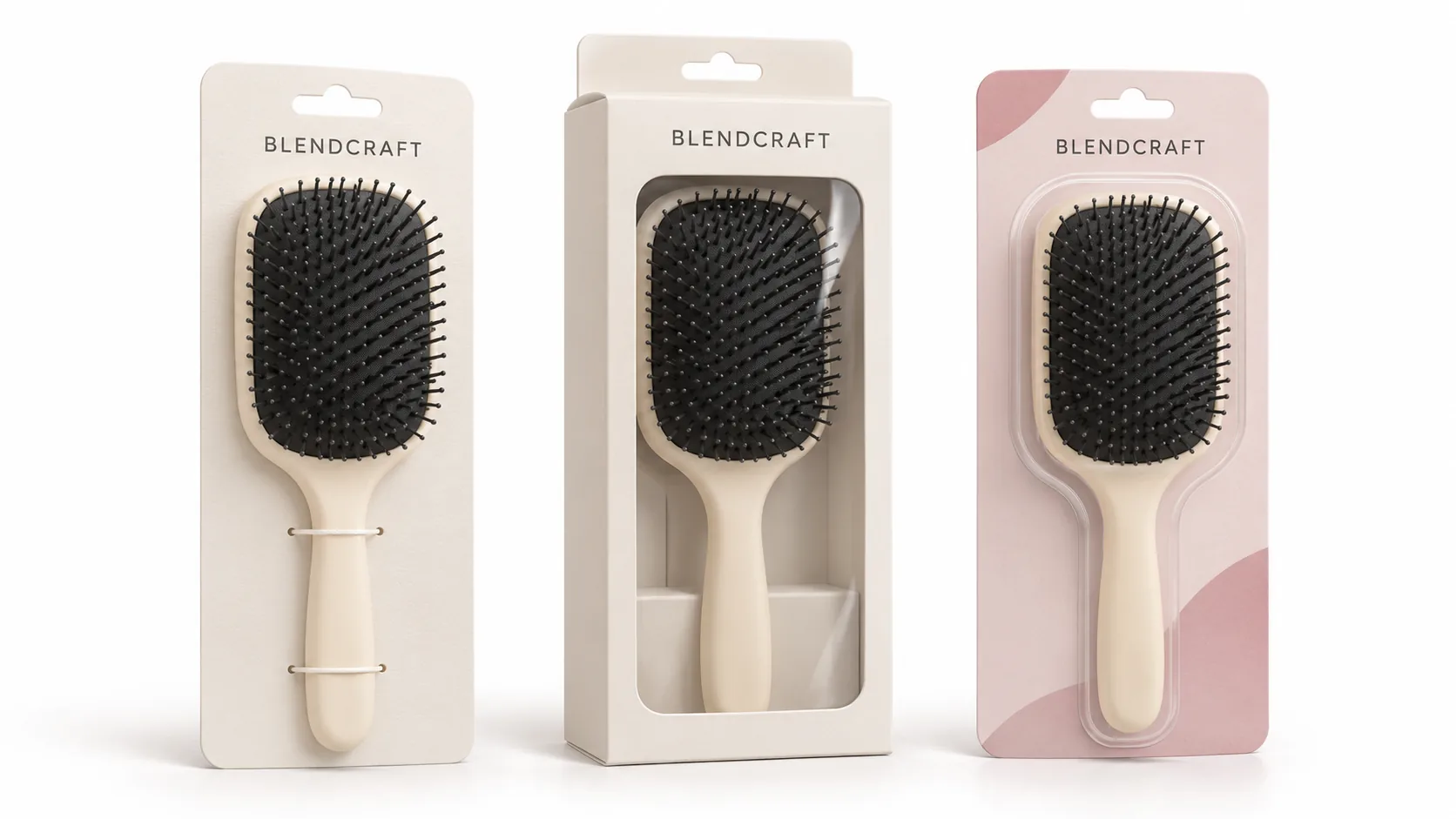
For an open retail peg display, shortlist a backing card with a defined fixing arrangement. If the brush head must be enclosed, compare a closed carton, a covered-window carton or a formed blister. For online orders, specify the retail unit and the parcel protection separately. Confirm each choice with the actual brush, then approve an assembled sample before production.
This guide helps brands, retailers and importers plan packaging as part of a manual hair brush order. It covers paddle, cushion, vented and round brushes, with combs where relevant. Powered styling tools need a different brief for their electrical product, accessories and documentation.
Use the comparisons and sample record to turn hair brush packaging requirements into a brief for quotation and sampling. The methods are purchasing tools; their acceptance criteria must be agreed for the project.
In this guide
Start with the sales unit and display requirement
Before requesting a box design, write down what the shopper buys. One brush, two brushes sold together and a brush-and-comb set are different retail units. A photograph showing several colors or sizes does not define the contents of one pack.
Use the hair brush and comb collection to identify a product reference, then give the project supplier these starting decisions:
- The brush model and configuration, including pins, tufts, cushion or barrel where present.
- The number of tools and accessories in each retail pack.
- The destination market, retailer or fulfillment route.
- Whether the pack must hang, stand on a shelf or arrive inside another shipping container.
- What the shopper should see without opening it: the entire brush, the bristle arrangement, a color reference or a printed product image.
For a retail peg, obtain the fixture requirements before placing the hanging feature on the artwork. For shelf display, review the assembled pack in its intended standing position. For online fulfillment, identify who adds the shipping protection and labels.
Make one decision before selecting materials: may shoppers touch the brush head, or must it remain enclosed? An exposed backing card can support an open-display brief. If contact is prohibited, shortlist an enclosure or specify an additional enclosing component. A clear window or blister can provide visibility; visibility alone does not establish a sealed or tamper-evident pack.
Compare hair brush packaging options by what they hold and expose
A backing card, a header card and a carton do different jobs. A backing card sits behind the product and uses an agreed restraint arrangement. A header card usually attaches at the top of a bag or another pack. A window is a feature of a pack; it can be an open cut-out or a covered opening. An insert is an internal support, not a competing outer-box type.
| Packaging direction | Shortlist when | What could change the choice? |
|---|---|---|
| Backing card with ties or a retaining structure | Open product visibility and peg display are required | If the working head must be enclosed, add an enclosure or change format. Confirm fixing and hanging before committing to the card. |
| Bag with a header or insert card | Individual separation and a printed information area meet the channel brief | If the bag catches on pins, the pack needs structural support or a different fit. Confirm display and parcel preparation separately. |
| Folding carton, closed or with a window | An enclosure and defined printed panels are required | Choose a covered rather than open window when the brief prohibits touching the head. Approve the inner support as well as the carton. |
| Formed blister with card or another backing | A shaped cavity and product visibility are part of the brief | Cavity contact, closure, removal and tooling need approval. Compare the complete proposal with a carton rather than assuming one costs less. |
| Presentation box with an insert | A gift or assortment requires an arranged presentation | If contents or size mix remain undecided, settle them before freezing the insert. Include assembly and shipping protection in the proposal. |
For online sales, a bag, carton or other retail unit may sit inside a separate shipping pack. Identify the complete route before deciding whether additional protection is required. Neither a display window nor a rigid-looking box establishes parcel suitability.
For each candidate, ask for a short assembly description: what is packed first, where the brush is secured, how the pack closes and how it opens. This makes two proposals easier to compare than a box name or rendering alone.
Match the support and clearance to the brush construction
Packaging should hold the tool in a defined position without using vulnerable working elements as convenient restraints. Ask the designer to identify intended support areas and areas that must remain clear. Confirm them on the actual brush; a photograph does not establish safe contact pressure or fastening tension.
Cushion and paddle brushes: inspect the packed and unpacked head
The rectangular paddle hair brush has a cushioned nylon-pin head and uses one OPP bag per brush as its standard unit pack. A proposed retail card or carton needs its own arrangement and approval.
Take a front and side reference of the unpacked sample. Assemble the proposed pack and photograph the same areas. Check whether a restraint, insert edge or closed panel presses on the pins or cushion. After removal, record the pin alignment, cushion appearance and any marks against the reference. Agree the packing duration and review conditions for the project; do not describe a short fitting exercise as a storage-life test.
Vented brushes: mark the fixing points
The BLC-03 curved vented hair brush combines a curved PP body with longer nylon pins and shorter bristle tufts. Its open geometry makes the fixing locations an important part of the packaging brief.
Ask for an annotated assembly photo showing the route of each tie, the surface it bears on and the position of any tab behind the brush. If tightening changes the head profile or pin arrangement, request a revised fixing route or support and a new sample. The drawing should identify usable attachment areas; an opening in the head is not automatically an approved tie point.
Round brushes: distinguish the barrel from the packing envelope
For round blow dry brushes, record the barrel diameter separately from the widest diameter including bristles. A commercial size label should not become a box dimension without checking what it measures.
Confirm the complete external profile, including the handle and ends, on each size being packed. If several sizes share one outer carton design, approve the locating arrangement for each size. The largest brush fitting inside does not prove that smaller brushes will remain correctly positioned. The supplier should identify whether inserts, restraints or the complete pack change across the range.
When a comb shares the pack, locate it independently of the brush's pins or tufts. Review tooth alignment and removal on the assembled set. Include every piece in the pack contents so a range photograph cannot be mistaken for the saleable assortment.
Approve dimensions with an assembled pack
Keep three measurements separate: the brush’s external envelope, the pack’s usable internal space and the finished retail pack’s external dimensions. For the product envelope, record length, width and maximum depth in the intended packing orientation, including projecting pins or bristles. A length-and-width listing alone leaves the depth unresolved.
Folded tabs, inserts and closures occupy space. Measure usable internal space after assembly, then use the finished external dimensions for display and carton planning. Define the axes on the drawing so two suppliers cannot silently interpret length, width and depth differently.
Use this sequence before releasing final artwork:
- Identify the product sample and packaging drawing revision. Mark the measurement axes and the intended brush orientation.
- Assemble the proposed structure with the actual brush and all included parts. Check that assembly does not require an unapproved change to the brush or packaging.
- Close the pack completely. Inspect the head, handle, ties, tabs and window from the relevant views.
- Check product location using an agreed handling sequence. Record movement, contact and any interference; do not invent a universal shake count or acceptable gap.
- Open it using the intended removal method. Check for catches, difficult release and visible changes to the product, then record the decision.
Ask the supplier to propose fit allowances based on the structure and production variation, and confirm them through sampling. Set the required space for the actual brush and pack rather than applying a universal gap.
For a family of sizes, retain a sample-to-pack mapping. The record should say which brush version uses which drawing, insert and artwork. Approving one representative combination should not silently approve every combination.
Review the retail display, artwork and materials together
Hair brush retail packaging should let the shopper identify the intended product without creating confusion between variants. Confirm the product name, color or size identifier, pack count and selected configuration. Review any use or material claim against the actual brush specification and supporting evidence.
For a hanging pack, inspect the complete weighted assembly on the intended fixture or an agreed equivalent. Record tilt, interference with neighboring units, product rotation and the condition of the hanging feature. Agree any duration or performance requirement with the retailer and supplier rather than borrowing a generic load or hanging-time limit.
For a standing carton, confirm its intended base and orientation with the brush inside. If display visibility requires an opening, specify whether it remains open or has a film, and include that component in the material and assembly brief.
Barcodes belong in the structural review
Reserve a usable barcode area before finalizing graphics. GS1 US guidance addresses placement, contrast, surrounding clear space and proportional sizing. Review the code on the finished printed pack: a tie, label, seam or closure should not obstruct its selected location or clear space.
A successful scan is a useful operational observation. If the buyer or retailer requires a barcode quality grade, GS1 describes verification using a compliant verifier. Record that requirement separately from an ordinary scan check.
The destination market and sales channel determine the labeling brief. Ask the responsible buyer or importer to approve the applicable text and retailer instructions. A generic packaging guide cannot establish every project’s required wording.
Describe the complete material construction
Request a component list for the card or carton, insert, window, bag, tie, label and closure. Decide whether a material change also changes the presentation, retention or removal method that was approved.
If FSC-labeled packaging is requested, confirm the eligible supply chain and approved label use with the certified supplier. FSC’s on-product labeling guidance explains the authorization and approval route. An FSC label and a recyclability statement answer different questions; neither should be inferred simply from a brown paper appearance.
Review environmental wording against the actual components and destination collection arrangements. Record exactly what a claim covers: the carton, the insert, the complete pack or the brush itself.
Confirm quotation scope and the shipping configuration
For private label hair brush packaging, ask for a quotation describing the packed retail unit. It should identify the structure and drawing, included components, print or artwork version, assembly, labels, setup or tooling charges, packaging minimums and sample scope. State quantities by brush version and packaging artwork.
Keep the brush minimum order quantity separate from the packaging production minimum. Specify whether quantities apply per structural size, artwork or variant. A shared outer box size does not establish a shared print minimum. Ask how unused packaging is handled and how changes to artwork or assortment affect the quote.
Send the same scope for each candidate: one complete retail pack, with its brush, insert or restraint, printed information, labels and assembly. If an alternative changes the enclosed contents or leaves assembly to another party, mark that difference before comparing the figures.
The existing custom hair brush cost guide covers complete quote comparison and shipment budgeting. Here, confirm what packaging the quotation buys and which assembled sample represents it.
Define the transport arrangement separately: units per inner pack, dividers or separation where needed, units per master carton, orientation, external carton dimensions and gross weight. Custom retail packaging may change those figures, so do not carry an OPP-bag packing reference into a boxed order without reconfirmation.
Where transport testing is needed, select the scope around the distribution route and the packaged product. ISTA’s design and testing guidance emphasizes appropriate test selection, representative samples and damage criteria defined before testing. Agree the applicable method with the buyer or laboratory. An informal handling check during development is not an ISTA test report.
Use a sample approval record that leads to a decision
Approve a named brush-and-pack combination in stages: first the structural fit, then the printed assembled pack, then any required shipping configuration or test evidence. Each approval record should state its scope. A plain structural sample cannot settle print color or barcode quality, and an artwork proof cannot settle product retention.
Use this record for the packaging decision and the hair brush quality control checklist for the wider product and batch inspection plan.
| Review item | Evidence to retain | Decision to record |
|---|---|---|
| Product and pack identity | Brush sample ID, configuration, drawing, insert and artwork revisions | Which exact combination is being reviewed? |
| Fixing and working elements | Annotated front, side and rear views; before/after unpacking photos | Accept the contact arrangement, or revise a named fixing point |
| Closure and removal | Closed-pack views and a removal sequence | Accept, or correct an interference or catch |
| Retail display | Packed-unit photos on the agreed fixture or shelf | Accept the orientation, or revise the display arrangement |
| Printed information | Finished printed sample, approved text and code-check record | Accept, or replace a named artwork or label version |
| Shipment configuration | Pack-out record, carton information and any required test report | Accept the agreed scope, or retain an open action |
Record reviewer, date, actual observation, evidence filename, required correction and final disposition: approved, revise and resubmit, or pending specified evidence.
For the relevant approval stage, request correction or further evidence when:
- The sample contains the wrong brush, quantity or artwork version.
- Assembly or closure changes a pin, tuft, cushion or body condition beyond the agreed criterion.
- A restraint moves into an area designated to remain clear, or the product will not stay in its approved position.
- The intended removal method catches or damages a part under the agreed review conditions.
- A required printed-pack, fixture or transport result is still missing.
These are review triggers. Define product-specific limits and methods in the brief, then judge the observed result against them. Keep an unresolved requirement open rather than recording an overall approval.
If a material, brush size, restraint, insert, closure or artwork changes, identify the affected checks and obtain the appropriate revised approval. Keep obsolete versions identifiable so they are not used for assembly.
Worked brief: a paddle brush for an enclosed peg display
The following buyer requirements are illustrative, using the paddle-brush construction discussed above. They are not an order, quotation or tested packaging specification.
| Brief field | Example entry |
|---|---|
| Product and retail unit | One rectangular cushion paddle brush; selected color and sample ID to be confirmed |
| Display and exposure | Hang on the retailer's peg; shoppers can see the head, while the packaging prevents direct contact with it |
| Candidate A | Printed hanging carton with a covered window and a proposed locating insert |
| Candidate B | Formed clear blister with printed backing and a proposed closure |
| Samples to request | Each complete assembled candidate with fixing locations marked, followed by the selected printed-pack sample |
| Open inputs | Product depth, fixture specification, materials, artwork, quantity by variant, quotation and shipment configuration |
An exposed backing card alone does not meet this example's enclosure requirement. Candidates A and B can proceed to design review, but neither is approved merely by being shortlisted. The supplier must resolve the cavity or internal space, fixing and closure with the actual brush.
If candidate A presses the pin bed when closed, record that observation against its drawing revision and request a revised fit. If candidate B is difficult to open without catching the pins, request a revised removal arrangement. Choose after those issues and the complete quotations have been resolved; there is no invented winner, price or test result in this example.
Prepare a hair brush packaging brief
Start with these six fields; mark an undecided item for discussion rather than delaying the whole enquiry:
- Product: model, configuration and reference sample or product link.
- Retail unit: number of brushes, combs and accessories in each pack.
- Quantity: pieces by size or color, retail-pack quantities and artwork variants.
- Market and channel: destination, hanging or shelf display, online route and any retailer brief.
- Packaging direction: card, bag, carton, blister or presentation pack; what must remain visible and protected.
- Branding and timing: available artwork, languages, barcode information and required project date.
Before final approval, add the measured product envelope, usable pack dimensions, fixing locations, materials, drawing and artwork revisions, removal method, carton configuration, required checks and approval responsibility.
The fillable packaging brief and sample record includes these fields, a candidate-comparison section and the illustrative brief. The essential decisions remain available in this article.
BlendCraft reviews retail packaging alongside the selected hair tool. Our OEM and private label support covers project-specific packaging coordination; available combinations are confirmed through feasibility review and sampling. Send the brush reference and the brief above to discuss a packed sample and quotation.
Method and references
The selection table, fixing-point review and approval record are editorial purchasing tools. The worked brief is illustrative. Linked product pages identify the referenced tools; performance of a new pack requires its own evidence. Agree dimensions, material, quantity and acceptance criteria for the proposed order.
Sources linked at their relevant decisions: GS1 US on barcode placement and printing; GS1 on printed-code verification; FSC on authorized on-product labeling; ISTA on design and transport-test selection; and the linked BlendCraft model, category, cost, QC and OEM pages.
Planning another accessory range? Review makeup mirror packaging for mirror contact, removal and sample decisions.
Working across several product lines? Browse the packaging and branding guides.
Continue reading
Related Guides
Custom Hair Brush Cost: How to Compare Private Label Quotes
Compare hair brush specifications, tooling, quantity allocations and packing before choosing a supplier quote. Includes worked calculations and a reusable worksheet.
Hair Brush Quality Control Checklist for Buyers
A practical inspection guide for brands and sourcing teams reviewing pins, bristles, cushions, brush bodies, branding and packaging against an approved sample.
Makeup Brush Packaging Options: A Buyer’s Guide for Private Label Brands
A practical guide to choosing brush packaging, comparing complete-set layouts and recording artwork and sample decisions before bulk production.
Makeup Sponge & Powder Puff Packaging: A Buyer’s Guide
Choose retail packaging for makeup sponges and powder puffs, compare complete quotations, and use practical worksheets to record packed-sample approval.