Private Label Makeup Sponge Cost: How to Compare Supplier Quotes
A buyer’s guide to makeup sponge cost drivers, piece-versus-pack pricing and supplier quote comparison, with a worked example and a reusable brief.
By BlendCraft
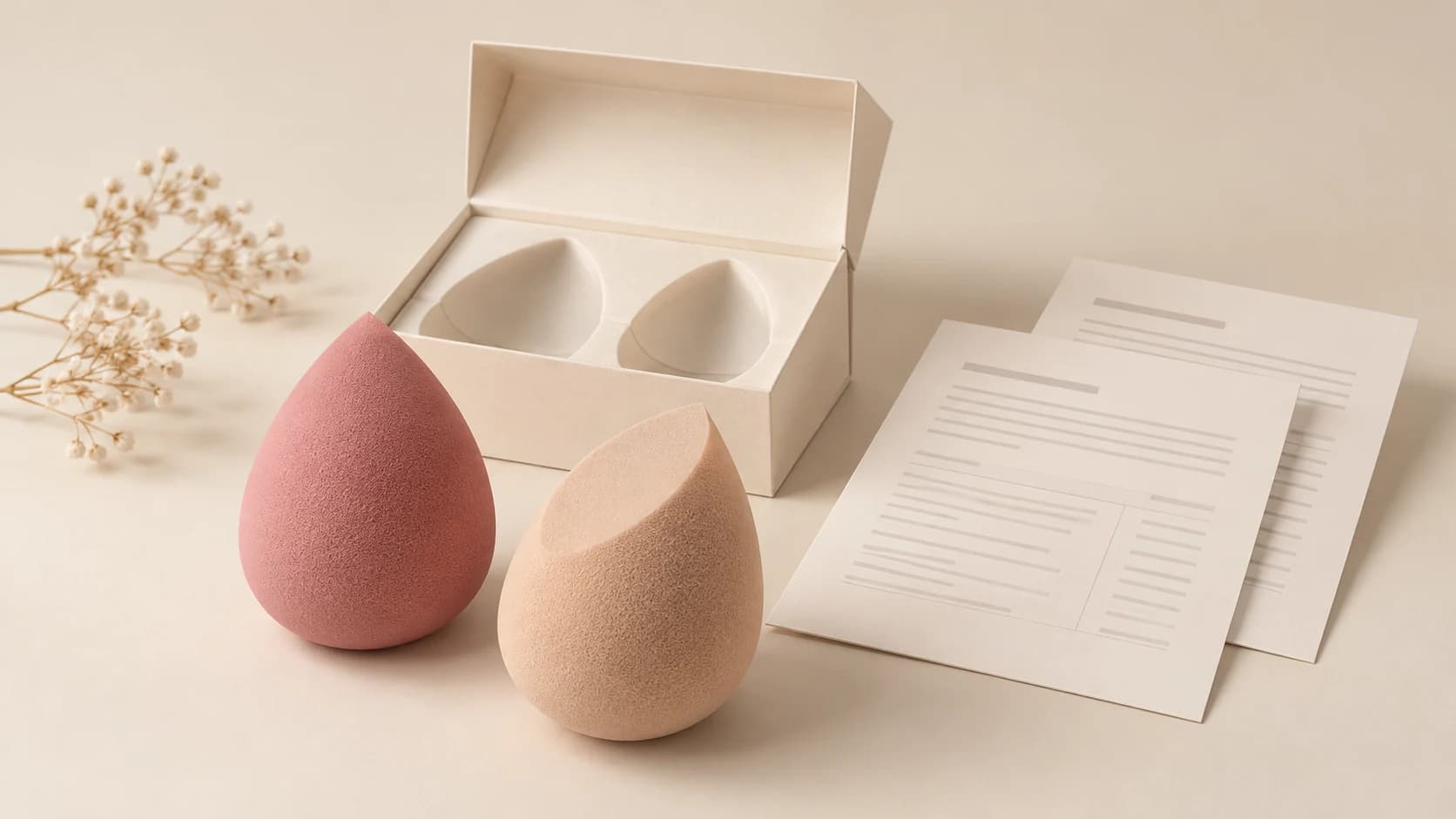
Private label makeup sponge cost depends on the specified foam, dimensions, shape, color allocation, branding, packaging and order quantity. Compare quotes for the same finished configuration, then convert per-piece and per-pack prices to one purchase unit. Record sampling, any development work and delivery separately. A stock wholesale listing is not a confirmed quote for a custom project.
This guide covers uncoated hydrophilic polyurethane (PU) blending sponges for brands and retail buyers. Fabric-covered powder puffs, layered cushion applicators and products supplied with a cosmetic formula need different specifications.
There is no verified factory price range in this guide. The worked prices below are fictional teaching assumptions, provided to show how to calculate a defined order rather than estimate your product’s market price.
What should a private label makeup sponge quote include?
A useful quotation identifies the sponge, the number purchased, the finished pack and the work included. First establish the project route:
| Project direction | Define before comparing prices |
|---|---|
| Existing stock format | Exact item, available color, quantity, current pack and any additional branding |
| Existing format with customization | Selected sponge reference, color allocation, product logo, retail pack and approval stages |
| New or revised format | Drawing or physical reference, dimensional changes, development work and any tools actually required |
These are scope descriptions, not a fixed price ranking. A new-looking design may use an existing format; an apparently simple request may still need a custom pack or additional approval work.
Mark each quotation item included, separately charged or pending: sponges, product decoration, retail packaging, packing labor, accessories, labels, export cartons, samples, development and the agreed inspection scope. Record where delivery begins and ends.
A price per sponge does not establish that the offer includes a retail-ready product. If the selected product or pack is still open, keep the price attached to that option instead of presenting it as a final project budget. The makeup sponge sourcing guide covers the broader selection process.
Why can similar makeup sponges have different prices?
Two product photographs can hide differences in foam, actual dimensions, shape details, branding and pack contents. Separate a change to the supplied product from an additional charge for work: a revised size changes the article being priced; a product logo adds a defined decoration requirement; a printed retail box introduces packaging and assembly scope. A supplier may bundle those costs into one price, so compare the included work as well as the fee lines.
| Cost area | Put in the common specification | What to check in the offer |
|---|---|---|
| Foam and sample identity | Material description and selected material/sample version | Whether both offers follow the same reference and requirements |
| Dimensions and unit mass | Measurement directions, state, target and agreed variation | Whether the proposed sponge has changed size or mass |
| Profile and cut faces | Outline, tip, base, angles and reference drawing | Existing format, revised processing or additional development |
| Colors and quantities | Quantity for each shape-and-color combination | Actual allocation and the minimum applicable to that combination |
| Product branding | Method, artwork, size, position and appearance reference | Decoration included, setup basis and sample coverage |
| Pack and assembly | Contents, pack count, protection, artwork, accessories and carton plan | Loose goods, packed retail units or another defined deliverable |
Material, dimensions and weight in the priced specification
“Hydrophilic PU,” “latex-free” and “soft” do not describe every property of a finished sponge. Link the material direction to a sample or material reference, then define the characteristics that matter for the intended formula and use.
Unit mass, density and firmness answer different questions. Density is mass per volume; firmness concerns the response to loading. The Polyurethane Foam Association’s foam-performance explanation distinguishes density from firmness. Its general foam guidance does not set a best density or service life for a makeup sponge.
A heavier sponge is not necessarily a denser version of another sponge: its true volume, shape or material may differ. Multiplying the maximum length, width and height gives a bounding box, not the actual volume of an egg-shaped or contoured sponge. Do not use that box to report a measured foam density.
If density is required, record the specimen, condition and applicable measurement method. ISO 845’s public abstract describes methods for apparent density in cellular plastics and rubbers; it is a method reference, not evidence that a selected product has been tested.
For quotation purposes, retain the agreed dimensions, measurement state and mass reference. A change from 7 g to 8 g does not produce a valid percentage price adjustment. Obtain a quote for the changed specification and review the sample’s application separately.
Shape, cut faces and development
Define the usable surfaces: the rounded body, tip, flat face, slant or narrowed grip. A flat-edge reference needs its profile and orientation, not just the word “egg.”
As one concrete starting point, BlendCraft’s P3 Flat-Edge Makeup Sponge lists 40 × 60 mm, 7 g, latex-free hydrophilic PU and a standard MOQ of 3,000 pcs. These facts identify that SKU; they do not establish another sponge’s density, price or permitted color split.
The PFA’s Foam Fabrication bulletin describes cutting, shaping and finishing routes for flexible foam, and explains why fabrication affects cost. This is general fabrication context, not evidence of the process used for a particular makeup sponge.
For a changed profile, identify which work actually changes: an existing format, a revised cutting or finishing step, a tool or another development task. Compare a fixed reference with the proposed alternative at the same quantity. Record the changed work, sample deliverable and quoted amount. A new outline does not automatically establish a new mold requirement, and a visible flat face does not establish a separate surcharge.
Color allocation and logo location
Specify quantities by shape and color. “6,000 pieces in two colors” and “6,000 pieces in six colors” describe different allocations, but neither statement tells you the price effect. Price each feasible allocation rather than applying a universal color surcharge.
Record logo on the sponge and logo on the packaging separately. A branded box does not mean the sponge is marked. For either location, define the artwork, size, position, colors and suitable process. Identify whether setup is charged per artwork, position or run, and confirm which features the sample will show.
Retail packaging and packing work
A loose sponge, an individually boxed sponge and a twin pack with an accessory are different purchases. List the bag or box, insert, labels, accessories, packing labor and transport carton. State how many sponges are inside each retail unit.
Review the packed sample for fit, appearance and removal. Smaller packaging may be worth exploring, but do not presume that strong compression or vacuum packing preserves the approved sponge’s shape and recovery. Agree how the revised pack will be assessed after the relevant storage or transport conditions, using the sponge inspection guide where appropriate.
Count sponges, retail packs and color allocations separately
A piece is not a sufficiently clear purchase unit until the quote says what it counts. It might mean one sponge, one retail multipack or another item.
For identical retail packs:
Required sponges = retail packs × sponges per pack
For a mixed pack, calculate each component separately:
Required quantity of a shape/color = retail packs × that component’s quantity per pack
For example, 1,000 twin packs containing one color A sponge and one color B sponge require 1,000 of each. An allocation of 900 A and 1,100 B contains 2,000 sponges but makes only 900 complete twin packs, leaving 200 B sponges. This is an illustrative count, not a statement about a supplier’s mixing policy.
Confirm the minimum that applies to each shape, color, decoration and packaging configuration. An order-level MOQ does not establish that every proposed split is acceptable. Keep any additional required purchases and unused packaging visible rather than spreading them into a unit price without explanation.
If a quote is per carton, establish each supplier’s own retail packs per carton and whether partial cartons can be purchased. Those carton counts may differ even when the retail pack is the same. Reconcile each offer to the target retail-pack quantity; one shared carton count must not be applied to both. A case price cannot be divided meaningfully until its contents are known.
What if different sponge components have different prices?
A single per-sponge rate is usable only when that agreed rate covers every sponge being counted. Otherwise, keep the itemized rates. For a pack with two units of X and one of Y:
Product amount per retail pack = 2 × quoted price of X + quoted price of Y
Multiply that product amount by the retail-pack quantity, then add only the packing and other work not already included. An unweighted average of X and Y would misprice this pack. Retain the itemized quote even when recording its normalized product amount per pack in a comparison tool.
Worked example: compare a per-piece quote with a twin-pack quote
Fictional calculation only. These quantities, prices and fees are teaching assumptions, not supplier offers, BlendCraft ordering terms or market price estimates.
Assume both suppliers have confirmed the same sponge specification, product logo, retail pack, inspection requirements and USD currency. The order contains 3,000 identical twin packs, each with one color A and one color B sponge: 6,000 sponges in total, 3,000 of each color. Quote A expressly applies one agreed per-sponge rate to both colors. Both quotations use the same packed-goods collection boundary, with onward freight and destination charges excluded.
| Quotation line | Fictional quote A | Fictional quote B |
|---|---|---|
| Main price unit | Individual sponge | Complete retail twin pack |
| Main quantity | 6,000 sponges | 3,000 twin packs |
| Main price and scope | $0.36 per sponge, including the agreed product logo | $0.88 per twin pack, including the same sponges, logo, retail packing and assembly |
| Retail packing and assembly outside main price | $0.18 per pack × 3,000 packs | Included; do not add again |
| Unit-priced work for the order | $2,700 | $2,640 |
| Additional order-level charges | $150 | $300 |
| First-order comparison subtotal | $2,850 | $2,940 |
| Planned spend per ordered retail pack | $0.95 | $0.98 |
Quote A: 6,000 × $0.36 + 3,000 × $0.18 + $150 = $2,850.
Quote B: 3,000 × $0.88 + $300 = $2,940.
The figures $0.36 and $0.88 cannot be compared directly because they use different units. A’s unit-priced work is $0.90 per twin pack; B’s is $0.88. B has the lower unit-priced amount, while A has the lower first-order subtotal in this example.
The example assumes no other required excess-component purchases or applicable credits. In a real comparison, an unresolved fee remains pending rather than becoming zero. These subtotals are not complete landed costs, proof of sample quality or forecasts of reorder pricing.
The calculation rule is simple: multiply each charge by the quantity in its own stated unit, then add separate order charges and subtract applicable confirmed credits once. Keep the original lines behind the result.
The companion Makeup Sponge Quote & Pack Planner supports one common pack, currency and exact allocation. Its per-sponge option requires confirmation of a common rate across the components. For itemized rates, use the per-pack option for the documented product subtotal, keeping separately charged packing in its own field. Surplus-stock scenarios require a separate record. The companion includes filled-copy, print and brief-copy controls; the tables and method remain here without an email gate.
Separate sample costs from development and production
A stock reference sample can help select a direction without representing the final color, product logo or packaging. Record which features each sample actually covers.
| Sample or work stage | Confirm what the fee buys |
|---|---|
| Existing reference sample | Item, color, quantity and dispatch cost |
| Custom color or product-logo sample | Required features, artwork/version, revisions and approval scope |
| Retail packaging sample | Material, artwork, contents, assembly and whether the actual sponge is included |
| New-format development, if required | Defined output, tools or other work, revisions and arrangements for later orders |
Record charges already paid and any proposed credit conditions. Subtract a sample credit only after its applicability is confirmed, and only if it has not already reduced another price line. A deposit against the agreed invoice is part of payment timing, not a second cost added to the full invoice.
Before budgeting a reorder, reconfirm the specification, quantities, setup treatment, packaging and current quote. “Same design” does not guarantee the previous price or remove every charge.
What packing data do you need for shipping costs?
An 8 g sponge does not tell you the shipping weight of its retail pack or export carton. Obtain the packed configuration:
| Field | Record |
|---|---|
| Retail contents | Sponge count by shape/color, packaging and accessories |
| Carton quantity | Retail packs per carton; total cartons and any part carton |
| External dimensions | Actual packed carton length, width and height, with units |
| Gross weight | Each carton including goods and packaging |
| Delivery basis | Origin, destination, service, date and included/excluded charges |
DHL Express’s chargeable-weight explanation shows why a lightweight parcel can be billed using its volume. Confirm the calculation and conditions of the actual service; do not apply one divisor to every carrier or freight method.
Compare packing alternatives with measured carton data and new transport quotes. A smaller box does not establish a saving if carton quantities, protection or service conditions also change. Keep a supplier subtotal separate from freight, import and other destination costs until the full intended boundary is accounted for.
When are two makeup sponge quotes ready to compare?
Use a status before choosing a price:
| Finding | Status | Next action |
|---|---|---|
| Same specification, allocation, pack and delivery scope confirmed | Ready for cost review | Compare complete charge lines alongside the sample and schedule |
| “pc” or “set” undefined; logo scope or a necessary fee unresolved | Clarification required | Obtain the missing definition or revised quotation |
| Lower price uses a different foam, size, profile or pack | Specification alternative | Review the changed sample as a separate option |
| Sample omits the final color, product logo or retail pack | Sample scope pending | Identify what still needs approval |
For example, a quote for loose flat-edge sponges and a quote for boxed twin packs are not comparable merely because both say “latex-free PU.” Align their contents and included work first. If one supplier proposes a different sponge to meet the budget, keep it as an alternative rather than hiding the change in the total.
Example: record the difference before deciding
In this illustrative review, the common brief specifies one flat-edge reference and a branded individual box. No supplier performance or test result is being reported.
| Difference in a returned offer | Record now | What resolves it |
|---|---|---|
| Only a generic “PU sponge” photo is provided | Material/sample reference unresolved | A specified sample/reference matching the brief, or a separately identified alternative |
| Logo is quoted on the box; the brief also requires product marking | Product-logo scope pending | A revised included-work line and an appropriate sample |
| Price is per “set,” with no contents | Purchase unit undefined | Itemized pack contents and quantity basis |
| Required box purchase exceeds current use | Additional purchase commitment | Current consumption, extra amount, stock balance and ownership |
Keep the status clarification required while an essential field is open. A complete spreadsheet total does not repair an undefined product or purchase unit.
How can you reduce makeup sponge cost without losing the brief?
Ask for a defined alternative with a new quotation. Make the changed requirement visible and review what it means for the product.
| Alternative | What changes | What to recheck |
|---|---|---|
| Use an existing profile | Development or processing scope | Application surfaces, dimensions and whether the specific work is avoided |
| Reduce unnecessary color/shape combinations | Quantity allocation and assortment | Brand needs, demand and each revised minimum |
| Revise the branding plan | Product or pack decoration | Visibility, artwork, suitable process and sample appearance |
| Simplify or resize the retail pack | Material, insert, accessories or protection | Pack fit, recovery/appearance and measured carton data |
| Request a different quantity | Unit price and stock commitment | Revised total spend, inventory demand and required component purchases |
A possible saving is not a reason to silently relax an approved material or performance requirement. The makeup sponge QC checklist helps preserve those requirements when a proposal changes.
Copy this makeup sponge quotation brief
You can start with six items; write “options needed” where a decision is open.
| Field | What to send |
|---|---|
| Product reference | SKU, photographs or physical sample; known shape, dimensions and material direction |
| Application | Intended formula, wet/dry use and requirements the sample should meet |
| Quantity | Sponges or retail packs, with the proposed split by shape and color |
| Branding | Logo on the product and on the packaging, identified separately |
| Retail pack | Each pack’s contents, quantities, packaging and accessories |
| Market and timing | Sales market, delivery destination, required arrival date and specified documentation |
Please quote the sponge reference and pack contents described above. Identify the purchase unit and quantity for each shape/color combination. Show what the price includes for product branding, packaging, assembly and cartons. List sample, setup, development, inspection and any additional required purchases separately. Confirm the delivery scope, quote validity, approval requirements and open items; price specification alternatives on separate lines.
After selecting a direction, record the final material/sample version, measurement conditions, dimensions, mass, color, artwork, pack contents, quality criteria and approved references. Keep these beside each supplier’s quote, sample-coverage record, unresolved items and decision.
Example brief using a published sponge reference
The following is an illustrative quotation request, not a confirmed offer or color/pack MOQ commitment. It uses the published P3 facts above and leaves the buyer’s project choices visible.
| Brief field | Example request |
|---|---|
| Product | P3 flat-edge reference, 40 × 60 mm, 7 g, latex-free hydrophilic PU; confirm the sample and measurement conditions |
| Application | Liquid-foundation blending; compare the proposed sample with the buyer’s formula |
| Quantity | Proposed 3,000 sponges in one selected color, one sponge per retail pack: 3,000 retail packs; confirm feasibility and applicable minimum |
| Branding options | A: product logo plus printed box. B: printed box only. Keep the sponge and all other requirements the same |
| Retail pack | Proposed individual paper box; agree artwork, dimensions, protection, packing and carton plan |
| Delivery and timing | Buyer supplies destination city/country and required arrival date; supplier returns the scoped delivery and approval schedule |
Ask for A and B on separate lines at the same quantity. The comparison then answers a specific question—what changes when product marking is removed—without silently changing the foam, dimensions or pack. A saving remains unconfirmed until the revised offers are received.
Browse the makeup sponge formats, review the OEM and private label process, or share your sponge reference, color quantities and pack format with BlendCraft.
Questions buyers ask
Should setup fees be spread over hoped-for future orders?
Keep the current order’s full commitment visible. A separate forecast may allocate a fee over explicitly assumed future quantities, but unconfirmed reorders should not reduce the amount shown as required for the first purchase. Retain both views with their different purposes clearly labeled.
Can an expired quotation be used as a price benchmark?
Keep it as a dated reference, then obtain confirmation for the current specification, quantity and delivery scope. Record quote validity and any changed terms. An expired offer is not a current purchasing option merely because its listed price is lower.
Sources and scope
BlendCraft prepared this buyer comparison framework and its fictional arithmetic example. No current comparable supplier quotations or factory cost accounts were used to establish a market range. The guide supports quotation review; it does not report a product test or approve a shipment.
Public references checked on October 29, 2026:
- Polyurethane Foam Association — Foam Performance: general density and firmness terminology, used only within the limits described above.
- Polyurethane Foam Association — Foam Fabrication: general fabrication and cost context, not a record of a particular sponge’s manufacturing process.
- ISO 845:2006 — Determination of apparent density: official public abstract; the full standard was not used to carry out or claim a test.
- DHL Express — Chargeable Weight: carrier explanation of actual and volumetric weight; actual shipment terms require confirmation.
- BlendCraft — P3 Flat-Edge Makeup Sponge: published SKU facts used as a product-reference example, not price or performance evidence.
Continue reading
Related Guides
Makeup Sponge Wholesale & Manufacturing Guide for Buyers
A practical B2B guide to makeup sponge shapes, material evidence, sample evaluation, customization, quality control, packaging and quotations.
Makeup Sponge Quality Control Checklist for Buyers
A buyer inspection guide to approved samples, dry and wet measurements, color transfer, cleaning, packaging and traceable lot decisions. Includes an editable inspection record.
Custom Makeup Brush Cost: How to Compare Supplier Quotes
Compare supplier quotes on the same specification, calculate first-order costs, and record packaging, setup fees and payment terms with an editable worksheet.
Powder Puff Types & Materials: A Buyer’s Guide
A practical guide to powder puff shapes, surface materials and construction, with a sample-comparison record and a private label brief for buyers.