Powder Puff Types & Materials: A Buyer’s Guide
A practical guide to powder puff shapes, surface materials and construction, with a sample-comparison record and a private label brief for buyers.
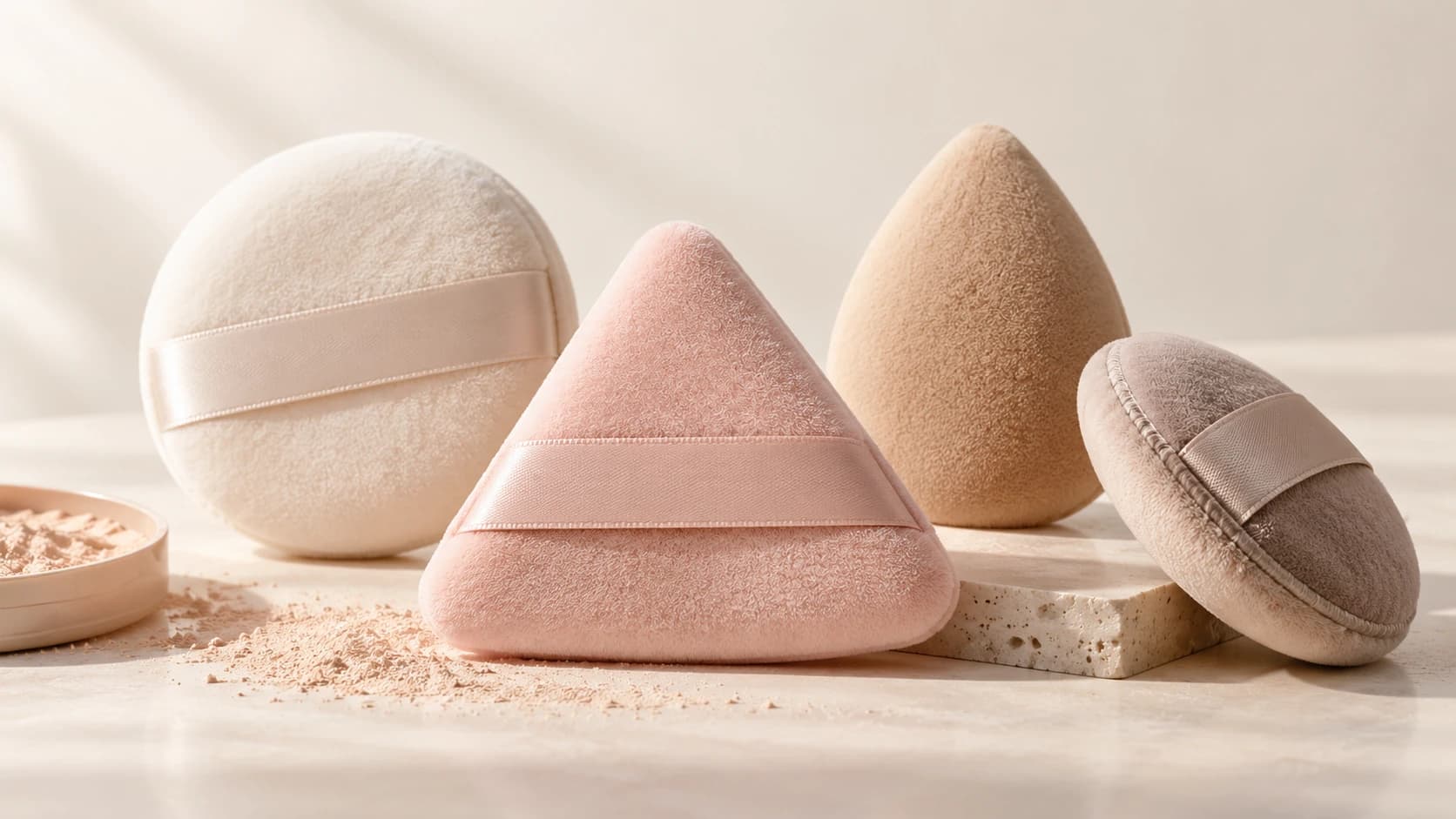
Illustrative powder puff formats and a makeup sponge. Actual materials and construction should be confirmed for the selected product.
Powder puffs may have cotton or synthetic-fiber working surfaces, with a separate cushion or foam core where specified. Triangle describes shape; velvet and velour are fabric terms; microfiber describes fiber fineness. These labels can overlap and do not identify the whole product. Choose samples around the intended powder, application area and pack, then confirm the selected construction and material composition.
For loose powder, compare how the sample picks up and releases the powder. For a pressed-powder compact, assess application and fit together. A puff that feels right in the hand still needs to work with the formula, close inside the pack and be easy to remove.
This guide helps brands and retail buyers turn those decisions into a sample brief and an approved specification.
In this guide
- Powder puff types
- What powder puffs are made of
- Velvet, velour and other material terms
- Choosing for the formula and pack
- Comparing samples
- Preparing a private label brief
- Buyer questions
- Sources and scope
Powder puff types: shape, surface and construction
Compare powder puff types along separate dimensions. Round and triangular describe the outline; mini describes size; cotton describes a fiber; a dual-sided design describes the arrangement of working faces. One product can combine several of these descriptions.
For shape selection, use the following starting points. These are sample-selection suggestions, not a ranking of tested products.
| Shape | A useful starting point for | What to compare on the sample |
|---|---|---|
| Round | Broad pressing and general face setting | Working area, grip and contact when the puff bends |
| Triangular | Targeted placement around smaller areas | The contact area at the tip under pressure, edge feel and strap position |
| Teardrop | A pointed end and a broader working area in one outline | Tip shape, curve and control with the intended grip |
| Square or rectangular | A chosen working edge or a matching pack design | Corners, removal from the pack and edge contact during application |
A small round puff and a large round puff may suit different tasks despite sharing a shape. Record actual dimensions and thickness rather than ordering by “mini,” “standard” or “large” alone.
Also separate intended use from construction. A cushion puff is selected for a particular formula and application task; the name does not establish a single material. A dual-sided puff may have different materials or roles on its two faces. Specify each face separately.
What are powder puffs made of?
Powder puffs can use cotton or synthetic-fiber surfaces, including polyester, with separate cushioning or other internal components where the design includes them. A fabric name describes only part of that construction.
Published product specifications illustrate the difference:
- Laura Mercier’s Velour Puff pairs the velour product name with a cotton material description.
- Beautyblender’s Power Pocket Puff identifies polyester for its velour and separately lists polyurethane for foam and other components.
- Kryolan’s Premium Powder Puff describes cotton velvet with a sponge insert.
These examples show why the surface and interior should be recorded separately. They do not establish the composition of another supplier’s puff.
Use a component record when reviewing powder puff materials:
| Component | Information to obtain | Why it matters to the brief |
|---|---|---|
| Working surface | Fabric reference, construction, fiber composition and the face concerned | Connects the material description to the actual application surface |
| Cushion or filling, if present | Confirmed material and construction | Identifies what sits behind the surface rather than guessing from softness |
| Backing or bonding layer, if present | Whether it exists and the available material information | Makes the construction record complete for that design |
| Edge | Confirmed stitching, sealing or other finishing method | Defines the outline and contact edge to approve |
| Ribbon or finger pocket | Material, position, dimensions and attachment | Defines grip and the area available for application |
For a two-sided product, repeat the working-surface information for both faces. Link the record to a physical sample ID and version. A description such as “pink velvet puff” is useful for identification, but insufficient for approving the construction.
Velvet vs velour powder puffs: what should buyers compare?
Velvet and velour are fabric terms; cotton and polyester name fibers. A velour powder puff can therefore use a cotton or polyester surface, depending on the product. The examples above make a simple cotton-versus-velour comparison misleading: the terms answer different questions.
There is also a textile distinction behind the fabric names. CottonWorks defines velvet as a woven cut-pile fabric. Its mechanical-finishing guide describes knitted velour made by shearing loops. Those references explain structures; a supplier’s sales name alone does not prove which structure a particular puff uses.
Keep these terms separate in a specification:
| Term | What it describes | What it does not establish by itself |
|---|---|---|
| Cotton or polyester | Fiber identity | Complete construction, texture or performance |
| Velvet or velour | A fabric description | Fiber percentages, filling or application results |
| Microfiber | Fiber fineness | One fixed polymer, surface construction or powder pickup level |
| Flocked | A surface-making process | The fiber, substrate or finished applicator’s performance |
CottonWorks’ microfiber entry identifies several possible fiber compositions. The American Flock Association describes flocking as applying short fibers to an adhesive-coated surface. Microfiber and flocked are therefore not interchangeable specifications.
When comparing velvet, velour or microfiber powder puff samples, request the fabric code, composition for each working face and the internal-construction description. Then compare the samples with the intended powder. Avoid choosing from a promised texture or finish alone.
Surface geometry deserves attention. A 2005 study of particular synthetic-fiber and cotton puffs examined powder intake and highlighted fiber diameter, pile length and spacing. It does not establish a universal ranking of today’s materials or make higher powder intake the same as better application.
How to choose a powder puff for the formula and pack
Start with the formula and task, then narrow the shape, surface, cushion and grip. The following questions help turn a visual reference into a useful sample request.
Loose powder: compare loading and release
For a loose powder puff, assess where powder collects on the surface, how evenly it is distributed after your chosen preparation, and what happens during pressing. Use the same powder and handling sequence for each candidate.
Look for the result your project needs: controlled placement in a small area, broad pressing, or a particular application pattern. Greater pickup alone is not a selection rule. A sample must also release the powder in a way that suits the task.
Pressed powder: test application and compact fit together
For a pressed powder puff, use the intended powder pan and compact. Record the puff’s dry outline and thickness, including its edge and grip. Check that it contacts the powder as intended, fits the available space, permits normal closure and can be removed without awkward handling.
Length alone cannot establish compact fit. A puff may fit the outline but be too thick with the strap folded into place. Approve the puff and pack as an assembly before treating their individual dimensions as settled.
Triangle vs round: compare the usable contact area
A triangle is a useful candidate when the brief calls for a pointed working area. A round shape is a useful candidate for a broader contact area. Compare the actual working surface under pressure: the edge, cushion and grip can change how much of the outline is usable.
If two shapes meet the application need, packaging and handling may decide the choice. Review the available makeup sponge and powder puff formats against that brief.
Powder puff vs makeup sponge or cushion puff
Use the selected surface and intended formula to define the applicator, rather than assuming every product called a puff performs the same task. Real Techniques’ dual-sided powder puff, for example, assigns powder application to one face and liquid or cream blending to the other. That is a product-specific design, not a claim that every powder puff has both uses.
Hydrophilic PU blending sponges and layered cushion applicators require their own evaluation plans. The hydrophilic PU makeup sponge inspection guide addresses a different scope; its wet-expansion checks should not automatically be applied to a fabric-covered powder puff.
How to compare powder puff samples
Write the requirements before comparing samples. Identify which conditions are essential, such as fitting an existing compact, and which are preferences, such as a particular cushion feel.
Keep the comparison conditions consistent
Assign each sample an ID and record its version, color and source. Identify the formula and pack references. Keep powder preparation, loading, excess removal, contact surface, operator and application sequence consistent across candidates. Record any changes instead of comparing unlike conditions as if they were equivalent.
Inspect the surface, edge and grip before application. During use, record pickup distribution, release, placement control and handling. If assessing care-related changes, follow the selected product’s instructions and record the cleaning sequence and final drying state.
Hand feel is one observation. A 2008 powder-puff study found different pile-length preferences when its samples were assessed with and without powder. That supports evaluating the intended application as well as touch; its findings are not a universal pile-length specification.
Use a record that leads to a decision
Record: Project; formula/lot; pack reference; date; operator; sample A and B IDs/versions; approved reference, if available.
| Criterion | Requirement and comparison condition | A / B observations and evidence |
|---|---|---|
| Material identity | Required component information and document references | Record confirmed and unresolved information separately |
| Working area and grip | Target area, contact sequence and grip | Describe placement, edge contact and handling |
| Pickup and release | Same formula, preparation and handling | Record distribution and application observations |
| Visible changes | Agreed handling and observation method | Record shedding, transfer or edge changes actually observed |
| Compact or pack fit | Specified insertion, closure and removal conditions | Record the assembled result and pack reference |
| Care, where relevant | Product-specific sequence and final dry state | Record changes and the method used |
The companion powder puff buyer worksheet provides separate A/B fields, a quick brief and a decision record. It can be filled, exported and printed without an email submission.
Use Approve, Revise or Hold, with reasons, unresolved items, an owner and a date. If a project’s required compact cannot close normally with a candidate puff inside, revise the design or select another sample. A preferred hand feel does not override that requirement. This is an illustrative decision rule, not a reported test result.
Visible color transfer or shedding observations are screening records, not proof of material identity or skin safety. Requirements, test methods and acceptance limits should be agreed for the selected project. This buyer comparison is not a substitute for a shipment inspection or laboratory assessment where one is needed.
What to include in a private label powder puff brief
A useful first request does not require a finished engineering specification. Provide the following six items; where a choice is open, ask for sample options.
| Field | What to send |
|---|---|
| Formula and task | Loose or pressed powder, or another formula; intended application area |
| Format and reference | Shape, approximate dimensions, photograph or physical reference |
| Material direction | Requested surface or feel, known composition, and options to compare |
| Quantity | Total units and proposed split by style and color |
| Branding and pack | Logo direction; single pack, multipack or compact insert; pack reference |
| Market and timing | Destination market, required arrival date and any specified documentation |
After selecting a direction, add component descriptions, final dimensions and measurement points, edge and grip details, color approval, artwork, packaging count, sample requirements and the approved reference. Review sampling cost, production timing and freight separately. The private label development process explains the project steps.
A BlendCraft triangle powder puff example
The Triangle Powder Puff specifications provide a concrete starting point: 45 × 55 × 10 mm, 2 g per puff, a velvet cover and a latex-free product description. The standard MOQ is 3,000 pcs; the proposed color split is confirmed with the quotation.
Pantone color, product and packaging logos, and packaging options can be reviewed for the project. Samples are charged; their preparation time and fee are quoted separately. Bulk production is 45 days after payment, with shipping additional.
Those facts describe this SKU. They do not establish its fiber percentages, inner filling or pile length, and they should not be treated as standard specifications for every powder puff. A request using velour as a surface reference should identify the desired sample or fabric direction rather than silently replacing the confirmed velvet description.
Powder puff questions buyers ask
Can one puff work with both loose and pressed powder?
Some products are designed for both. Evaluate each intended powder separately and record the handling conditions. Successful use with one powder does not establish the same result with another formulation.
Can a triangle powder puff fit inside a compact?
Yes, if its outline, thickness, edge and grip suit that particular compact. Check closure and removal using the actual assembly. There is no universal triangle-puff size that guarantees fit across powder cases.
Does latex-free mean hypoallergenic?
No. A latex-free statement does not establish that a product is hypoallergenic or suitable for everyone’s skin. Confirm the scope and supporting documentation of each product claim separately.
Should a reusable puff have a fixed replacement interval?
Use the selected product’s care and replacement instructions. Do not copy another brand’s interval into an untested private label specification. If reuse is part of the brief, agree how the chosen sample’s condition will be assessed after its defined care sequence.
Discuss your powder puff specification. Share the six-item brief, reference images and any existing compact with BlendCraft so the candidate format, sample requirements and quotation can be reviewed together.
Sources and scope
This guide concerns applicator selection for brand and retail projects. It separates material descriptions, product examples and practical sample-comparison suggestions. The two historical studies are used only for the limited observations described in their published abstracts. They are not acceptance standards or BlendCraft product tests.
Sources consulted on October 29, 2026:
- Textile terms: CottonWorks — Velvet, Mechanical Finishing and Microfiber.
- Surface process: American Flock Association — Flocking Process.
- Specific product examples: Laura Mercier Velour Puff, Beautyblender Power Pocket Puff, Kryolan Premium Powder Puff and Real Techniques Miracle 2-In-1 Powder Puff. These references illustrate their published descriptions, not equivalent performance or a commercial relationship with BlendCraft.
- Powder intake: Manabe et al. (2005), Intake Ability of Powder Puffs Made of Synthetic-fiber Cloths, 46(8), 519–528. DOI: 10.11419/senshoshi1960.46.519.
- Pile length and use: Sukigara et al. (2008), Effect of Pile Length on the Comfortable Usage of Powder Puff, 54(1), 1–8. DOI: 10.4188/jte.54.1.
Continue reading
Related Guides
Makeup Sponge Quality Control Checklist for Buyers
A buyer inspection guide to approved samples, dry and wet measurements, color transfer, cleaning, packaging and traceable lot decisions. Includes an editable inspection record.
Makeup Sponge Wholesale & Manufacturing Guide for Buyers
A practical B2B guide to makeup sponge shapes, material evidence, sample evaluation, customization, quality control, packaging and quotations.
Hair Brush Quality Control Checklist for Buyers
A practical inspection guide for brands and sourcing teams reviewing pins, bristles, cushions, brush bodies, branding and packaging against an approved sample.
Eyelash Curler Quality Control: A Practical Sourcing Guide
For brands and retail buyers comparing mechanical eyelash curlers: learn what to check in a sample, how to record defects, and which specifications to agree before production.