Custom Powder Puff Cost: How to Compare Private Label Quotes
A buyer’s guide to powder puff specifications, ribbon branding, packaging minimums and comparable first-order budgets.
By BlendCraft
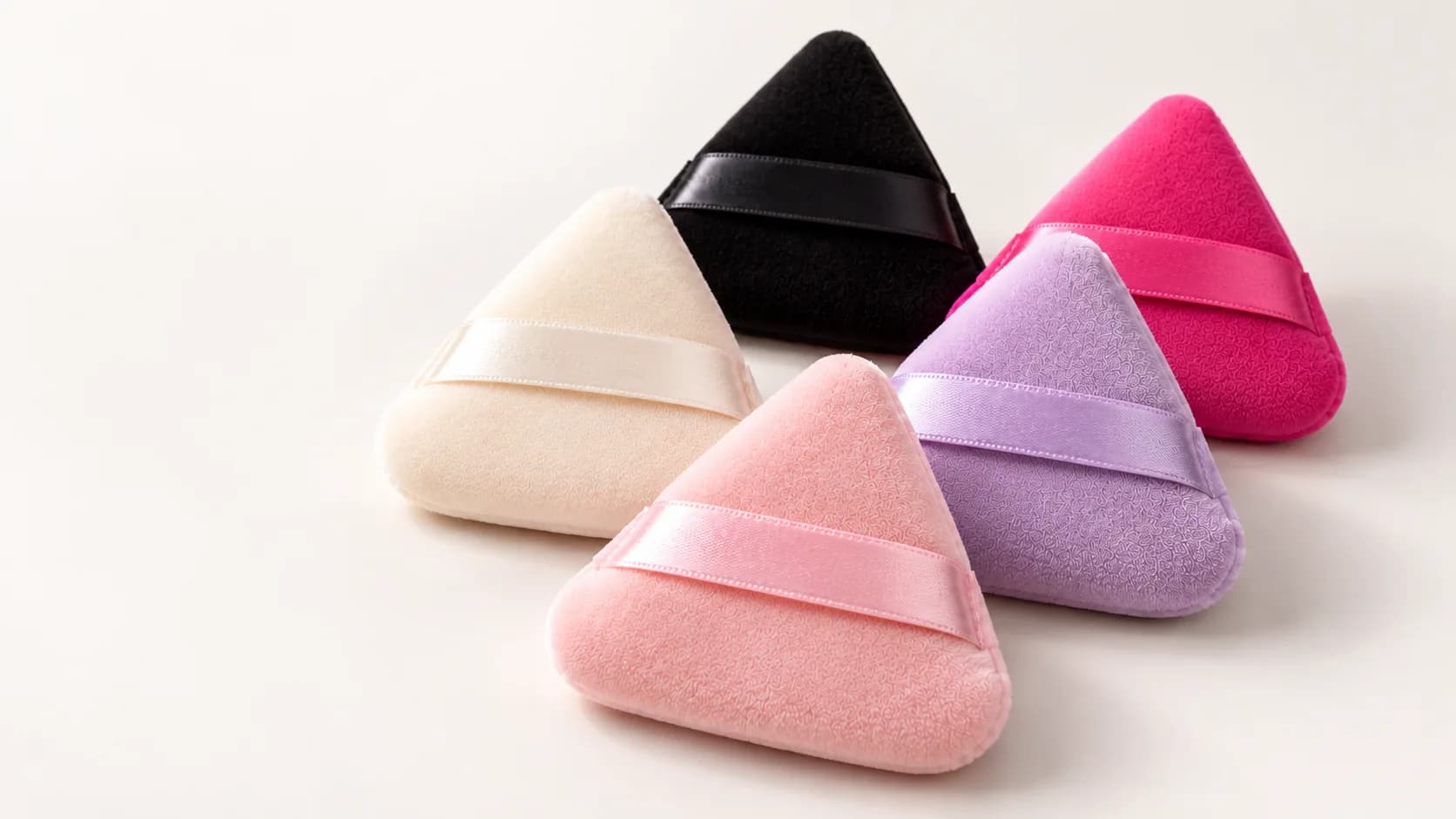
Custom powder puff cost depends on the cover, inner construction, edge finish, ribbon branding, quantity allocation and finished pack. For brands and retail buyers, a useful comparison starts with the same product specification and delivery scope. Then calculate every charge in its own purchase unit, including any packaging you must buy beyond the quantity used in the order.
First-order spending within an agreed scope = required purchases + separate order charges − confirmed applicable credits.
Preparing your first inquiry? Start with the product and quote scope, then copy the supplier brief. Already have offers? Check the quantity and packaging basis before using the worked comparison.
This guide covers fabric-covered powder puffs intended for powder application. Uncoated hydrophilic PU blending sponges and layered cushion applicators require different specifications. The numerical example below is fictional; it demonstrates calculation rather than a factory price range.
Define the product and quote scope
Two offers for a “triangle velvet puff” do not necessarily describe the same purchase. One may identify only the outline and surface name; another may specify the inner layer, stitched edge, ribbon and retail pack. Resolve those differences before treating the prices as interchangeable.
Put the construction behind the product name
Use a reference sample or drawing, with a version, and record the parts that matter:
| Part | Put in the common specification | Clarify in each offer |
|---|---|---|
| Working surface | Fabric or surface reference, fiber composition and the face concerned | Whether the offered material follows that reference |
| Inner construction | Confirmed filling or layers, where present; finished dimensions and thickness | Any proposed substitution or thickness change |
| Edge | Stitching, sealing or other specified joining method | Which construction the sample and production will use |
| Grip | Ribbon or pocket, material, width, position and attachment | Whether the quoted product includes the requested grip |
| Branding | Artwork, location, size, colors and agreed method | Which product and packaging locations are included |
| Finished pack | Puffs per pack, bag or box, labels, inserts and assembly | Whether the price buys loose puffs or completed retail packs |
Cotton, velvet, microfiber and flocked are not four mutually exclusive material grades. Cotton identifies a fiber; CottonWorks describes velvet by its woven pile construction. Its microfiber definition concerns fiber fineness and allows different compositions. The American Flock Association describes flocking as applying fibers to an adhesive-coated surface.
These distinctions help you ask what is being priced. They do not establish that one sales name is always more expensive or performs better. If you have not selected the surface and format, use the powder puff types and materials guide first.
Published products show why a component record is useful. Beautyblender lists materials separately for the velour, satin, ribbon, foam and other parts of its Power Pocket Puff. That is one product’s construction, not a specification for every powder puff.
Apply the method to a defined powder puff
BlendCraft’s Triangle Powder Puff specifications provide a starting reference: 45 × 55 × 10 mm, 2 g per puff, a velvet cover, padded body, stitched perimeter and ribbon finger strap. Its published MOQ is 3,000 pieces. Pantone color customization and product and packaging logos are available; samples are charged, with their fee and preparation time quoted separately. Bulk production is 45 days after payment, with shipping additional.
For a comparison, retain that reference and confirm the selected version’s fiber content, filling and ribbon material. The public specifications do not supply those details or approve every color split. Another offer with a different inner layer or edge is a different proposal until the differences are resolved.
A triangular outline alone does not settle the construction: Taiki’s Triangle Powder Puff, for example, describes ultrasonic joining and a finger pocket. That illustrates an alternative design, not a cost ranking or a feature of BlendCraft’s stitched model.
Mark the quotation scope
For each line, record included, separately charged or pending, followed by the unit and quantity. Check the puffs, ribbon and product decoration, retail packaging, packing labor, labels, transport cartons, samples, development work, agreed inspection and delivery.
If an offer says “logo included,” ask where. If it says “packaging included,” ask for the material, dimensions, pack count and assembly. An unresolved necessary item stays pending; it does not become a zero-cost item.
Specify branding, samples and development
Powder puff branding can involve several distinct purchases: the ribbon itself, decoration on that ribbon or another product location, and printing on the retail pack. Identify each location separately, even when it uses the same brand artwork.
For the product mark, give the position, finished dimensions, colors and artwork version. Ask the supplier to identify a suitable method for the selected surface, its setup basis and which features the sample will show. A method suitable for one ribbon or backing is not automatically suitable for the working face.
If the puff, ribbon and paper box share a brand color, record a reference for each material and approve their physical appearance together. One Pantone reference does not by itself confirm a match across all three surfaces.
Confirm what the sample fee buys
A reference sample may show shape and hand feel while using an existing color and blank ribbon. A decorated sample may still lack the final retail pack. Ask the offer to distinguish the features already represented from those awaiting approval, along with revision, dispatch and credit terms.
Do not approve a higher-priced version on softness alone. A 2008 powder-puff study reported different preferences when its particular samples were assessed by touch without powder and during powder application. This supports evaluating the intended use; it does not establish an ideal pile length for another product.
For your comparison, use the intended powder and the same loading, excess-removal and application sequence. Record grip, placement, pickup and release observations. Any required cleaning assessment, laboratory method or acceptance limit should be agreed for the selected version and priced within its stated scope.
Identify the development work
A changed outline does not automatically require a new injection mold. Ask what the proposed design actually changes: an existing format, a cutting tool, a joining operation, material development or another task. The quote should name the work, the deliverable and the fee, including ownership and reuse conditions for any tools.
The OEM and private label development process provides the broader sequence from brief and quotation to sampling, approval and production. Keep the sample specification and approved version attached to the cost record.
Count puffs, packs and extra packaging
A piece price is useful only when “piece” has a clear meaning. Ask whether it counts one puff, a retail multipack or another unit.
For identical packs:
Required puffs = target retail packs × puffs per pack
For mixed packs, calculate each component separately. If every pack requires one black puff and one cream puff, sufficient total puffs do not guarantee sufficient pairs. Check each color’s allocation and the minimum applying to it.
For the 3,000-piece BlendCraft reference above, 3,000 single-puff packs or 1,500 twin packs each use 3,000 puffs. That arithmetic does not approve either packing configuration, its packaging minimum or a proposed color split. Put all three counts in the inquiry: individual puffs, puffs per pack and completed packs.
Treat packaging minimums as purchases
Powder puff packaging cost needs its own unit and quantity. Record the pack material, dimensions, artwork, contents, labels, inserts, assembly and transport-carton plan. Confirm the minimum purchase for the printed pack separately from the puff order.
If a supplier requires you to buy more boxes than the order uses, keep the whole required purchase in the spending comparison. Show the unused quantity separately, together with who owns it, where it will be stored, any handling charges and whether a later order can use it. Do not assume free storage or deduct an unconfirmed future credit.
A more compact pack is an option to evaluate, not an automatic saving. Obtain the revised price and packing data, then confirm that the approved shape, surface and removal from the pack remain acceptable. Compression should not be presumed harmless to an untested construction.
For compact inserts, confirm the assembled fit
A puff going inside an existing powder compact has a different packing task from a separately boxed accessory. Supply the compact or its usable internal dimensions, including depth, and check the lid, edge clearance, ribbon position and removal together.
For a 45 × 55 × 10 mm reference, matching the length and width does not establish fit. The thickness and folded grip still need review. Do not assume the puff can be compressed enough for normal closure; approve the actual assembly. If a thinner puff is required, treat that as a changed specification and obtain a new sample and quote.
Compare a first-order budget
Fictional example: 1,500 twin packs with excess packaging
All prices, fees, quantities and supplier conditions in this example are fictional teaching assumptions, not market estimates or BlendCraft offers.
Assume both suppliers have confirmed the same puff specification, sample reference, ribbon branding, paper box, assembly and inspection scope. The order requires 1,500 identical twin packs containing 3,000 same-color puffs. Both offers use USD and the same packed-goods handover boundary. Onward transport and destination charges are outside this comparison.
Also assume the stated quantities are feasible for both offers. In fictional quote A, the buyer must purchase 2,000 boxes and has confirmed how the surplus will be held. These assumptions do not establish a real product or packaging MOQ.
| Quotation line — fictional amounts | Quote A | Quote B |
|---|---|---|
| Main price basis | One puff, including specified ribbon branding | One complete twin pack, including the same branding, box and assembly |
| Main quantity and price | 3,000 puffs × $0.30 | 1,500 packs × $0.72 |
| Main amount | $900 | $1,080 |
| Boxes charged outside the main price | 2,000 boxes × $0.10 = $200 | Included |
| Assembly charged outside the main price | 1,500 packs × $0.04 = $60 | Included |
| Separate first-order charges | $90 | $200 |
| Spending within this comparison | $1,250 | $1,280 |
| Spending divided by 1,500 target packs | $0.8333 per pack | $0.8533 per pack |
| Extra boxes bought | 500 boxes, costing $50 within the box purchase above | No separate surplus purchase in this example |
Quote A: 3,000 × $0.30 + 2,000 × $0.10 + 1,500 × $0.04 + $90 = $1,250.
Quote B: 1,500 × $0.72 + $200 = $1,280.
The $0.30 puff price and $0.72 pack price cannot be compared directly. A’s unit-priced work used in one finished pack is 2 × $0.30 + $0.10 + $0.04 = $0.74. B’s corresponding amount is $0.72, yet B’s first-order spending is $30 higher in this fictional case because the separate charges differ.
A’s $50 of surplus boxes is already inside the $200 box purchase. Do not add it again or subtract it from the payment budget as an assumed future credit. The $0.8333 figure allocates the comparison’s spending across the target pack quantity; it is not the material consumed per pack or a complete landed cost.
Apply the calculation to your offer
Multiply each required purchase by its own stated rate, add separate charges once and subtract only confirmed applicable credits. Keep the original quotation lines behind the result.
If a sample fee was paid earlier, distinguish total project spending from the amount still payable. Record the earlier payment and any approved credit once; do not deduct both as separate discounts from the same balance.
For a mixed pack with different component prices, use each component’s quantity and rate rather than an unweighted average. If two offers use different currencies, quantities or delivery boundaries, reconcile those differences before ranking their totals. A lower subtotal with necessary fees still pending is not a complete budget.
Decide what to clarify or change
Finish the comparison with an action, not just a lowest-price cell.
| What you find | What to do next |
|---|---|
| Same name, different construction or sample version | Obtain a quote against one common reference, or label the offers as different options |
| Packing, assembly or delivery scope unclear | Ask for the missing scope and price; retain pending items |
| Same product, different packaging minimums | Compare the actual required purchases and record surplus ownership and handling |
| Price scope aligned, final sample not approved | Compare budgets separately from product approval; complete the agreed sample review |
| Product, scope, charges and approval requirements clear | Review payment, timing and quotation validity, then retain the confirmed version |
To explore lower spending, request alternatives with specific changes. For example, compare fewer color allocations at the same total quantity, simpler ribbon artwork, an existing profile that still fits the compact, or a different retail pack. Ask for revised quantities, fees and samples where needed. None of these changes has a universal saving percentage.
For a reorder, reconfirm which setup work repeats and whether stored tools or packaging are still usable, available and compatible with the current artwork. Do not copy the first-order subtotal or assume every separate charge disappears.
Copy the powder puff inquiry brief
Use this brief even if some choices remain open. Mark them “options requested” and provide the intended use or reference instead of guessing a material.
Project / brand:
Puff reference or photographs:
Intended powder and application task:
Shape, dimensions and thickness:
Known cover, inner construction, edge and grip:
Total puffs and quantity by color:
Puffs per retail pack / target completed packs:
Product logo location, size, colors and artwork:
Retail packaging, artwork and labels:
Existing compact reference and usable space, if relevant:
Sample features required for approval:
Destination market and agreed delivery point:
Required arrival date:
Open choices / options requested:

Please identify the quoted purchase unit and quantity.
Mark product, branding, packaging, assembly, cartons,
samples, development, inspection and delivery as
included, separately charged or pending.
State the minimums for each color and packaging option,
required excess purchases, sample-credit conditions,
production start milestone and quotation validity.
Keep one comparison record for each quotation version:
| Record | Supplier A | Supplier B |
|---|---|---|
| Quote ID, date, validity and currency | To complete | To complete |
| Product/sample version and unresolved differences | To complete | To complete |
| Puff quantities by color; contents of each pack | To complete | To complete |
| Price lines: item, unit, required quantity and rate | To complete | To complete |
| Included, separate and pending items | To complete | To complete |
| Extra components/packaging, ownership and handling | To complete | To complete |
| Sample scope, setup charges and confirmed credits | To complete | To complete |
| Delivery point, inclusions and exclusions | To complete | To complete |
| Comparison subtotal and unresolved necessary charges | To complete | To complete |
| Decision, follow-up question, owner and date | To complete | To complete |
Ready to define a project? Review the available makeup sponge and powder puff formats, then send BlendCraft your reference, quantity by color, branding and packing brief at info@blendcrafttools.com. The selected construction, sample scope and quotation can then be reviewed together.
Sources and scope
This guide combines published material references, BlendCraft’s product specifications and a fictional budget calculation. Its comparison records are practical buyer tools; it does not report comparative product testing or a survey of factory prices.
Sources reviewed on November 2, 2026:
- CottonWorks — Velvet and Microfiber: terminology; the definitions available in the source’s search listings were used.
- American Flock Association — Flocking Process: process definition.
- Beautyblender — Power Pocket Puff, and Taiki — Triangle Powder Puff: examples of published component and construction descriptions, not equivalent products or evidence of a supply relationship.
- Sukigara et al. (2008), Effect of Pile Length on the Comfortable Usage of Powder Puff, Journal of Textile Engineering 54(1), 1–8: the limited observation described above comes from the published abstract, not a test of BlendCraft’s product.
Continue reading
Related Guides
Powder Puff Types & Materials: A Buyer’s Guide
A practical guide to powder puff shapes, surface materials and construction, with a sample-comparison record and a private label brief for buyers.
Private Label Makeup Sponge Cost: How to Compare Supplier Quotes
A buyer’s guide to makeup sponge cost drivers, piece-versus-pack pricing and supplier quote comparison, with a worked example and a reusable brief.
Custom Eyelash Curler Cost: How to Compare Private Label Quotes
Compare complete retail configurations, identify missing quotation items and calculate first-order spending for mechanical eyelash curlers. Includes an editable worksheet and worked payment examples.
Custom Makeup Mirror Cost: How to Compare Supplier Quotes
Compare mirror specifications, quotation scope and required charges before calculating a first-order budget. Includes a worked example and an editable comparison sheet.