How to Choose a Makeup Brush Supplier for Your First Private Label Order
Compare suppliers on the same first-order brief and decide which paid sample will answer your most important question.
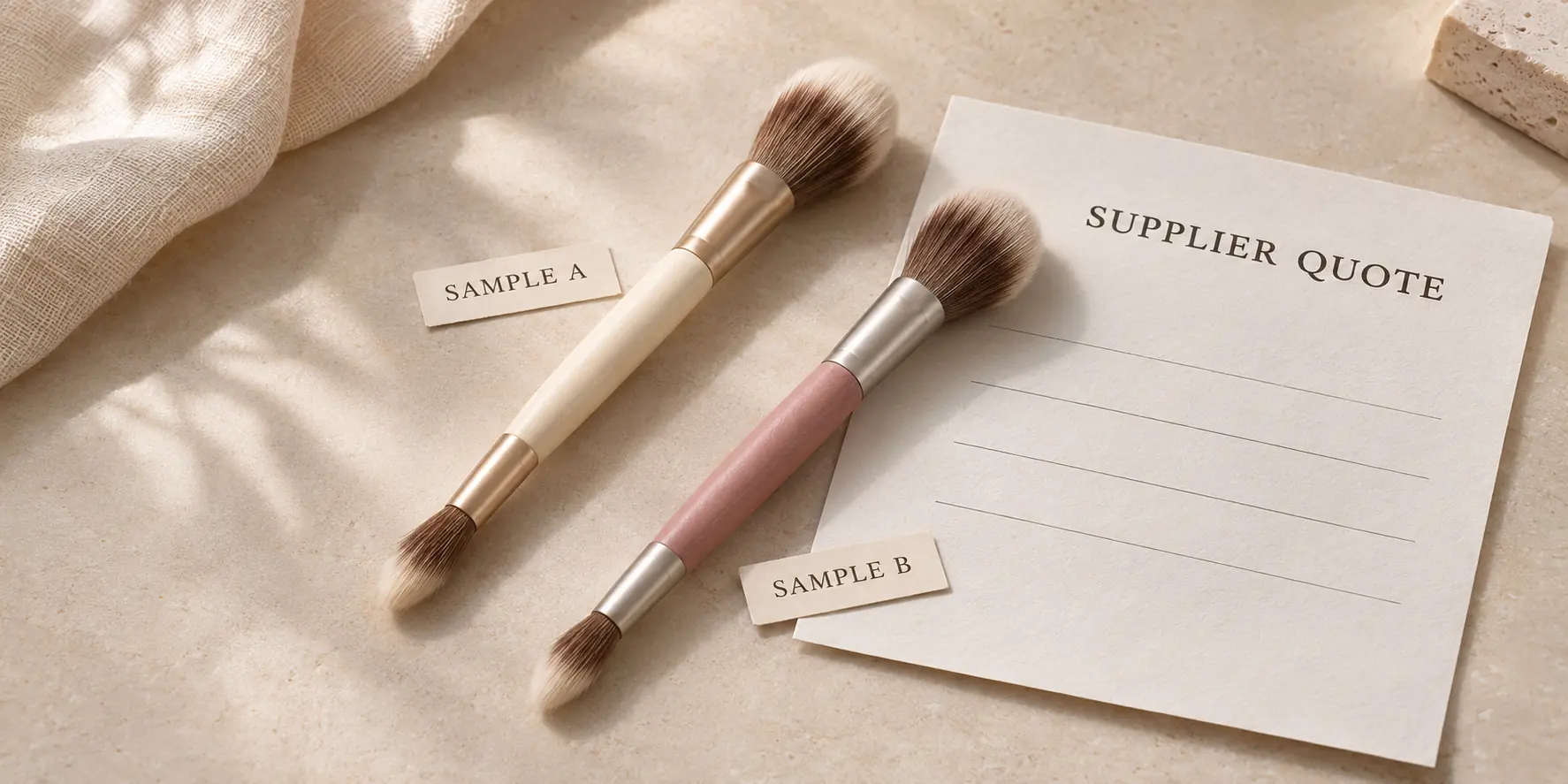
Choose a makeup brush supplier by checking whether the sample or model reference, the proposed specification and the written quote describe the same brushes. Send every candidate the same brief. Before paying for a sample, verify that the supplier can quote your quantity by color, identify who will handle the work and explain exactly what you will receive for the fee.
If two suppliers meet those requirements, start with the sample that will answer the question most likely to change your order. For a three-piece double-ended set, that may be how the foundation head performs with your formula, how a logo reads on the smallest handle or whether both ends of each brush clear the retail insert.
Makeup brush supplier evaluation checklist
Use five checks to decide who advances to a paid sample. Confirmed means you have evidence for the scope you are about to buy. Open means you are waiting for a specific answer or document. Blocked means the offer conflicts with a requirement your team has decided to keep.
| Check | Evidence to record | When to hold the decision |
|---|---|---|
| Product and quote match | A model code or annotated reference, the proposed specification revision and the quote line for that version. If a stock sample was supplied, record its code and any differences. | The supplier sent a similar brush and the differences from the quoted build remain unclear. |
| First order is feasible | The quantity in complete sets for each color or finish, the relevant minimums and a quote for the components, branding and retail pack included. | The quote gives an order total while the per-color split or a mandatory packaging component remains open. |
| Production responsibilities are clear | A written reply covering who manages assembly, decoration, packout, corrections and requests for your approval. | A key operation or the owner of a correction has yet to be identified. |
| Paid sample has a defined scope | A list of the physical items and digital proofs you are buying, the question each will answer and the features that will still be open. | The sample offer says “custom set” and leaves the finish, logo or insert scope unresolved. |
| Sample charges and timing are clear | Supplier and invoicing entity, fees and freight due now, any credit terms, the start event and expected dispatch timing. | A charge, timing commitment or invoicing relationship needs clarification. |
Ready for paid sample requires five confirmed checks and a reference for each piece of evidence. Use Hold for evidence while a material answer is open. Use Out of scope when there is a confirmed conflict with a firm requirement. The ready decision covers the sample round described in the offer. Record sample approval separately after you review what arrives.
Download the makeup brush supplier comparison worksheet (Excel)
Send the same first-order brief to every supplier
A request for “1,200 rose-pink brush sets” gives each supplier room to quote a different order. Issue a dated brief, mark which requirements are firm and ask every supplier to answer the original request first. Record any proposed alternative on a separate line.
| Give the supplier | Ask for in reply |
|---|---|
| One complete saleable set. The brush references or drawings, number of handles and number of working heads. | The code or an annotated photo for every brush and a list of what ships inside one retail unit. |
| The performance you need. Identify the product formula or application the key head will be used for. | The proposed head profile, bristle specification, handle and ferrule materials, plus any changes from the reference. |
| Quantity by finish. Give a quantity for each color or finish and identify any firm launch allocation. | The MOQ for your actual build, including separate minimums for finishes, decorated parts or packaging where they apply. |
| Branding and retail packing. Show the intended logo locations and say whether the unit needs an insert, label or printed carton. | What is included in the quoted unit, which items are priced separately and what proof is available in the first sample round. |
| Target date and delivery basis. Provide the destination, when you need the goods and the delivery basis to quote. | Separate sample preparation, sample transit and bulk production. If the quote uses Incoterms®, ask for the rule, named place or port and version. |
A concrete catalog reference is BlendCraft’s three-piece double-ended set. It identifies D112, D113 and D111 across three wooden handles and six synthetic-bristle heads. Using those codes, a buyer can ask for specific finishes, logo positions and a quotation for the exact set in the intended retail pack. BlendCraft three-piece double-ended makeup brush set
Match the sample, specification and quote
Ask the supplier to carry the same reference through three records. Save the model or sample code and a photo. Record the proposed construction or revision beside it. Ask for the quote line that covers that exact configuration. For a double-ended set, match both heads to each handle.
A related stock brush can help you evaluate a handle shape or an existing construction. Ask the supplier to name any differences in the proposed order and say which ones affect your decision. A different fiber or head profile can change how a brush applies your intended formula. A larger head can also change how the assembled set sits in its insert. Carry those differences into the paid sample brief.
A project can start with a drawing if the exact brush is being developed. Ask for a versioned drawing or annotated reference, a written list of differences and a quote for the work needed to make the first prototype. Record when the actual brush and its final specifications will be reviewed. Sample reviews can be scoped to different stages of a project, including prototype and pre-production. QIMA sample review stages · Makeup brush quality control checklist
Verify who will make, check and correct the order
Ask who sources or makes the critical components, who assembles the brushes and who handles the logo and retail pack. A supplier may work with several facilities. For any outsourced step that affects your brief, ask who checks the result, who owns the correction and who will send a proposed substitution to you for approval.
Make the follow-up specific. If a print partner handles the logo, ask the supplier where the print sample will be checked and who will arrange another proof if it misses the agreed position or finish. A job-specific marked-up proof, a responsibility confirmation in writing or a redacted record from a similar order gives you something to review with that person.
If your retailer or purchasing process calls for a manufacturing audit, check that its scope covers the planned site and relevant operations. A manufacturing audit can assess factory capability and quality systems. Use the project’s sample and specifications when you review the brush set itself. QIMA manufacturing audit scope
Check the color split and compare the same packed set
Calculate the MOQ for the actual allocation. Start with complete sets per finish, then check shared or separate minimums for the insert, carton, labels and decorated parts. Ask which minimums can be pooled across variants and which apply separately. When the supplier proposes a different allocation, ask for it as a second written option.
Compare quotes against one packout. If a quote lists an insert on a separate line, ask whether it is included in the unit price and whether there is a minimum purchase beyond your planned order. Identify what is included in one packed set, what will be charged once and what still needs a price. Reconcile different delivery terms by requesting a matched basis. The ICC recommends naming the place or port and version when using an Incoterms® rule. ICC guidance on naming the place or port · Makeup brush MOQ guide · Guide to comparing custom brush quotes
Decide what the sample fee will buy
Ask for a written list of what will arrive. Separate the physical brush, decorated components, packaging mock-up and digital artwork proof. For each item, say which finish, model or revision it represents and what it needs to show. Put items that remain open next to it. If the sample includes only one finish, identify the second finish as a later approval. If you need to determine which proof or physical item is worth requesting, choose the right type of sample for the decision at hand.
Record the amount due for this round and what would trigger an additional cost. Add the sample charge, sample freight and any setup fee due now. Record a proposed credit against the bulk order separately, including the condition for claiming it. Ask what event starts the sample schedule, when the package should be ready for dispatch and whether courier transit is included in the timing you have been given.
Check the supplier name on the quote against the entity issuing the sample invoice. If the names differ, ask who is billing for the sample and who will handle revisions. Confirm the relationship with the supplier contact you already verified and keep the reply with the offer.
Use the following order when two suppliers are ready for a paid sample.
- Evidence for the biggest open decision. If you are unsure whether the wordmark will fit on the smallest handle, prioritize the supplier who will produce that marked handle in the intended finish. A proof for a wider handle leaves that question open.
- Time to receive the relevant evidence. Compare when the exact item will be ready and when it should reach your team. Include any artwork or payment steps the supplier needs to start.
- Cash due for equivalent scope. Compare the fee and freight after you align the physical items and proofs. Use a potential sample credit separately when evaluating the later order.
Worked example with two supplier replies
Illustrative buyer scenario. A brand needs 1,200 complete sets of three double-ended makeup brushes, with 600 sets in each of two handle finishes. The retail unit needs a carton with a fitted insert and a wordmark on all three handles. The color allocation is firm. Both suppliers send attractive existing sets.
| What the buyer learns | Supplier A | Supplier B |
|---|---|---|
| Quote and make-up of the set | Quotes brushes in protective bags. The sample has similar brush shapes and the individual model references are still open. | Links the stock sample to the proposed brush references and quotes the carton and insert with the complete set. |
| 600 sets per finish | Clarifies that the minimum is 1,200 sets per finish. Two finishes would mean 2,400 sets, or 1,200 more than the launch plan. | Confirms 600 sets per finish and a shared insert design, subject to physical fit review. |
| Sample decision after the first reply | Out of scope for the current brief. A one-finish option can be quoted against a revised brief if the buyer is willing to change the launch. | Hold for evidence. The reply says “packed sample” without specifying whether the insert is physical or a drawing. |
| Written follow-up | The firm two-finish requirement still conflicts with the confirmed minimum. | Confirms marked brushes in the first finish, a physical insert for fit and a PDF carton proof. The project lead identifies who handles assembly, decoration, packout and corrections. The sample offer confirms the invoicing entity, start event and dispatch timing. |
| Next decision | Close the current comparison row and retain the reason. | Ready for paid sample for this round. File the revised sample offer and record the open approvals. |
Suppose B’s revised offer shows a $145 sample charge plus $38 courier freight, with no other charge due in that round. The cash payable now is $183. If $50 can be credited only after a qualifying bulk order, record the $50 as a potential future credit.
Test how the wordmark reads on the first handle finish and check clearance at both brush ends in the physical insert. Review the PDF for layout. Record the second handle finish and the appearance of the physical carton print as open. The buyer now knows what the first paid sample can help decide and what evidence still needs to arrive. Makeup brush logo printing guide · Makeup brush packaging options
Questions to ask before ordering a custom brush sample
Send the supplier the one unresolved issue most likely to change your decision. This message works when you still need the quote and the sample scope aligned.
Hi [Name], thanks for the sample and quote. Could you update the quote against brief [version]? Please match each brush in the set to its model or a labeled photo, confirm [sets by color or finish], and show what is included in one packed set. Please mark any change from the sample we reviewed.
Our first sample needs to answer [specific question]. Could you list the physical items and files we’ll receive, what will remain open, the sample and freight charges, and when the timing starts? Please also confirm who will handle corrections and which company will issue the sample invoice.
Bring your brief, candidate model references and quantity by finish when you are ready to discuss a sample with BlendCraft. Explore makeup brush models · OEM and private label project process
Continue reading
Related Guides
Custom Makeup Brush MOQ: Per Style, Color and Set Explained
Learn how to read makeup brush minimum order quantities, calculate style and color combinations, and compare product and packaging requirements before ordering.
Custom Makeup Brush Cost: How to Compare Supplier Quotes
Compare supplier quotes on the same specification, calculate first-order costs, and record packaging, setup fees and payment terms with an editable worksheet.
Makeup Brush Quality Control Checklist for Private Label Brands
A specification-led inspection guide for private label teams reviewing makeup brush samples, components, assembly, branding, packaging and shipment readiness.
How to Launch Your Private Label Makeup Brush Line
A practical guide to planning a private label makeup brush line, from assortment and specifications to samples, packaging, quality control and launch readiness.