What to Confirm Before Paying a Deposit for a Private Label Beauty Tools Order
Check your first beauty tools order against the approved sample, correct the pro forma invoice and agree what can start after the deposit.
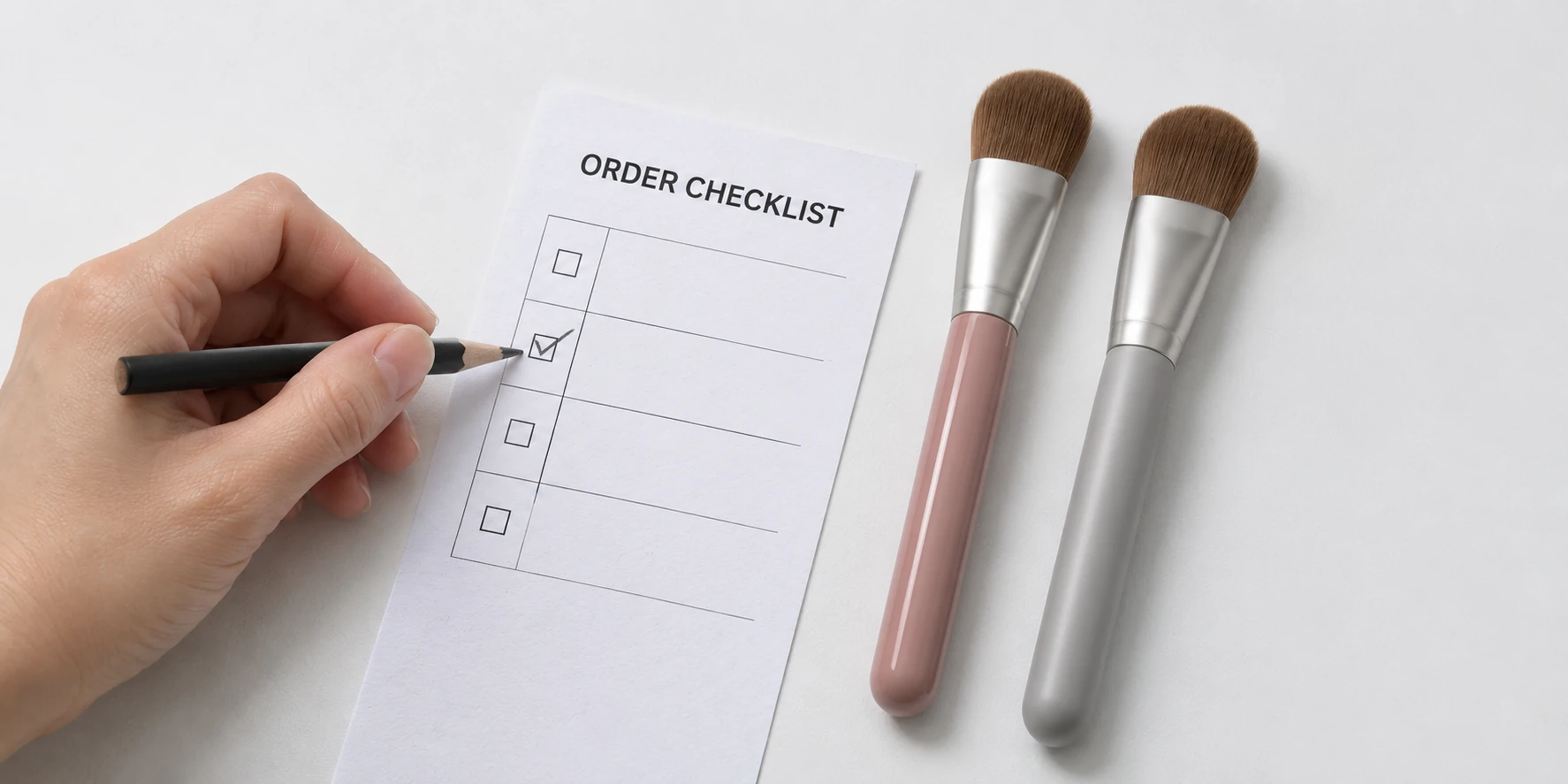
Before paying a supplier deposit on your first private label beauty tools order, compare the supplier’s pro forma invoice with your purchase order or written order confirmation and your sample approval records. Confirm the brush or tool revision, quantity by color, retail packaging, deposit calculation and the event that starts production. If an approval is still open, write down what the deposit authorizes and which steps need a separate go-ahead.
A pro forma invoice can show the right total and still describe the wrong order. For example, 500 rose brushes and 500 silver brushes add up to 1,000, just like 600 rose and 400 silver. If you planned a 600-unit launch in rose, the first split leaves that launch 100 units short even though the invoice total matches.
First-order deposit checklist at a glance
Gather the latest PI, your purchase order or written order confirmation, the sample approval record, and the current product and packaging specifications. Open the files side by side and use one row below for each decision. If you are still deciding who should make the order, start with the makeup brush supplier checklist.
| Check | What should match | What to ask for if it is unclear |
|---|---|---|
| Product and approved sample | Each order line identifies the product, ordering unit and the current specification revision. The approval record identifies the physical sample and what it represents. | A corrected order line or a referenced attachment that identifies the accepted sample and revision. |
| Quantity by model and color | Pieces or complete sets, the quantities for each model and finish, and the total. | Separate lines for each variant and any agreed allowance for over- or under-delivery. |
| Retail pack and artwork | What one sellable unit includes, which insert and carton versions apply, and the status of artwork and physical proofs. | An itemized pack description, with included and separate charges and the outstanding approval named. |
| Deposit and balance | Currency, amount the deposit percentage applies to, charges due now, the remaining balance, and when each payment is due. | A written breakdown and a revised PI if the amounts or terms differ. Independently verify unexpected changes to payment instructions. |
| Start date and milestones | The events that start each stage, whether the days are calendar or working days, and which date means completion, inspection or shipment. | Written start conditions and separate estimated dates. |
| Authority to proceed and to change the order | Who can approve a change, which steps may start after the deposit, which wait for approval, and how the agreed inspection findings will be reviewed. | A record of the revised version, affected approvals, cost and schedule changes, and the work that remains on hold. |
For each open row, record the supplier’s reply, the person responsible and what would close the item. A wrong quantity requires a correction. An unfinished print proof can remain pending if both teams agree which work must wait for it.
Match the pro forma invoice to the purchase order and approved sample
The supplier’s pro forma invoice (PI), also written proforma invoice, presents the offer in invoice form. The buyer’s purchase order (PO) states what the buyer is ordering. Some teams use a written order confirmation in place of a formal PO. In either case, reconcile the current documents and ask both sides to acknowledge the same revisions. The U.S. International Trade Administration lists item descriptions, prices and payment terms among the information a pro forma invoice can carry. U.S. trade guidance on the pro forma invoice
For each order line, record the item or SKU, specification revision, sample ID and approved features. “As per sample” leaves room for confusion if the team reviewed two brush versions or if the brush and packaging were approved in different rounds. For a product with a separate artwork file, include its version too. Keep the referenced attachments and approval messages with the order.
If the approved brush has a wider ferrule and the PI still cites the earlier version, ask the supplier to correct the reference and confirm which version the production team will use. If the supplier proposes a material, finish or dimension change, ask which approvals it affects. A new brush dimension may reopen insert fit even if the logo on an unchanged handle is already approved. How to choose a stock or custom sample
Confirm quantities by color and the exact retail pack
Read each quantity with its ordering unit. “1,000 sets” can mean 1,000 retail units of several tools. If your order combines single brushes and complete sets, use the unit on each line and check that the carton counts use the same basis. List quantities by model and color even when several variants share a price. Record any quantity tolerance explicitly if your commercial team agrees to one. How makeup brush minimums work by style, color and set
Define one sellable unit in writing. For example, the unit price could include one brush, the fitted insert and the printed retail carton. Ask the supplier to identify any separate setup, tooling or extra packaging charge and what it covers. If the carton layout has been reviewed on a PDF and the physical print is still pending, record both statuses. These address different decisions, even if they carry the same artwork revision. Makeup brush packaging options
Check the deposit amount and the production start date
A deposit percentage needs a base. Ask whether it applies to goods alone or to the total that includes agreed extras. Record any charge payable in full now, the exact first payment, the remaining balance and the trigger for paying it. If the order uses an Incoterms® rule, record the chosen rule, named place or port, and version. State the payment terms separately. ICC guidance on writing the named place and version · ICC introduction to Incoterms® rules
If payment instructions change, pause and have your payment team check them through a previously verified supplier contact channel. If the invoice issuer and beneficiary differ, ask the supplier to explain the relationship in writing and verify the authorization before any transfer. An email thread containing the change is insufficient by itself. FBI guidance on verifying payment changes
“35 days” becomes useful when you know what starts the clock and what ends it. Ask whether it starts when funds clear, when artwork or the production reference is approved, or once both events have occurred. Then distinguish the date the goods are expected to be ready for inspection, the target shipment date, and the projected arrival date if relevant. Put the calendar basis and expected dates in the same written record.
Record what can start while an approval is open
Agree what the deposit authorizes. In one order, the supplier might wait for every approval before starting work. In another, the parties might authorize purchasing specified materials after funds clear and hold carton printing and bulk production until the physical proof is approved. Write down the scope that can start, the work on hold, the approval needed and the person who will release it.
Apply the same rule to changes. When a revision arrives, record the new file or sample ID, which approvals reopen, any price or delivery effect, and who must acknowledge it. Ask the supplier to confirm which documents supersede the earlier versions. Keep that record with the order so the production and inspection teams can work from the same reference.
Agree the inspection scope, criteria and report reviewer for the order. A pre-shipment inspection can check finished goods against specifications, including quantity, workmanship, labeling and packaging. If you want an accepted inspection report to be the trigger for paying the balance, put that trigger and the process for handling a failed inspection in writing. QIMA on pre-shipment inspection · Makeup brush quality control checklist
Worked example: the total is right but the PI needs revision
Illustrative case. The buyer has approved the B2 foundation brush for construction and checked fit with the I2 paperboard insert. The first order uses that construction in two handle colors. The buyer has also approved the layout of the C3 retail carton. The physical print proof is still pending. The first PI has the agreed order total of USD 1,840.
| Field | First PI and attachments | What the buyer asks to see in the revision |
|---|---|---|
| Brush and insert | “1,000 brushes with custom packaging” | B2 brush construction, the current brush specification and an I2 insert in each retail unit. |
| Color split | 500 rose and 500 silver | 600 rose and 400 silver, at 1,000 pieces in total. |
| Retail carton | “Custom packaging included” | C3 printed retail carton included. Layout approved. Physical print proof pending. Hold carton printing until written proof approval. |
| Amount due | “30% deposit” and a separate USD 40 setup fee | USD 580 due now and USD 1,260 remaining under the terms agreed in this example. |
| Lead time | “35 days after deposit” | 35 calendar days to estimated bulk completion after both funds clear and the physical print proof is approved. Set inspection and shipment milestones separately. |
Reconcile the payment. At USD 1.80 per brush, 1,000 pieces cost USD 1,800. The USD 40 setup fee brings the order total to USD 1,840. In this example, the buyer and supplier agree on 30% of the goods value plus all of the setup fee upfront. The first payment is USD 580, made up of USD 540 in deposit and USD 40 in setup. The balance is USD 1,260. If the agreement instead applied 30% to the full USD 1,840, with no extra amount due that day, the first payment would be USD 552 and the balance USD 1,288. The revised PI should show the agreed calculation. How to compare custom makeup brush quotes
Reconcile the schedule. Funds clear on day 0 and the print proof is approved four days later. Under the example terms, the production clock starts on day 4. Counting 35 elapsed calendar days gives an estimated completion on day 39 after funds cleared. That is the completion milestone. The inspection and shipment dates still need their own entries in the schedule.
The buyer requests the revised PI and the written list of outstanding approvals together. For this example, agreed material purchasing can start after payment. Printing the carton and starting the full production run wait for written proof approval.
Copy this email to request a corrected PI
Subject — Revised PI and production start for [order reference]
Hi [Name],
Could you update the PI to show 600 rose brushes and 400 silver brushes, with the approved B2 brush, I2 insert and C3 retail carton referenced? We’ve approved the C3 layout and still need to review the physical print proof.
Please confirm the deposit calculation, setup fee due now and remaining balance. Could you also confirm what can start once payment clears, what needs our written approval, and when the 35 calendar days start?
Thanks,
[Name]
For another order, replace the quantities and version IDs with yours, and name the one milestone that is still unclear.
FAQs about a first production deposit
What if my supplier uses an order confirmation instead of a PO?
Check the written order confirmation against the PI, current specifications and sample approval record. Ask both sides to acknowledge the same version and its attachments. If a line or an attachment changes, use the corrected record for the next approval.
Can I pay the deposit before the packaging sample is approved?
It depends on the order agreement and your approval process. If you agree to pay before the physical packaging proof is ready, identify what the payment covers, which steps can start and which require written approval. State what happens to the schedule if the proof needs another round.
Is “35 days after deposit” enough to plan a launch?
Ask which event starts the 35 days, whether they are working or calendar days, and whether the number ends at production completion, inspection readiness or shipment. Use a separate arrival estimate for launch planning.
If you’d like BlendCraft to review a first order, share the model, quantities by color, current sample and packaging versions, and any approvals still open. Discuss your private label beauty tools order
Continue reading
Related Guides
Stock vs. Custom Samples for Private Label Beauty Tools
Choose the sample, proof or mock-up that answers your next private label sourcing decision.
How to Choose a Makeup Brush Supplier for Your First Private Label Order
Compare suppliers on the same first-order brief and decide which paid sample will answer your most important question.
Manicure Set Packaging Guide for Retail Buyers
Choose packaging for a manicure kit, then use the loaded-sample checklist to approve how it displays, holds tools and scans at checkout.
Eyelash Curler Packaging: How to Choose and Approve a Retail Pack
Choose a retail pack for a mechanical eyelash curler, verify the fit and spare-pad position, and record which sample you approved.